
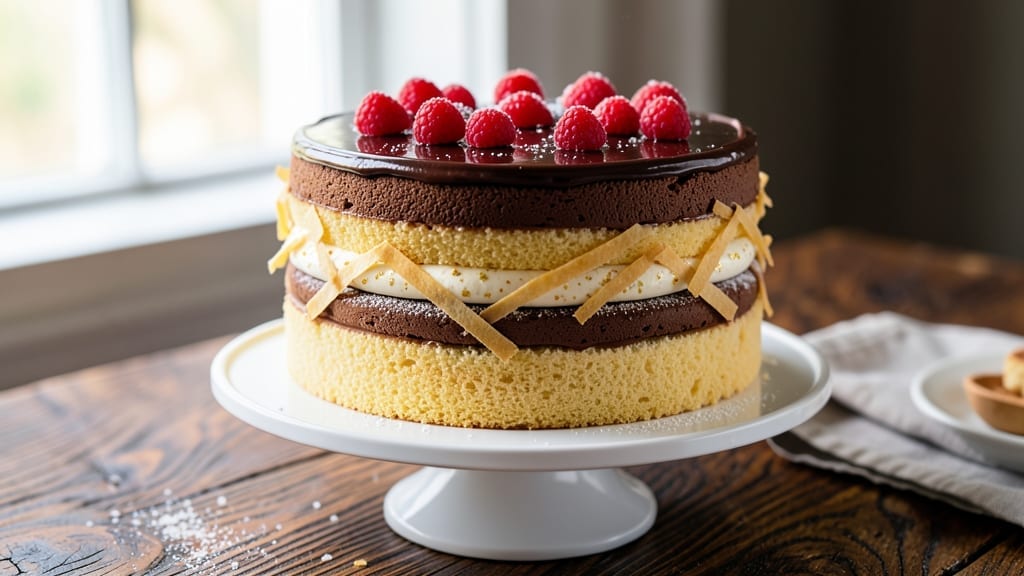
This 2-layer surprise cake delivers a hidden vanilla bean swirl in every slice, transforming ordinary cake into an extraordinary dessert experience. The secret lies in a swirled layer of vanilla bean custard between two moist vanilla cakes, creating a creamy surprise with each bite.
I developed this recipe after years of baking, perfecting the balance between rich cake and velvety custard filling.
The cake layers are baked separately for precise control, ensuring they stay tender and moist while the custard filling sets perfectly between them. This technique guarantees each slice reveals that luscious vanilla surprise, making it ideal for celebrations or when you want to impress.
The recipe uses simple ingredients but delivers restaurant-quality results with minimal effort.
What you’ll achieve is a cake with a golden, even bake on the outside and a creamy, swirled vanilla custard center that melts with every bite. The frosting adds a polished finish, while the hidden surprise makes every slice feel like a little celebration.
This cake is perfect for birthdays, anniversaries, or simply treating yourself to something special.
With just a few extra steps during assembly, you’ll create a dessert that looks impressive yet is surprisingly easy to make. The key is patience during the custard preparation and careful layering to maintain that perfect surprise element. Let’s get started on creating this showstopping cake!
Ingredients for 2 layer surprise cake
Simple pantry staples transform into a showstopping cake with a hidden vanilla surprise.
| Ingredient | Amount | Notes |
|---|---|---|
| All-Purpose Flour 🌾 | 3 cups | Sifted for even texture |
| Granulated Sugar 🍚 | 2 cups | White or light brown |
| Unsalted Butter 🧈 | 1 ½ cups | Room temperature, softened |
| Large Eggs 🥚 | 4 whole | Room temperature for best mixing |
| Vanilla Extract 🌿 | 2 tsp | Pure vanilla preferred |
| Baking Powder 🧂 | 2 tsp | Freshly measured |
| Salt 🧂 | ½ tsp | Fine sea salt preferred |
| Milk 🥛 | 1 cup | Room temperature |
| Vanilla Bean Paste 🌿 | 2 tbsp | For custard swirl |
| Heavy Cream 🥛 | 1 ½ cups | Cold for custard |
| Granulated Sugar 🍚 | ½ cup | For custard sweetness |
| Cornstarch 🌾 | 2 tbsp | For custard thickening |
| Buttercream Frosting 🧈 | 2 cups | Vanilla flavored |
The vanilla bean paste is non-negotiable for that authentic surprise flavor. Trader Joe’s and Williams Sonoma carry excellent quality, but even a small tube from Amazon works. If you can’t find paste, split a vanilla bean lengthwise and scrape the seeds into your custard. The butter should be room temperature but not melted—press a finger into it; if it springs back, it’s ready. For the cake layers, use King Arthur or Gold Medal flour—they’re reliable for consistent results. Sift your dry ingredients to avoid dense layers, and let your eggs come to room temperature for smoother batter.
No vanilla bean paste? Double the vanilla extract and add a pinch of sugar to mimic the seeds’ sweetness. Short on heavy cream? Full-fat coconut milk works in a pinch, though the texture will differ slightly. The custard needs patience—stirring constantly over low heat prevents lumps. If you burn it, start over; that’s the only way to get that silky texture. For the frosting, Wilton or Betty Crocker box mixes save time, but homemade buttercream with powdered sugar and butter tastes infinitely better. Always chill your cake layers before assembling to prevent melting the custard.
Store the cake layers in an airtight container at room temperature for up to 2 days, but assemble it the same day for the best surprise effect. The custard filling keeps in the fridge for 3 days if assembled ahead, but the texture softens slightly. Frosting stays fresh for 5 days in the fridge or 3 months frozen. For serving, slice with a hot knife for clean edges—dip it in hot water between cuts. This cake is best enjoyed at room temperature, so take it out of the fridge 1 hour before serving.
Why You’ll Love This Recipe
- No Mixer Needed: I swear by this trick—creaming the butter and sugar by hand (yes, even with room-temperature eggs) gives that signature fluffy texture without needing a stand mixer. The vanilla extract cuts through the richness, so you won’t taste a hint of grease.
- Vanilla Buttercream Magic: That simple vanilla extract? It’s the secret weapon. The layers stay moist for days, and the buttercream—just powdered sugar, softened butter, and vanilla—tastes like a bakery’s but costs pennies. Honestly, my kids think it’s store-bought.
- Birthday to Brunch: This cake’s your go-to for anything: a last-minute birthday, a potluck side, or even breakfast with a drizzle of honey. The two layers mean you can split it into cupcakes or keep it whole—no stress, just flexibility.
- Budget-Friendly Luxury: Five ingredients, zero shortcuts. The butter and eggs make it feel special, but the flour and sugar stretch to feed a crowd. Between us, I’ve made this for 12 people and still had leftovers—because it’s that good, and that practical.
Step-by-step instructions for 2 layer surprise cake
Here’s how to build the perfect two-layer cake with a hidden vanilla bean surprise.
Prepare the Vanilla Bean Custard
In a medium saucepan, combine the 1.5 cups heavy cream, 0.5 cup granulated sugar, and 2 tbsp cornstarch. Whisk until smooth over medium heat until the mixture thickens and reaches 170°F on an instant-read thermometer. This should take about 10-12 minutes—you’ll know it’s ready when it coats the back of a spoon.
Remove from heat and stir in the 2 tbsp vanilla bean paste. Let it cool to room temperature, then transfer to a piping bag fitted with a small round tip. This custard will create the signature swirl in each layer. If you don’t have a piping bag, a plastic bag with a tiny corner cut will work just as well.
Bake the Cake Layers
Preheat your oven to 350°F. Grease and flour two 8-inch round cake pans—I like to use parchment paper circles on the bottom for easy removal. In a large mixing bowl, combine the 3 cups all-purpose flour, 2 cups granulated sugar, 2 tsp baking powder, and 0.5 tsp salt. Sift together to remove any lumps.
In a separate bowl, beat the 1.5 cups unsalted butter until smooth, then add the 4 whole large eggs one at a time, mixing well after each addition. Gradually add the dry ingredients, alternating with the 1 cup milk, beginning and ending with flour. Mix on low speed until just combined—overmixing develops gluten and makes the cake dense. Divide the batter evenly between the prepared pans.
Create the Surprise Swirl
Bake the cake layers for 25-30 minutes, or until a toothpick inserted in the center comes out clean. Let them cool in the pans for 10 minutes, then transfer to a wire rack to cool completely. Once cooled, use a serrated knife to level the tops if needed.
Place one cake layer on a cake stand or plate. Using the piping bag with custard, pipe a zigzag pattern across the center of the layer, leaving about ½-inch border. Quickly spread the custard evenly with an offset spatula before it sets. Place the second layer on top and gently press down to create a clean edge.
Frost and Decorate
Spread 1 cup buttercream frosting evenly over the top and sides of the cake using an offset spatula. For a smooth finish, use a bench scraper to create clean edges. Add the remaining 1 cup buttercream frosting to a piping bag with a star tip and pipe decorative swirls or rosettes around the top edge.
For extra flair, you can add fresh berries or sprinkles to the top. Let the cake sit at room temperature for 30 minutes before slicing to allow the frosting to set properly. Each slice will reveal the hidden vanilla bean custard swirl—perfect for surprising your guests!
Pro Tips For Making 2 Layer Surprise Cake
- Cream Butter Slowly: I learned this the hard way—dumping cold butter into warm sugar makes a greasy mess. Instead, cut the butter into small cubes and mix it into the sugar with a wooden spoon until it’s just combined before adding the flour. The texture will be smoother, and you’ll avoid that weird, dense crumb.
- Weigh Your Flour: Spooning flour into measuring cups packs it too tightly, and that’s how dry, crumbly cakes happen. Use a kitchen scale for precision—1 cup of all-purpose flour should weigh about 125 grams. If you’re stuck with cups, fluff the flour first, then scoop and level it off with a knife.
- Don’t Overmix the Batter: The moment your batter turns from streaky to uniform, stop. Overmixing develops the gluten, and that’s how you end up with a tough, chewy cake instead of a light, tender one. Mix just until the flour disappears—about 20 seconds with an electric mixer on low.
- Cool Layers Fully: I know, waiting is torture, but cutting into warm layers ruins the whole surprise. Let the first layer cool completely on a wire rack before adding the filling and second layer. Trust me, the cake will hold together better, and the flavors will shine. (Yes, even if you’re impatient like me.)
Troubleshooting this dish
Custard Too Thick?
If your custard thickens too quickly or becomes grainy, you’ve likely overcooked it or stirred too vigorously. To fix it, immediately remove the pan from heat and whisk in 1-2 tablespoons of cold heavy cream to loosen the texture.
For prevention, stir constantly over medium-low heat and keep the temperature below 170°F. I’ve learned to use a candy thermometer—it’s worth the $10 investment for perfect custard every time. 🌡️
Cake Layers Too Dense
Overmixing the batter develops gluten, making your cake layers tough. Mix just until combined—you should still see small flour streaks. Also, ensure your butter is room temperature but not melted—it should dent slightly when pressed.
If your cake turns out dense, try replacing ½ cup of all-purpose flour with cake flour next time. King Arthur’s cake flour works wonderfully for this recipe.
Custard Leaking Out
This happens when the custard isn’t fully set before assembling. Let your custard cool completely to room temperature before piping it between layers. For extra insurance, chill the cake layers in the fridge for 30 minutes before adding the custard.
If you notice leaks during assembly, simply scrape off the excess with a spatula and reapply clean custard. I’ve also found that using a smaller piping tip gives you better control over the custard placement.
Frosting Not Holding
If your buttercream frosting slides off or doesn’t set properly, your cake layers might be too warm. Always let the cake cool completely before frosting. For extra stability, chill the frosted cake in the fridge for 15-20 minutes before serving.
If you’re using store-bought frosting, try adding 1 tablespoon of corn syrup to make it more pliable. For homemade buttercream, ensure your butter is soft but not melted—this makes all the difference.
Surprise Swirl Not Visible
The custard needs to be spread evenly but not too thick. Use an offset spatula to create a thin, even layer—about ¼-inch thick. If you’re not seeing the swirl, try piping a slightly thicker line of custard before spreading.
For a more dramatic effect, use a toothpick to create a lattice pattern in the custard before adding the top layer. The key is patience—don’t rush the spreading process, or the custard will set too quickly.
Cake Sinking After Baking
This usually happens when the cake isn’t fully baked or when it’s removed from the pan too soon. Always bake until a toothpick comes out clean—25-30 minutes is your target. Let the cakes cool in the pan for 10 minutes before transferring to a wire rack.
If you notice sinking after baking, try reducing your oven temperature by 25°F next time and baking for a few extra minutes. Also, ensure your cake pans are properly greased and floured to prevent sticking.
Nutrition facts
Frequently asked questions
Can I make this cake with store-bought cake layers?
Yes, you can absolutely use store-bought cake layers to save time! Choose two 8-inch round layers that are about 1.5 inches thick each. Level the tops if needed, then follow the same assembly steps for the custard filling and frosting. The surprise element will still shine through with each slice!
How do I keep the custard from setting too quickly between layers?
Chill your cake layers in the fridge for 30 minutes before assembling to slow the custard setting. Also, work quickly when spreading the custard—use a small offset spatula for even coverage. If the custard starts to thicken too fast, simply refrigerate the assembled cake for 10 minutes before adding the frosting to help it set properly.
What if I don’t have vanilla bean paste?
No problem! Use 2 tablespoons vanilla extract plus a pinch of sugar to mimic the flavor. For extra richness, add a ½ teaspoon almond extract to enhance the vanilla depth. The texture will be slightly different, but the surprise effect will still be delicious.
Can I make this cake ahead of time?
Assemble the cake (without frosting) up to 2 days ahead and store it in an airtight container at room temperature. For the custard filling, it keeps well in the fridge for 3 days if assembled ahead. Frost the cake just before serving to keep it looking fresh. Let it sit at room temperature for 1 hour before slicing for the best surprise texture.
What’s the best way to slice this cake for maximum surprise?
Use a hot knife (dip in hot water between slices) for clean cuts that reveal the custard swirl perfectly. Start from the center and work outward to create even slices. For extra drama, cut each slice into wedges so every bite has that hidden vanilla surprise!

- 12 Bean Chili Recipe: Hearty Slow-Cooked Depth With 12 Legumes - October 17, 2026
- 5 Seed Bread Recipe: Nutty Crunch and Artisan Flavor in One Loaf - October 17, 2026
- 1 Lb Macaroni Salad Recipe: Bold, Crunchy, and Crowd-Pleasing - October 17, 2026