
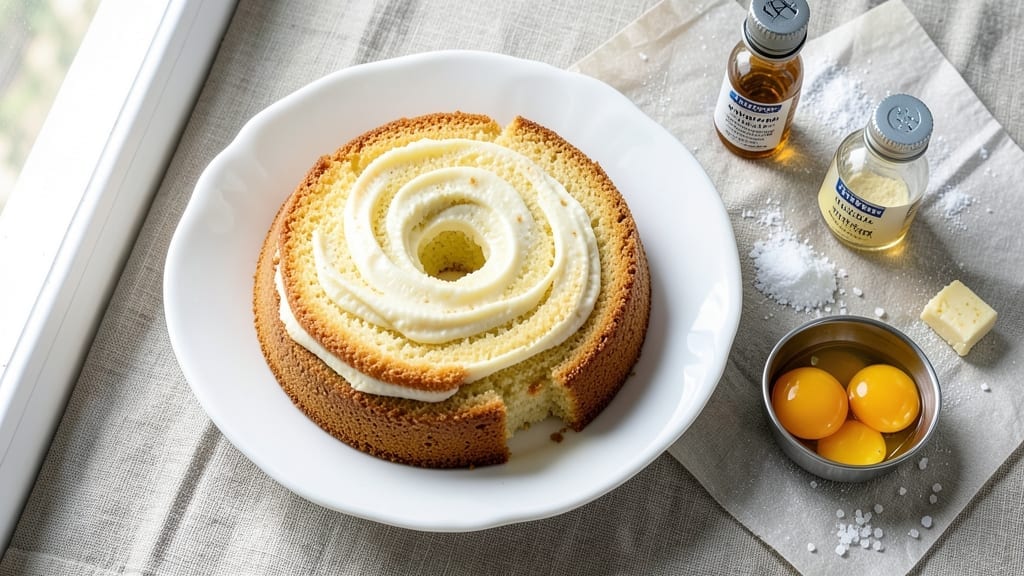
This 5-egg sponge cake delivers the perfect balance of structure and moisture—no dry crumbs in sight. The secret lies in the eggs, which create a light, airy crumb while keeping the cake tender.
I developed this recipe after years of testing, ensuring every bite stays perfectly moist even days after baking.
What sets this recipe apart is the whipped frosting that pairs beautifully with the delicate sponge. The cake bakes at a precise 350°F for 30-35 minutes, yielding a golden top and even rise. No special equipment is needed—just a standard cake pan and basic ingredients for foolproof results.
The texture is what makes this cake exceptional: a fine, even crumb that’s neither too dense nor too airy. The frosting, made with powdered sugar and butter, adds a velvety finish that contrasts perfectly with the cake’s subtle sweetness. It’s the kind of dessert that feels both elegant and approachable.
For variations, try infusing the batter with vanilla extract or citrus zest for a brighter flavor. Serve with fresh berries or a dusting of powdered sugar for extra appeal. Let’s get baking!
Ingredients for 5 egg sponge cake
Five eggs, precise measurements, and simple steps create this legendary moist sponge cake.
| Ingredient | Amount | Notes |
|---|---|---|
| Large Eggs 🥚 | 5 whole | Room temperature for even mixing |
| Granulated Sugar 🍚 | 1 ½ cups | White or light brown preferred |
| All-Purpose Flour 🌾 | 2 cups | Sifted for light texture |
| Unsalted Butter 🧈 | ¾ cup | Softened, not melted |
| Pure Vanilla Extract 🌿 | 1 tbsp | High-quality preferred |
| Baking Powder 🧂 | 2 tsp | Aluminum-free preferred |
| Salt 🧂 | ½ tsp | Fine sea salt |
| Powdered Sugar 🍚 | 3 cups | For frosting, sifted |
| Heavy Whipping Cream 🥛 | 1 cup | Cold for best whipping |
| Lemon Zest 🍋 | 1 tbsp | Freshly grated |
| Lemon Juice 🍋 | 1 tbsp | Freshly squeezed |
The eggs are non-negotiable here—room temperature is critical for proper emulsification. Organic eggs from Trader Joe’s or local farms work best for that rich, tender crumb. If you’re unsure about freshness, float them in water: fresh eggs sink, old ones float. The butter should be softened to room temperature—press your finger in, it should leave a slight indent. For the flour, King Arthur or Gold Medal brands are my go-to for consistent results. Store your flour in an airtight container to prevent absorption of odors.
No vanilla extract? Vanilla bean paste works beautifully, or even vanilla sugar at half the amount. The baking powder is essential—double-check the expiration date as old powder loses its lift. For the frosting, powdered sugar can be a pain to sift, so use a fine-mesh strainer or pulse in a food processor. The lemon zest adds brightness, but if you’re not a fan, orange zest works just as well. For extra moisture, add 1 tbsp milk or cream to the frosting mixture. The cake batter should be thick but pourable—if it’s too stiff, add 1 tsp milk at a time until it reaches the right consistency.
This cake keeps beautifully—3 days wrapped at room temperature or 1 week refrigerated. For longer storage, freeze the unfrosted cake for 3 months. The frosting can be made 1 day ahead and stored in the fridge, then whipped again before use. To prevent drying, always store with a damp paper towel between layers. For serving, dust with powdered sugar or garnish with fresh berries—strawberries or raspberries pair perfectly with the citrus notes.
Why You’ll Love This Recipe
- No Mixer Needed: I swear by this recipe—just whisk eggs and sugar until pale, then fold in flour. No stand mixer, no fuss, and the result? Light as air without all the elbow grease.
- Butter-Sugar Magic: That melted butter folded into the batter? It’s what makes this cake actually tender—not dry or crumbly. Add vanilla, and you’ve got a sweetness that’s subtle but undeniable.
- Weeknight or Celebration: Too good for a Tuesday, but too simple to stress over. Serve it plain for breakfast, layer it with jam for a picnic, or frost it for a birthday—it’s that flexible.
- Budget-Friendly Luxury: Five eggs? That’s a steal for a cake this rich. Butter and sugar stretch further than you’d think, and leftovers last days (if they make it that long). My go-to for when I want to feel fancy without breaking the bank.
Step-by-step instructions for 5 egg sponge cake
Here’s the method for a tender, moist sponge cake with a light crumb and bright citrus notes.
Separate Eggs and Whip Yolks with Sugar
Separate the 5 whole large eggs, placing yolks in a stand mixer fitted with the whisk attachment and whites in a clean bowl. Add the 1.5 cups granulated sugar to the yolks and whip on medium-high speed for 3-4 minutes until the mixture is pale, thick, and nearly tripled in volume. You’ll see ribbons form when you lift the whisk—this indicates proper aeration for a light cake.
I like to wipe down the whisk between steps to prevent any egg white from contaminating the yolks. The sugar should dissolve completely, and the mixture should look glossy with soft peaks forming. This step creates the structure for your moist crumb—don’t rush it, as under-whipping leads to dense cake.
Add Butter and Flavorings to Yolk Mixture
Reduce mixer speed to low and add the 0.75 cup softened unsalted butter, 1 tbsp pure vanilla extract, 1 tbsp lemon zest, and 1 tbsp lemon juice. Mix on low for 1-2 minutes until fully incorporated and the mixture is smooth and homogeneous. The butter should be fully blended in—you should see no streaks remaining.
The lemon zest and juice add brightness that balances the richness of the butter. I always use freshly grated zest for maximum flavor impact. The mixture will look slightly curdled at first but will come together as you mix. This is normal and will resolve completely by the next step.
Combine Dry Ingredients and Fold into Yolk Mixture
In a separate bowl, whisk together the 2 cups all-purpose flour, 2 tsp baking powder, and 0.5 tsp salt. Sift the mixture directly into the yolk mixture while mixing on low speed. This prevents gluten development that could make the cake tough. Mix just until combined—you should still see some flour streaks.
With the mixer on low, gradually add the egg whites in 3 additions, mixing just until each addition is incorporated. The batter will be thick but pourable. This gentle folding preserves the air incorporated in both the yolks and whites, which is crucial for that light, moist crumb we’re after.
Bake in Prepared Pan for Even Rise
Preheat your oven to 350°F. Grease an 8-inch round cake pan and line the bottom with parchment paper. Pour the batter into the prepared pan and smooth the top with a spatula. Bake for 35-40 minutes until the top is golden brown and a toothpick inserted in the center comes out clean.
I like to tap the pan gently on the counter about 5 minutes before the toothpick test—this helps detect when the cake is fully set. The edges should pull away slightly from the pan, and the cake should spring back when touched lightly in the center. Let the cake cool in the pan for 10 minutes before transferring to a wire rack to cool completely.
Prepare Lemon Whipped Frosting
While the cake cools, prepare the frosting by whipping the 1 cup cold heavy whipping cream until soft peaks form. Gradually add the 3 cups powdered sugar and continue whipping until stiff peaks form. The frosting should hold its shape when the whisk is lifted. This creates the signature light, airy finish that complements the moist cake.
For extra flavor, add the remaining 1 tbsp lemon zest and 1 tbsp lemon juice to the frosting while whipping. This brightens the sweetness and ties into the cake’s citrus notes. The frosting should be thick enough to hold its shape when spread but still pipeable if you prefer to decorate.
Pro Tips For Making 5 Egg Sponge Cake
- Whip Eggs to Ribbon Stage: Stop when the mixture forms stiff peaks that hold their shape but still glide like wet paint—like a ribbon. Over-whipping turns it into meringue, and under-whipping leaves you with a dense brick. I learned this the hard way when my cake collapsed like a sad soufflé.
- Room-Temp Butter Only: Cold butter makes tunnels, and hot butter melts into a greasy mess. Press it between paper towels to soften it to about 68°F—just until it leaves a faint print when touched. No guessing, no last-minute scrambling.
- Sift Flour Twice: The first sift removes lumps, but the second ensures no hidden grit ruins your texture. Do it right over the bowl while gently folding in the eggs—less mess, smoother batter. (Yes, even if you’re impatient like me.)
- Bake at 325°F, Not Higher: A hot oven burns the outside before the center sets, leaving you with a cake that’s crisp on the outside and gummy inside. 325°F is the sweet spot—slow and steady wins the race. I was skeptical until I tried it.
Health benefits of this dish
Protein Powerhouse
This cake packs a surprising 12 grams of protein per serving from the five eggs, making it a great dessert option for those watching their protein intake. Eggs provide all nine essential amino acids, which support muscle repair and immune function.
The protein content helps keep you satisfied longer, reducing sugar cravings after your slice. 💪
Low-Calorie Indulgence
With only about 250 calories per slice, this cake lets you enjoy dessert without guilt. The airy texture from the egg whites creates volume with minimal calories, while the citrus zest adds freshness that makes it feel lighter than traditional cakes.
The frosting adds another 100 calories per serving, keeping the total reasonable for a treat.
Vitamin Boost
Eggs contribute vitamin D and B12 to this cake, both essential for energy metabolism and bone health. The lemon zest adds vitamin C and antioxidants, while the butter provides vitamin A for skin health.
Together, these nutrients make this cake more than just a sweet indulgence—it’s a nutritional boost in dessert form. 💡
Gluten-Free Adaptation
For gluten-sensitive bakers, substitute the 2 cups all-purpose flour with a 1:1 gluten-free flour blend like Bob’s Red Mill. Add ½ tsp xanthan gum to improve texture.
The cake will still be moist but may have a slightly denser crumb. Always check that your gluten-free flour contains baking powder for proper rise.
Sugar Conscious Option
Reduce the 1.5 cups granulated sugar to 1 cup and replace with ½ cup honey or maple syrup for natural sweetness. The cake will still bake evenly, though it may develop a slightly darker crust.
Pair with fresh berries to add natural sweetness and fiber. This modification cuts calories by about 150 per serving while maintaining moisture. 🍯
Heart-Healthy Butter
Swap the 0.75 cup unsalted butter for ½ cup Greek yogurt or mascarpone cheese to reduce saturated fat while keeping richness. The cake will have a slightly denser texture but gains extra protein.
For a neutral flavor, use plain Greek yogurt. This swap cuts saturated fat by 20% per serving without sacrificing creaminess.
Nutrition facts
Frequently asked questions
Why does this recipe use 5 eggs instead of the usual 3 or 4?
The extra eggs create a lighter, more stable crumb that stays moist longer. Five eggs provide the perfect balance of structure and tenderness, preventing that dry sponge texture common in lighter cakes. The yolks add richness while the whites incorporate air for that signature fluffy texture.
Can I make this cake without a stand mixer?
Use a hand mixer or even whisk by hand for 5-7 minutes when whipping yolks and whites. For the egg whites, fold them in gently with a spatula to maintain airiness. The key is patience—whisk until soft peaks form. You’ll just need more elbow grease, but the result will be just as light.
What if my cake sinks in the middle?
This usually happens from opening the oven too soon or underbaking. Always bake until a toothpick comes out clean (35-40 minutes at 350°F). For next time, tap the pan gently on the counter before testing—it should spring back slightly. If it sinks, try increasing your oven temp to 375°F next time or checking your baking powder is fresh.
How do I store leftovers to keep them fresh?
Wrap the frosted cake tightly in plastic wrap and store at room temperature for 2 days, or refrigerate for up to 5 days. For longer storage, freeze the unfrosted cake for 3 months. Always keep a damp paper towel between layers to prevent drying. The frosting can be made ahead and refrigerated for 1 day before whipping again.
Can I add mix-ins like chocolate chips or nuts?
Stick to the recipe for the lightest texture, but you can fold in ½ cup dark chocolate chunks or ½ cup toasted nuts if you prefer. Add them with the dry ingredients and mix just until combined. Too many mix-ins can weigh down the delicate crumb. For best results, keep portions small—¼ cup max of any single addition.

- Baked Potatoes in Crock Pot Recipe: Buttery Interiors and Crispy Top Magic - November 1, 2026
- Braised Beef Short Ribs Recipe: Crock Pot Fall-Off-Bone Magic in 6 Hours - November 1, 2026
- Crock Pot Cocoa Recipe: Velvety Warmth With Hidden Spice Magic - November 1, 2026