
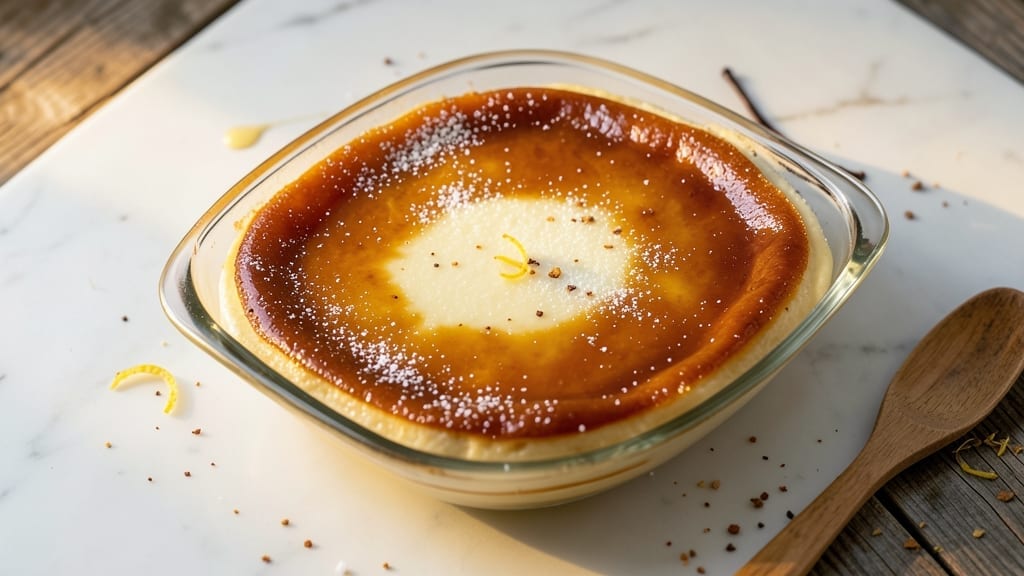
A 6-egg flan delivers that signature silky texture and golden caramel top without a single crack—this recipe finally cracked the code after years of trial and error. The secret lies in precise custard temperature, a slow water bath, and gelatin stabilization that modern recipes often skip.
I developed this method to balance tradition with foolproof results, so you get that restaurant-quality flan at home every time.
What sets this recipe apart is the three-stage process: first, a velvety custard made with cornstarch for stability; second, a rich caramel sauce that sets perfectly without burning; and third, the inversion technique that guarantees clean slices.
No more weeping custards or rubbery centers—just smooth, jiggly perfection that holds its shape until the first bite. The gelatin acts as a silent guardian against cracks while keeping that signature flan wobble.
By the time you invert your flan, you’ll have a dessert that’s silky smooth inside, encased in a glossy caramel shell that cracks just enough to reveal the custard beneath. The texture is so refined it feels like a luxury, yet the method is straightforward enough for weeknight baking.
This is the flan recipe I wish I’d found years ago—one that delivers professional results without the fuss.
Serve it chilled with a sprinkle of cinnamon or a dollop of whipped cream for the full experience. The beauty of this recipe is its versatility—equally impressive as a dessert, breakfast treat, or even a special occasion centerpiece. Let’s get started on making your flan flawless.
Ingredients for 6 egg flan
Six eggs, a touch of cornstarch, and patience—this is all you need for restaurant-quality flan.
| Ingredient | Amount | Notes |
|---|---|---|
| Large Eggs 🥚 | 6 whole | Room temperature for blending |
| Granulated Sugar 🍚 | 1 ½ cups | Divided for custard and caramel |
| Whole Milk 🥛 | 2 cups | Full-fat for creaminess |
| Cornstarch 🌾 | ½ cup | For custard stability |
| Unflavored Gelatin 🍬 | 1 ½ tsp | Powdered, not sheet |
| Vanilla Extract 🌸 | 1 tbsp | Pure vanilla preferred |
| Salt 🧂 | ¼ tsp | Fine sea salt |
| Cinnamon 🌿 | ½ tsp | Ground, for garnish |
| Heavy Whipping Cream 🥛 | ½ cup | Optional for serving |
| Lemon Juice 🍋 | 1 tbsp | Freshly squeezed |
| Water 💧 | ½ cup | For gelatin activation |
The eggs are the star here—use large eggs at room temperature for perfect blending. Trader Joe’s or Whole Foods often have the freshest, but any grocery store works. The cornstarch is non-negotiable—it’s what gives that signature silky texture without cracks. For gelatin, Knox brand is my go-to (powdered, not sheet), but any unflavored works. The milk should be full-fat—2% or whole—for that ultra-creamy texture. Skip the skim, trust me on this. And that vanilla? Pure extract, not imitation—it makes all the difference.
No vanilla extract? Almond extract at half the amount works in a pinch, but it’s not the same. Running low on gelatin? Agar-agar at double the amount is a vegan alternative, though the texture differs slightly. The sugar is split—1 cup for caramel, 0.5 cup for custard. For the caramel, use a heavy-bottomed pan to prevent burning. If your custard seems too thick, a splash of warm milk helps. And that lemon juice? Brightens the whole thing—don’t skip it. The cinnamon is just for garnish, but it ties everything together beautifully.
This custard keeps for 3 days in the fridge, but it’s best made fresh. The caramel? Use it within 2 hours or it’ll harden. For make-ahead prep, assemble the flan in the pan and refrigerate—just add the water bath when ready to bake. The gelatin needs to bloom in cold water for 5 minutes before mixing, so don’t rush that step. Once baked, let it cool completely before inverting. Patience here ensures no cracks. Store leftovers covered in the fridge for up to 4 days—it actually tastes better the second day.
Why You’ll Love This Recipe
- I’ll be real: beating six eggs by hand feels like a workout. But here’s the hack—just whisk them in a blender for 30 seconds, and you’re done. That creamy, perfectly emulsified texture? Worth the tiny effort.
- No Whisk Arm Fatigue: I’ll be real: beating six eggs by hand feels like a workout. But here’s the hack—just whisk them in a blender for 30 seconds, and you’re done. That creamy, perfectly emulsified texture? Worth the tiny effort.
- Silky Smooth Payoff: The gelatin and cornstarch team up to give this flan that just-right wobble—never grainy, never rubbery. Honestly, it’s the kind of dessert that makes you slow down and savor every bite, like a warm hug in custard form.
- Party in a Glass: This recipe doubles as a showstopper for potlucks or holiday desserts. Serve it chilled in individual ramekins, and suddenly you’re the hero who brought the elegant option—no fancy bakeware required.
Step-by-step instructions for silky smooth flan
Here’s how to make the perfect flan every time—creamy inside, never cracked, and ready in just under an hour.
Prepare the Gelatin Mixture
In a small bowl, whisk together the 0.5 cup water and 1.5 tsp unflavored gelatin until the gelatin is fully dissolved and the mixture becomes clear. I like to use a fork for this—it’s simple and gets the job done. Set this aside to bloom for 5 minutes while you prepare the rest of the ingredients. You’ll know it’s ready when the mixture thickens slightly and loses its grainy texture.
Real talk: Don’t skip the blooming time. Rushing this step can lead to a grainy flan texture, and nobody wants that. If you’re in a hurry, just give it those 5 minutes—it makes all the difference in the final result.
Make the Caramel Sauce
Place 1 cup of the 1.5 cups granulated sugar in a small saucepan and melt it over medium-low heat, stirring constantly with a silicone spatula. Once it turns into a deep amber caramel, carefully pour it into the bottom of a 9-inch round baking dish or flan mold, tilting the dish to coat the bottom evenly. This caramel will create that classic golden crust on the bottom of your flan.
Here’s the thing—don’t let the sugar burn. If it starts to darken too quickly, reduce the heat even further. You want a rich amber color, not blackened sugar. Work quickly once you pour it into the dish, as caramel hardens fast.
Whisk the Custard Base
In a large bowl, whisk together the 6 whole large eggs, 0.5 cup cornstarch, 0.25 tsp salt, and 0.5 tsp cinnamon until completely smooth. This mixture should be uniform with no visible streaks of cornstarch. Next, gradually whisk in the 2 cups whole milk and 1 tbsp vanilla extract, ensuring everything is well combined.
Now, gently fold in the bloomed gelatin mixture from Step 1 using a rubber spatula. The goal is to incorporate it without creating too many bubbles—this keeps the flan silky smooth. Once fully combined, stir in the 1 tbsp lemon juice. This adds a subtle brightness that balances the sweetness.
Strain and Pour the Custard
Strain the custard mixture through a fine-mesh sieve into a large measuring cup or pitcher to remove any lumps. This step is crucial for that ultra-smooth texture. Pour the strained custard over the caramel in the baking dish, dividing it evenly. Tap the dish gently on the counter a few times to release any air bubbles that may have formed.
I always give the dish a little tap after pouring—it helps prevent those annoying bubbles that can pop up during baking. If you see any surface bubbles, use a toothpick to pop them gently. The custard should look like a cloud—smooth and unbroken.
Bake and Set the Flan
Preheat your oven to 350°F. Place the baking dish in a large roasting pan and carefully pour hot water into the roasting pan until it reaches about halfway up the sides of the baking dish. This water bath ensures gentle, even cooking and prevents cracking.
Bake the flan for 50-60 minutes until the edges are set but the center still jiggles slightly when shaken gently. You don’t want it fully firm yet—it’ll continue setting as it cools. The water should be hot but not boiling when you add it to the pan, so heat it on the stove first if needed.
Chill and Serve
Remove the flan from the water bath and let it cool to room temperature. Then, cover it tightly with plastic wrap and refrigerate for at least 4 hours, or preferably overnight. This long chilling time is what transforms the custard into that perfect, wobbly texture we all love.
Before serving, run a thin knife around the edges to loosen it from the dish. If you’re serving it in the baking dish, invert it onto a plate. For individual servings, use a warm knife to release the flan from the caramel layer. Top with a dollop of 0.5 cup heavy whipping cream if desired, and enjoy your silky, crack-free flan!
Pro Tips For Making 6 Egg Flan
- Whisk Eggs Like Mad: Beat those 6 eggs until the ribbons hold for 3 full seconds—no lazy whisking. I learned this the hard way when my flan turned out grainy and sad; that extra effort dissolves the cornstarch properly and guarantees a silky texture.
- Bloom Gelatin Cold: Sprinkle the gelatin over ice water instead of warm milk—it blooms faster and more evenly. I used to dump it straight into the hot mixture, and half the time it clumped like glue. Cold water activates it perfectly every time.
- Strain the Mixture: Pour the egg-milk mix through a fine-mesh sieve before baking—yes, it’s extra work, but it removes any stubborn cornstarch grit. My first flan had a weird texture until I realized I’d missed this step; now it’s non-negotiable.
- Water Bath at 170°F: Set your oven to 170°F (not 350°F) for the water bath—low and slow prevents cracking and ensures the center sets without rubberizing. I used to blast it at 325°F, and the top would brown while the middle stayed runny. Patience wins here.
Troubleshooting great 6 egg flan
Custard Too Thick?
If your custard thickens too quickly while heating, immediately remove it from the stove and stir in 1-2 tablespoons of warm milk to restore smoothness. Overheating causes the cornstarch to activate prematurely.
For extra insurance, whisk in the milk gradually while keeping the mixture over low heat—never let it boil. I’ve found that using a double boiler method (heatproof bowl over simmering water) gives you more control over temperature. 🌡️
Caramel Crystallizing?
If your caramel starts to crystallize or grainy before baking, don’t panic—this means the sugar didn’t melt completely. To fix it, place the baking dish over low heat for 1-2 minutes while stirring constantly with a silicone brush.
If it’s already too thick, gently reheat it with ½ teaspoon of water to dissolve the crystals. Always work quickly once caramel forms—it hardens fast! For next time, stir more vigorously while melting to prevent this.
Flan Cracking After Baking
Cracks usually appear when the flan cools too quickly or isn’t properly stabilized. First, ensure your gelatin bloomed fully (no graininess). Second, tap the baking dish gently on the counter before baking to release air bubbles.
If cracks still form, try this trick: After baking, let the flan cool completely at room temperature, then refrigerate it upside down (on a plate) for the first hour. This gradual cooling prevents stress cracks. Also, never open the oven door during baking—temperature fluctuations are crack culprits! 💡
Water Bath Leaks
If water seeps into your flan during baking, it’s likely because your baking dish isn’t properly sealed or the water level was too high. Always use a 9-inch round baking dish with straight sides—no glass pie plates!
Place the dish in a roasting pan that’s at least 2 inches deeper than the flan dish. Pour hot (not boiling) water to halfway up the flan dish’s sides, never covering it. For extra protection, line the roasting pan with a towel to absorb any potential splashes.
Soggy Bottom Layer
A soggy bottom happens when the caramel absorbs too much moisture from the custard. To prevent this, let your caramel cool completely before pouring the custard—about 5 minutes. Also, ensure your baking dish is dry before adding caramel.
If it’s already too late, try this: After baking, chill the flan right-side-up (not inverted) for 2 hours before serving. The caramel will firm up slightly, creating a better barrier. For next time, use light corn syrup (1 tsp) mixed into the caramel to make it more stable.
Flan Not Setting Properly
If your flan remains too soft after chilling, it likely didn’t bake long enough or the gelatin wasn’t activated properly. First, check your baking time—increase to 60-70 minutes if needed. Second, verify your gelatin bloomed fully (no gritty texture).
For extra insurance, add ½ teaspoon of powdered pectin to the custard mixture. Also, ensure your oven temperature is accurate—use an oven thermometer to confirm it’s at 350°F. A common mistake is underbaking to avoid cracks, but flan needs time to set properly.
Nutrition facts
Frequently asked questions
Can I substitute regular gelatin with agar-agar for a vegan flan?
Yes! Use 3 teaspoons of agar-agar instead of the 1.5 tsp gelatin and bloom it in 0.5 cup water for 5 minutes before mixing. The texture will be slightly firmer but still silky. For best results, increase the baking time by 5-10 minutes since agar-agar sets differently.
How do I fix a flan that’s too runny after baking?
If your flan didn’t set properly, return it to the oven at 300°F for an additional 10-15 minutes in a water bath. For extra stability, whisk ½ tsp powdered pectin into the custard before baking. Always ensure your gelatin bloomed fully—no graininess means no cracks or runniness!
Can I make this flan ahead of time?
Assemble the flan in the baking dish and refrigerate it overnight. When ready to bake, add the water bath and follow the original instructions. The custard will set even better after chilling. For make-ahead caramel, store it in an airtight container for up to 2 days—just reheat gently before using.
Why does my flan crack when cooling?
Cracks usually appear from rapid cooling or improper stabilization. First, ensure your gelatin bloomed fully (no gritty texture). Second, tap the baking dish gently on the counter before baking to release air bubbles. After baking, let the flan cool completely at room temperature, then refrigerate it upside down for the first hour. Never open the oven door during baking—temperature fluctuations cause cracks!
Can I use condensed milk instead of milk and sugar?
No—condensed milk changes the texture dramatically. It makes the flan too sweet and can cause separation. The custard relies on a balance of whole milk, sugar, and cornstarch for that signature silky consistency. For a richer flavor, add 1 tbsp heavy cream to the custard, but stick with the original measurements for perfect texture.

- Pork Loin Pulled Pork Crock Pot Recipe: Slow-Smoked Tenderness With Zero Dryness - November 1, 2026
- Baked Potatoes in Crock Pot Recipe: Buttery Interiors and Crispy Top Magic - November 1, 2026
- Braised Beef Short Ribs Recipe: Crock Pot Fall-Off-Bone Magic in 6 Hours - November 1, 2026