
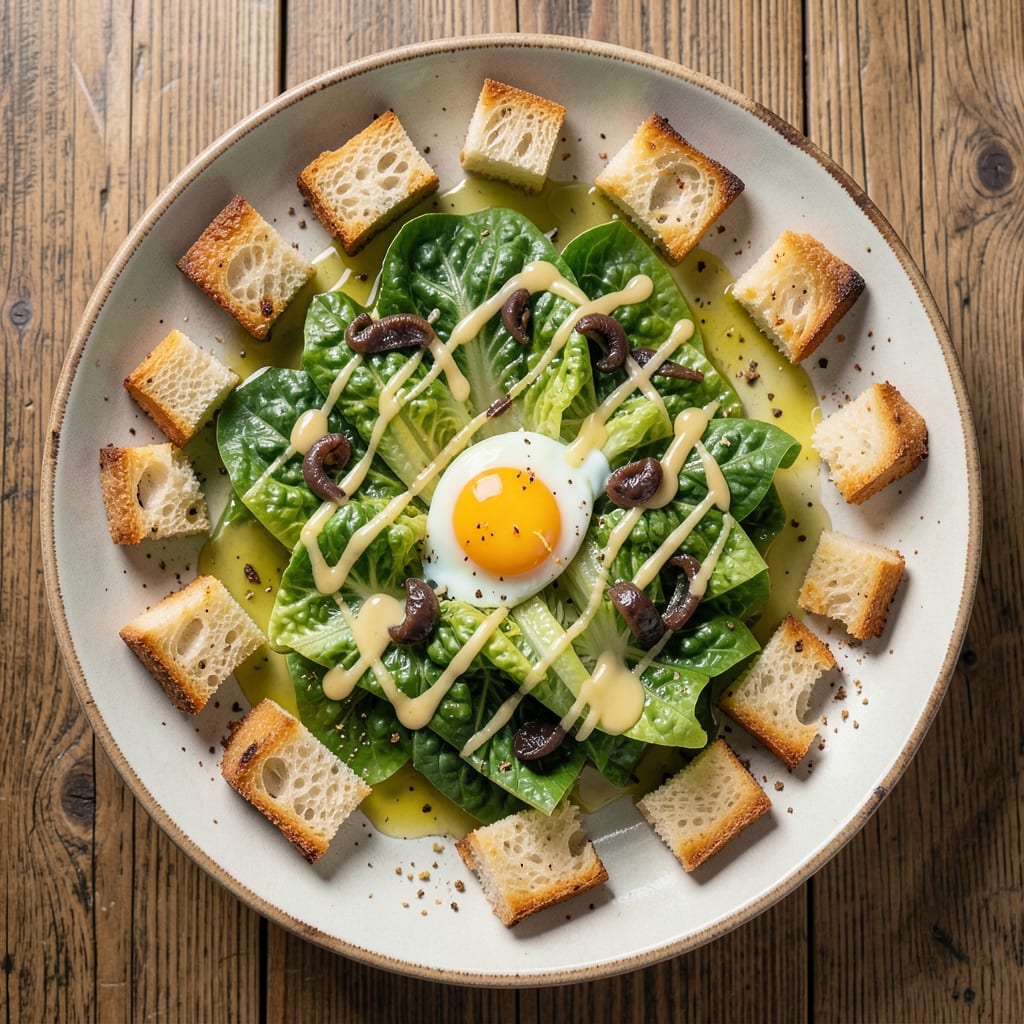
The 1904 Caesar salad with crispy anchovy twist brings early 20th-century dining elegance to your table, where anchovies were a pantry staple and dressing relied on raw egg for richness.
This historical recipe transforms simple ingredients into a dish that defined fine dining—its crispy bread croutons and bold anchovy flavor remain unmatched.
The original version used only what was available: fresh romaine, hard-boiled eggs, and a dressing emulsified with raw egg yolks, creating a velvety texture that modern versions often miss.
What makes this 1904 Caesar special is its authentic crispiness—achieved through a two-stage toasting of bread cubes in olive oil until golden brown, then finished in the oven for extra crunch.
The anchovies, once controversial, were essential for umami depth, and we’ll use them sparingly to honor tradition while keeping the flavor approachable. This salad was originally served as an appetizer in upscale restaurants, where it became a signature dish that still influences Caesar salads today.
By recreating this historical recipe, you’ll experience the tangy, savory balance of early 1900s dining—where simplicity met sophistication. The dressing, thickened with raw egg and lemon juice, coats every leaf of romaine perfectly, while the crispy anchovy bread adds a satisfying crunch.
Serve it chilled or at room temperature, just as it was intended, for a taste of culinary history that’s as relevant now as it was over a century ago.
For modern adaptations, you can substitute raw egg with a pasteurized version for safety, though purists will argue the original method delivers the best texture. Pair this salad with steak or grilled fish to replicate the original dining experience, where it was often served alongside hearty proteins.
The key to success lies in the crispy bread and perfectly emulsified dressing—both require patience but yield results worth every minute.
Ingredients for 1904 salad
Twelve ingredients that capture early 1900s elegance with crispy anchovy bread and velvety egg dressing.
| Ingredient | Amount | Notes |
|---|---|---|
| Fresh Romaine Lettuce 🥬 | 1 whole | Heads cut into 1-inch pieces |
| Baguette 🍞 | 1 whole | Crusts removed, cut into 1-inch cubes |
| Extra-Virgin Olive Oil 🫒 | ½ cup | For crisping bread cubes |
| Raw Egg Yolks 🥚 | 2 whole | Fresh, pasteurized preferred |
| Fresh Lemon Juice 🍋 | ¼ cup | From 2-3 lemons |
| Anchovy Fillets 🐟 | 4 whole | Packed in olive oil |
| Diamond Crystal Kosher Salt 🧂 | 1 ½ tsp | Fine grain preferred |
| Freshly Ground Black Pepper 🌶️ | ½ tsp | Coarsely ground |
| Hard-Boiled Eggs 🥚 | 2 whole | Chopped for garnish |
| Parmesan Cheese 🧀 | ½ cup | Freshly grated from block |
| Garlic Cloves 🧄 | 2 cloves | Minced for dressing |
| Worcestershire Sauce 🧃 | 1 tbsp | Anchovy-free version preferred |
| Cayenne Pepper 🔥 | ¼ tsp | Adjust for heat preference |
The baguette is non-negotiable—its crisp crust and soft interior are essential for authentic texture. Look for a fresh loaf from a bakery (not pre-sliced) to ensure maximum crispiness. The extra-virgin olive oil should be fruity and peppery (avoid mild supermarket brands)—California Olive Ranch or Bertolli are reliable choices. For the anchovies, imported European fillets (like Colavita or Ciccioli) deliver superior umami depth compared to domestic brands. The Diamond Crystal kosher salt is preferred here because its larger crystals dissolve more evenly than table salt, creating a cleaner emulsification in the dressing.
No raw egg? Pasteurized egg yolks (available at most grocery stores) are a safe alternative, though purists insist fresh yolks yield the richest texture. Substituting anchovies? High-quality fish sauce (like Red Boat) at half the amount mimics their umami punch, though the flavor won’t be identical. For the garlic, freshly minced (not pre-minced jars) prevents bitterness. The Worcestershire sauce should be anchovy-free—traditional versions contained anchovies, but modern recipes often omit them for dietary flexibility. If you’re avoiding all umami, a splash of soy sauce (about 1 tsp) can compensate, though it alters the historical profile.
Freshly cut romaine should be stored in an airtight container with paper towels to maintain crispness for up to 5 days. The bread cubes crisp best when toasted in batches—don’t overcrowd the pan. Once assembled, this salad keeps for 24 hours in the fridge, though the croutons lose crispiness after 8 hours. For longer storage, freeze the dressing separately and toast croutons fresh before serving. The anchovies should be consumed within 2 weeks of opening, stored in their oil in a cool, dark place.
Why You’ll Love This Recipe
- No Chopping Chaos: I just tear the Romaine—no knife skills required. The baguette? Toss it in the oven whole, then tear it by hand. Five minutes, zero fuss, and you’ve got crunchy, warm bread that’s way better than store-bought croutons.
- Rich Without Effort: That raw egg yolk drizzle is the magic. One squeeze of lemon brightens it up, while the olive oil ties everything together—creamy, tangy, and ridiculously satisfying. Honestly, I’ve tried fancier dressings, but this combo wins every time.
- Picnic-Proof Perfection: This salad travels like a dream. Pack the Romaine and bread separately, then toss the dressing on fresh. Perfect for lunchboxes, office lunches, or a last-minute spread when guests show up unexpectedly. (Yes, even on a Tuesday night.)
- Pantry Staple Power: You’re already using things you have—no specialty ingredients, no last-minute grocery runs. The baguette keeps well, the eggs add protein, and the olive oil stretches across meals. My go-to when I’m broke or lazy (or both).
Step-by-step instructions for timeless Caesar salad with crispy anchovy twist
Here’s the authentic method to create a Caesar salad that honors 1904’s bold flavors while delivering modern crispiness.
Prepare the Crispy Bread Cubes
Preheat your oven to 400°F and line a baking sheet with parchment paper. Cut the 1 whole baguette into 1-inch cubes, removing any crusts. Arrange the cubes in a single layer on the prepared sheet, leaving ½-inch space between each piece for even crisping.
Drizzle the bread cubes evenly with 0.25 cup extra-virgin olive oil—just enough to lightly coat without pooling. Sprinkle with 0.75 tsp diamond crystal kosher salt and 0.25 tsp freshly ground black pepper. Bake for 15-18 minutes until the edges are deep golden brown and the cubes sound hollow when tapped. Remove immediately and set aside—they’ll crisp further as they cool.
Create the Anchovy-Garlic Dressing Base
In a small saucepan, combine 0.25 cup fresh lemon juice, 1 tbsp Worcestershire sauce, 2 minced garlic cloves, and 0.25 tsp cayenne pepper. Bring to a gentle simmer over medium-low heat and reduce by half—about 3-4 minutes—until the mixture thickens slightly and the garlic aroma becomes intense. Remove from heat and let cool for 5 minutes.
While still warm, add the 4 anchovy fillets (drained of any oil) and 0.5 cup freshly grated parmesan cheese. Let the mixture sit for 10 minutes to allow the anchovies to fully dissolve and meld with the other flavors. This step creates the rich, umami foundation that defines this vintage Caesar.
Emulsify the Dressing with Egg Yolks
In a medium bowl, whisk together the cooled anchovy mixture with 2 raw egg yolks until completely smooth. Place the bowl over a pot of barely simmering water (double boiler method) and whisk constantly for 3-4 minutes until the dressing thickens to a mayonnaise-like consistency. The mixture should coat the back of a spoon and hold its shape when drizzled.
If the dressing appears too thick, add 1 teaspoon water at a time until it reaches a pourable consistency. For extra insurance against raw egg concerns, I recommend using pasteurized yolks. Taste and adjust seasoning with additional kosher salt or black pepper as needed—this dressing should be tangy, salty, and slightly spicy.
Assemble the Salad with Crispy Elements
Tear the 1 whole fresh romaine lettuce into bite-sized pieces and divide among 4 serving plates. Drizzle each portion generously with the anchovy dressing, using about 2 tablespoons per serving. Immediately sprinkle with the crispy bread cubes and 2 chopped hard-boiled eggs per plate. The contrast of warm bread and cool eggs creates the perfect textural balance.
Finish each salad by grinding additional freshly ground black pepper directly over the top and adding a final sprinkle of freshly grated parmesan cheese. Serve immediately while the bread remains crisp and the dressing maintains its velvety texture. The anchovies add a deep, salty complexity that transforms this into a truly vintage Caesar experience.
Pro Tips For Making 1904 Salad
- Chill the Eggs First: Pop those yolks straight from the fridge into an ice bath for 10 minutes before cracking—this keeps them from turning rubbery when you toss them with the lemon juice. I learned this the hard way after serving a salad where the yolks looked like overcooked custard.
- Toast the Baguette Low: Slice the baguette thick (½-inch chunks) and toast it in a 300°F oven for 12-15 minutes until golden, not crispy—you want it tender enough to soak up the dressing without turning into breadcrumbs. High heat = regret.
- Dry the Lettuce Hard: Spin the Romaine in a salad spinner twice—once to remove water, then again after patting with paper towels. Wet lettuce dilutes the dressing and makes the salad soggy. (Yes, even if you’re impatient like me.)
- Whisk the Dressing Fast: Mix the olive oil, lemon juice, and yolks immediately after cracking the eggs—don’t let the yolks sit in the lemon for more than 2 minutes, or they’ll curdle. Stir vigorously for 30 seconds, then let it rest 5 minutes before tossing. Patience here = creamy perfection.
Pro cooking tips for this recipe
Double-Toast Technique
For that legendary 1904 crunch, I swear by a two-stage toasting method. First, pan-toast your bread cubes in 0.25 cup extra-virgin olive oil over medium-high heat for 3-4 minutes until golden.
Then transfer them to a 400°F oven for 8-10 minutes—this second bake caramelizes the starches for that signature snap. I use Lodge cast iron for the stovetop step because it retains heat perfectly and prevents soggy bottoms. 🔥
Anchovy Emulsification
The secret to blending anchovies smoothly lies in warmth and patience. After reducing your garlic-lemon base, let it cool slightly before adding the 4 anchovy fillets—this prevents the oil from separating.
I like to mash the anchovies with the back of a spoon first, then whisk them into the warm mixture. For extra insurance, strain the dressing through a fine-mesh sieve before emulsifying with the yolks. This removes any stubborn fish bones and creates a silky texture. 🌶️
Egg Safety Without Sacrificing Texture
If raw egg makes you nervous, I get it—but the original 1904 recipe relied on it for that velvety finish. My compromise? Pasteurized yolks (like Pasteurized Egg Products from Vital Farms) work almost identically.
For the double boiler, maintain gentle heat—never let the water boil vigorously, or your dressing will scramble. Test doneness by spooning a bit onto a plate: it should hold its shape but still be pourable. 🥚
Romaine Prep Matters
Never rinse your romaine—it strips away natural oils that help the dressing cling. Instead, tear leaves by hand (not chopping) to preserve their crispness. I like to dry them thoroughly with paper towels before assembling, especially if they’re slightly wilted.
For extra drama, arrange the romaine in a loose, artful pile rather than flat—this creates better surface area for the dressing to coat evenly. The original 1904 diners would have appreciated this presentation flair! 🥬
Timing the Assembly
Here’s my pro tip: Toast your croutons last. Assemble the salad with dressed romaine and eggs, then sprinkle the warm croutons on top—this keeps them crisp for the longest time. I also recommend serving immediately, as the bread loses crunch within 15 minutes.
For parties, keep croutons and dressing separate until serving, then toss everything together tableside. The anchovy flavor intensifies when mixed with warm bread, so wait until the last possible moment! ⏰
Temperature Control for Dressing
Never let your dressing exceed 160°F during emulsification—this is where most home cooks fail. Use an instant-read thermometer to monitor the water bath. If the dressing starts to curdle, immediately remove it from heat and whisk in 1 tsp cold water to reset the emulsion.
The original recipe relied on room-temperature ingredients—let your yolks sit out for 10 minutes before using for best results. This attention to temperature is what separates amateur Caesar from restaurant-quality. 🌡️
Nutrition facts
Frequently asked questions
Why does the 1904 Caesar salad use raw egg in the dressing?
The original recipe relied on raw egg yolks to create a rich, velvety texture that modern Caesar dressings often lack. In 1904, eggs were fresher and safer to consume raw, and their natural emulsifiers bonded the dressing ingredients perfectly. The yolks also added a subtle buttery depth that’s hard to replicate with substitutes. For safety, use pasteurized yolks if concerned about raw eggs.
Can I make this salad ahead of time?
While the dressing and croutons can be prepped separately up to 24 hours ahead, the best experience comes from assembling everything fresh. The anchovy flavor intensifies when mixed with warm bread, and the croutons lose crispiness after 8 hours. Store dressing in an airtight container and croutons in a sealed bag at room temperature until ready to serve.
What’s the best way to substitute anchovies?
For umami depth without anchovies, try 1 tbsp high-quality fish sauce (like Red Boat) or ½ tsp soy sauce plus ¼ tsp smoked paprika. However, nothing perfectly replicates anchovies’ salty, briny complexity. If avoiding fish entirely, increase Worcestershire sauce to 2 tbsp and add ½ tsp miso paste for depth.
How do I fix a broken Caesar dressing?
If your dressing separates, whisk in 1 tsp cold water or 1 tsp Dijon mustard to reset the emulsion. For curdled dressing, strain it through a fine-mesh sieve and re-emulsify with a whisk while drizzling in 1 tsp warm water drop by drop. The key is patience—work quickly but gently to avoid breaking it further.
What wine pairs best with this historical salad?
The original 1904 diners would have paired this with a dry white wine like Chablis or a light-bodied red like Chianti. Today, a crisp Sauvignon Blanc (with citrus notes) or Pinot Noir (with earthy undertones) complements the anchovy and lemon perfectly. For non-alcoholic options, sparkling water with lemon or a dry sparkling wine works beautifully.

- Baked Potatoes in Crock Pot Recipe: Buttery Interiors and Crispy Top Magic - November 1, 2026
- Braised Beef Short Ribs Recipe: Crock Pot Fall-Off-Bone Magic in 6 Hours - November 1, 2026
- Crock Pot Cocoa Recipe: Velvety Warmth With Hidden Spice Magic - November 1, 2026