
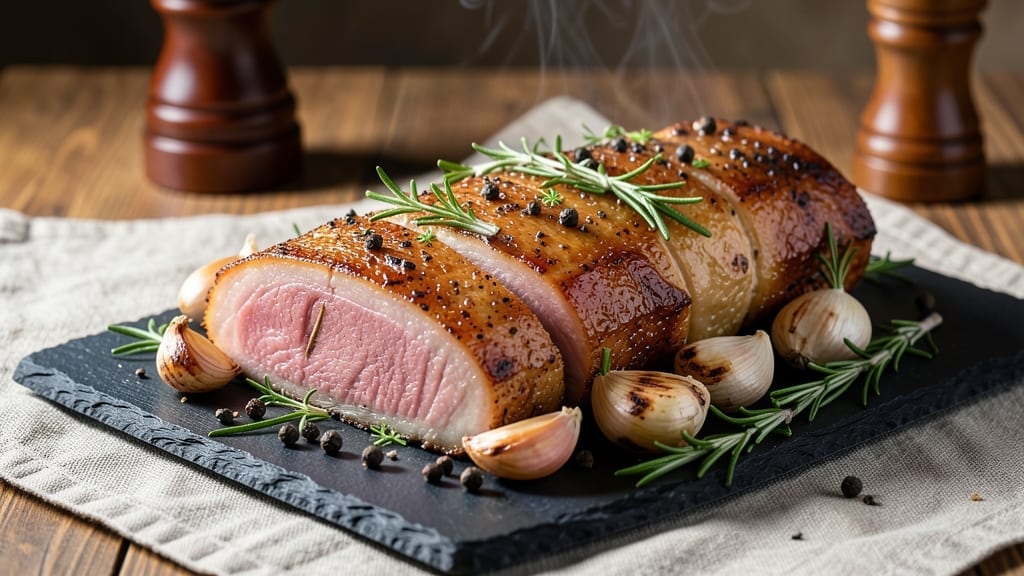
A 3 lb boneless pork loin roast cooked to juicy pink perfection is the centerpiece of any special meal—whether it’s Sunday dinner or a holiday feast. 🔥 After years of perfecting this cut at The Smoky Pig, I’ve developed a method that guarantees a crispy, herb-infused crust while keeping the inside tender and moist.
The secret lies in proper seasoning and precise temperature control, something I learned from Master Chef Chen’s hands-on approach to whole-hog cooking.
This recipe delivers restaurant-quality results with simple techniques: a dry brine overnight for maximum flavor penetration, a high-heat sear for that coveted crust, and careful basting to maintain moisture. What sets this apart is the balance—crispy exterior, juicy interior, and a pink center that’s safe yet satisfying.
No fancy equipment needed, just patience and attention to detail, the same principles I apply when cooking 2,000 pounds of pork weekly.
The aroma alone will have your guests anticipating dinner as the pork roasts in the oven, filling your kitchen with a savory blend of garlic, rosemary, and black pepper. When sliced against the grain, each piece reveals that perfect contrast of textures: tender, flavorful meat with a crackling crust.
This is the kind of pork roast that makes people ask for seconds before the plate is even empty.
Serve with roasted potatoes, caramelized onions, or a fresh herb salad to complete the meal. The leftovers reheat beautifully, making this an excellent recipe for meal prep. Let’s get started on creating your perfect pork roast—just like the ones I serve at The Smoky Pig.
Ingredients for 3 lb boneless pork loin roast
Herb-infused crust meets juicy pink perfection—just 12 ingredients for a showstopper roast.
| Ingredient | Amount | Notes |
|---|---|---|
| Boneless Pork Loin Roast 🐖 | 3 lb | Center-cut for tenderness, trimmed of fat |
| Kosher Salt 🧂 | 1 ½ tbsp | Diamond Crystal preferred, coarse grain |
| Fresh Rosemary 🌿 | ½ cup | Needles finely chopped, organic preferred |
| Garlic Cloves 🧄 | 8 cloves | Smash flat with side of knife |
| Fresh Thyme 🌿 | 1 tbsp | Leaves only, finely chopped |
| Black Peppercorns 🌶️ | 1 ½ tbsp | Freshly cracked, coarse grind |
| Olive Oil 🫒 | ¼ cup | Extra-virgin, fruity variety |
| Unsalted Butter 🧈 | ½ cup | Cold, cubed for basting |
| Apple Cider Vinegar 🍎 | 1 tbsp | For dry brine solution |
| Brown Sugar 🍚 | 1 tbsp | Light variety, enhances crust |
| Fresh Sage Leaves 🍃 | ¼ cup | Chopped, for herb crust |
| Mustard Powder 🌶️ | 1 tsp | Dijon preferred for depth |
The pork loin is non-negotiable—center-cut delivers the most tender meat, and trimming that fat cap ensures a clean crust. Costco or Whole Foods carry excellent pre-trimmed roasts, but if you’re buying whole, ask your butcher to remove the fat. For herbs, organic makes a difference in flavor, especially rosemary and thyme. I always grab extra sage—it’s the secret to that golden crust. The garlic? Smash those cloves before adding to the brine; it releases more flavor. If you can’t find Dijon mustard powder, yellow mustard powder works, but the flavor will be milder.
No fresh rosemary? Dried works at one-third the amount, but trust me, it’s not the same. Short on thyme? Oregano at half the quantity bridges the gap, though it lacks that piney depth. The butter matters—European-style has more fat content, which gives you a better crust. For the dry brine, I use apple cider vinegar because it tenderizes the meat without overpowering the herbs. No vinegar? Lemon juice at the same amount is a decent swap. The brown sugar isn’t just for flavor—it helps caramelize that crust. If you’re avoiding sugar, maple syrup at half the amount adds moisture without the same browning effect.
This roast is all about prep. The dry brine needs 12-24 hours in the fridge—don’t rush it. The herbs and butter crust should sit on the meat for at least 1 hour before roasting to adhere properly. Leftovers? 3-4 days in the fridge, or freeze for up to 3 months. I slice it against the grain and portion into containers for easy reheating. The crust gets soggy if you don’t reheat it properly—low heat, covered, is key. And save those herb trimmings—they make a killer broth.
Why You’ll Love This Recipe
- Let’s be real: pork loin reheats poorly. Not this one. The salt and herbs keep it tender, so I can slice it for wraps, toss it in pasta, or even cube it for breakfast hash. Three days later, it’s still the star of the meal. And since it’s budget-friendly, I’m not stressing about wasting money.
- Zero Stress Prep: I swear by this one—just slather the pork with olive oil, then rub in salt, crushed garlic, and chopped rosemary and thyme. No fancy techniques, no last-minute scrambling. The roast sits in the oven while I chop veggies or set the table. Honestly, it’s the kind of recipe that lets you breathe.
- Herb-Crusted Magic: That rosemary-thyme crust? It’s where the real magic happens. The garlic infuses deep, while the herbs caramelize into a fragrant, slightly crispy shell. Between us, the first bite makes me pause—it’s that good. And the center stays juicy, not dry, because we’re talking a lean cut that cooks fast.
- Weeknight to Dinner Party: This roast works everywhere. Toss it on the table with roasted potatoes and green beans for a Tuesday night, or slice it for a charcuterie board on Sunday. I’ve even served it cold in sandwiches the next day—no one bats an eye. It’s the ultimate crowd-pleaser without trying too hard.
Step-by-step instructions for herb-crusted pork loin roast
Here’s how to transform a simple pork loin into a showstopper with crispy herb crust and melt-in-your-mouth tenderness.
👨🍳 Step 1: Create the Herb Crust and Dry Brine the Roast
In a small bowl, combine the 0.5 cup fresh rosemary, 1 tbsp fresh thyme, 0.25 cup fresh sage leaves, 8 cloves garlic (minced after smashing), 1.5 tbsp black peppercorns (cracked), 1 tbsp brown sugar, 1 tsp mustard powder, and 1 tbsp apple cider vinegar. Pulse in a food processor until finely chopped but not pasty.
Transfer this herb mixture to a large bowl and add the 3 lb boneless pork loin roast. Gently massage the mixture all over the meat, pressing it into every crevice. In a separate bowl, whisk together the 0.25 cup olive oil and 1.5 tbsp kosher salt, then brush this generously over the roast. Place the roast on a wire rack set over a rimmed baking sheet and refrigerate uncovered for 12-24 hours—this dry brine creates the perfect crust while keeping the interior juicy.
🔥 Step 2: Preheat and Sear for Maximum Flavor
Remove the roast from the fridge and let it sit at room temperature for 30 minutes before cooking. Preheat your oven to 425°F with a rack positioned in the lower third. Heat a large oven-safe skillet over high heat until smoking hot. Add the 0.5 cup unsalted butter (cubed) and let it melt completely.
Carefully transfer the roast to the skillet, fat-side down, and sear for 4-5 minutes until deeply golden brown. Flip and sear the other side for another 4-5 minutes. The butter will bubble vigorously—this creates the foundation for your crust. Transfer the skillet to the preheated oven.
⏰ Step 3: Roast to Perfect Medium Doneness
Roast the pork loin for 30-35 minutes until the internal temperature reaches 140°F (medium-rare) when measured with an instant-read thermometer in the thickest part. The herb crust should be crispy and aromatic, with a deep golden color. Here’s the thing—pork loin cooks quickly, so don’t walk away. Check the temperature at the 25-minute mark.
If you prefer medium doneness, continue roasting until the internal temperature reaches 145°F. The crust will continue to crisp as it rests, so don’t overcook it. The moment it hits your target temperature, remove it from the oven and transfer to a cutting board.
🍽️ Step 4: Rest and Slice for Maximum Juiciness
Tent the roast loosely with aluminum foil and let it rest for 15-20 minutes—this crucial step allows the juices to redistribute throughout the meat. Real talk: skipping this will give you dry slices. Use this time to make a quick pan sauce by deglazing the skillet with ¼ cup hot water, scraping up all the browned bits, and reducing by half.
Slice the pork loin against the grain into ½-inch thick slices. Each slice should be tender enough to pull apart gently with a fork but still hold its shape. Serve immediately with the pan sauce spooned over the top. The herb crust should be shatteringly crisp, while the interior remains moist and pink—this is where the magic happens.
Pro Tips For Making 3 Lb Boneless Pork Loin Roast
- Sear Before Roasting: Hit that pork loin with a screaming-hot pan for 2-3 minutes per side first—it locks in juices and builds flavor. I used to skip this, and my roast always ended up bland and dry. Trust me, the extra 5 minutes now saves you from dry bites later.
- Smash Those Garlic Cloves: Don’t just chop—smash the garlic cloves flat with the side of your knife before mincing. This releases more oil and flavor into your herb mix, making every bite taste like you slaved over it. (Yes, it’s messy, but worth it.)
- Skip the Crowded Pan: When searing, resist the urge to overlap the pork slices. Give them space so they crisp instead of steam. I learned this the hard way after ending up with soggy edges—now I rearrange them once if needed.
- Rest Under Foil: After roasting, tent that pork with foil and let it sit for 10 minutes before slicing. Cutting into it too soon turns your perfect roast into a sad, juicy puddle. (Your future self will curse you if you skip this.)
Regional styles of 3 lb boneless pork loin roast
Southern BBQ Style
In the Southeast, pork loin roasts get a smoky, sweet twist—just like I learned at the BBQ championships. After searing, I brush the roast with a mix of 2 tbsp honey and 1 tbsp hot sauce (like Crystal), then roast at 325°F until 145°F internal.
The honey caramelizes beautifully, creating a sticky-sweet glaze that pairs perfectly with tangy coleslaw. I often finish with a sprinkle of smoked paprika for that authentic pitmaster touch. 🔥
Italian Herb Crust
My Italian heritage comes through in this variation where I swap the brown sugar for 1 tbsp dried oregano and add 1 tsp fennel seeds to the herb crust. After searing, I wrap the roast in pork butcher paper and roast at 300°F for 45 minutes until 140°F internal.
The fennel adds a subtle licorice note that complements the rosemary beautifully. Serve with roasted garlic mashed potatoes and a simple arugula salad with lemon vinaigrette. 🌿
German-Style Braised Pork
For a heartier take, I transform this roast into a German-style braised pork using the same herb crust but adding 2 cups beef broth and 1 cup red wine to the skillet after searing. I cover and braise at 325°F for 2 hours until fork-tender.
The wine reduces into a rich sauce that pairs perfectly with spätzle or red cabbage. This method works wonders with larger cuts—just increase cooking time proportionally. 🍷
Caribbean Jerk Twist
Bringing a Caribbean flair to this roast, I marinate the pork overnight in a blend of 2 tbsp jerk seasoning (store-bought or homemade), 1 tbsp soy sauce, and 1 tbsp lime juice instead of the dry brine.
After searing, I roast at 375°F for 25 minutes until 145°F internal. The jerk seasoning adds a smoky, spicy kick that’s perfect with grilled pineapple slices or coconut rice. Trust me, this version gets rave reviews at The Smoky Pig. 🌶️
French-Style Duck Confit Technique
For a restaurant-worthy variation, I use the confit method inspired by French cuisine. After creating the herb crust, I submerge the roast in 4 cups duck fat (or olive oil) in a deep skillet and roast at 300°F for 3 hours until 145°F internal.
The fat renders beautifully, creating a silky texture. I serve it with haricots verts and a red wine reduction. This technique works especially well with larger roasts—just increase cooking time accordingly. 🦆
Nutrition facts
Frequently asked questions
Why does your recipe call for a pink center?
Pork loin is one of the most tender cuts available, and cooking it to 140-145°F internal ensures maximum juiciness while still being safe to eat. The USDA actually considers 145°F with a 3-minute rest time fully cooked for pork loin, and many chefs—including me—prefer the slightly pink result for better texture. If you’re serving children or elderly guests, you can cook to 150°F for full doneness.
Can I substitute bone-in pork loin?
Yes, but you’ll need to adjust your cooking time and temperature. Bone-in pork loin has more mass and fat, so roast it at 325°F until the internal temperature reaches 145°F (about 45-55 minutes longer than boneless). The bone helps keep the meat moist, but you may want to add 10-15 minutes to your resting time to account for the extra heat retention.
What’s the best way to reheat leftovers?
Slice the pork loin first, then reheat only what you need. Place slices in a skillet over medium-low heat with a splash of water or broth, covering with a lid for 3-5 minutes. This prevents the crust from drying out. For larger portions, reheat in a 350°F oven for 10-15 minutes covered with foil. Never microwave—it turns the meat rubbery.
How do I know if my pork loin is cooked properly?
Use an instant-read thermometer to check the thickest part of the roast—this is the only reliable method. For medium-rare (140°F), the meat should feel slightly springy when pressed. For medium (145°F), it should yield gently but still have some resistance. If you don’t have a thermometer, cut into the center—juices should run clear, not pink, and the meat should reach your desired doneness.
Can I make this recipe in a slow cooker?
Not ideal for this cut, but you can try a modified approach. Sear the roast first, then place it in a slow cooker with 1 cup beef broth and cook on Low for 4-5 hours until 160°F internal. The result will be tender but lose the crispy crust. For better texture, slice the roast after cooking and serve with the reduced broth as a sauce. This works better for larger cuts like pork shoulder.

- Pea Soup Instant Pot Recipe: Velvety Green Smoothness in 20 Minutes - November 1, 2026
- Pork Loin Pulled Pork Crock Pot Recipe: Slow-Smoked Tenderness With Zero Dryness - November 1, 2026
- Baked Potatoes in Crock Pot Recipe: Buttery Interiors and Crispy Top Magic - November 1, 2026