
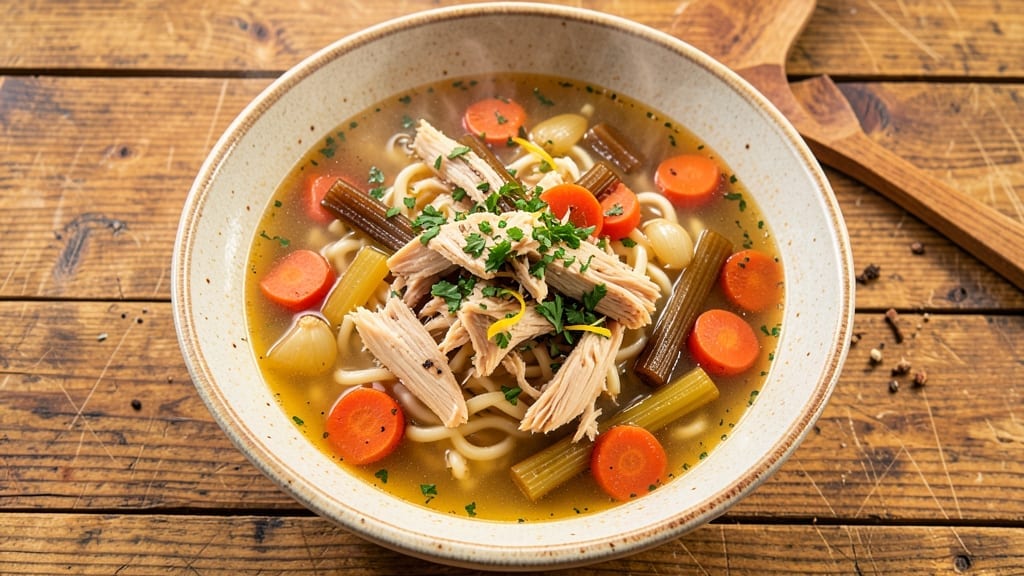
This 5-gallon chicken noodle soup recipe is the ultimate comfort food for gatherings, game days, or chilly evenings—packed with rich broth, tender chicken, and hearty noodles in one pot. This recipe delivers restaurant-quality flavor with simple ingredients and a foolproof method that scales perfectly for crowds.
The secret lies in slow-simmered broth and properly cooked chicken, ensuring every spoonful is warm, satisfying, and full of homestyle goodness.
What sets this recipe apart is its one-pot simplicity—no complicated techniques, just layers of flavor built through aromatics, herbs, and a long simmer. You’ll start with a flavorful base of onions, carrots, and celery, then add chicken and noodles that cook directly in the broth.
The result? A deeply aromatic, velvety soup that’s rich enough to stand alone but light enough to pair with crusty bread or a side salad.
By the time you’re done, you’ll have five gallons of soup ready to serve—enough to feed a crowd, freeze for later, or enjoy over multiple meals. The broth stays rich and flavorful even after reheating, and the chicken remains tender while the noodles hold their bite.
This is the kind of soup that warms both body and soul, perfect for sharing with family or friends.
Whether you’re prepping for a holiday meal, a potluck, or simply craving a comforting classic, this recipe delivers restaurant-quality results with minimal effort. Let’s get started on creating your perfect batch of chicken noodle soup.
Ingredients for 5 gallon chicken noodle soup
Five gallons of cozy goodness—just 14 ingredients for crowd-warming perfection.
| Ingredient | Amount | Notes |
|---|---|---|
| Yellow Onions 🧅 | 6 whole | Medium to large size, chopped |
| Carrots 🥕 | 6 lb | Whole, peeled and chopped |
| Celery Stalks 🧆 | 6 whole | With leaves, chopped |
| Garlic Cloves 🧄 | 12 cloves | Minced for depth of flavor |
| Chicken Breasts 🍗 | 6 lb | Boneless, skinless, cut into pieces |
| Egg Noodles 🍜 | 4 lb | Medium or wide egg noodles |
| Chicken Broth 💧 | 5 gallons | Low-sodium preferred |
| Fresh Thyme 🌿 | ½ cup | Leaves only, chopped |
| Fresh Parsley 🌿 | ¼ cup | Chopped for garnish |
| Bay Leaves 🌿 | 6 whole | For aromatic depth |
| Salt 🧂 | 2 tbsp | Kosher or sea salt |
| Black Peppercorns 🌶️ | 1 tbsp | Crushed for texture |
| Butter 🧈 | ½ cup | Unsalted for richness |
| Heavy Cream 🥛 | 1 cup | Optional for velvety finish |
The base trio—onions, carrots, celery—is your flavor foundation. Buy fresh, vibrant produce from the market or grocery store’s produce section—avoid wilted or rubbery veggies. For the chicken, Costco or local butchers often have bulk deals on boneless breasts. Look for pieces with good marbling if you’re buying whole cuts to cut yourself. The broth? Low-sodium is key—you’ll be adding plenty of salt later. Pro tip: Save your own chicken bones and make a big batch of broth to use here. It’s a game-changer for depth of flavor.
No fresh thyme? Dried works at one-third the amount—just crush it between your palms first. Short on parsley? Fresh basil or cilantro gives a different but still delicious vibe. The butter and cream are optional but take this from good to restaurant-quality. Vegan butter and coconut cream work perfectly if you need dairy-free options. For the noodles, egg noodles are traditional, but gluten-free or whole wheat versions work too. Just make sure they’re medium or wide—thin noodles can get mushy in this big batch. And if you’re really in a pinch, penne pasta in a pinch (though it won’t be the same texture).
This soup tastes even better the next day—make extra and freeze portions. Store in airtight containers for up to 3 months or freeze in gallon-sized freezer bags for easy serving later. The broth keeps well separately too, so you can customize toppings each time. For serving, garnish with fresh herbs and a crack of black pepper. And trust me on this—crusty bread is mandatory. The soup reheats beautifully, so plan to make it a day ahead if you’re serving a crowd.
Why You’ll Love This Recipe
- One-Pot Magic: I swear by this recipe—just toss the onions, carrots, and celery into the pot whole (yes, really), let the broth work its magic, and they soften perfectly. No chopping, no mess, no stress. The garlic cloves get minced in at the end, and that’s when the whole kitchen smells like home.
- Rich Umami Bomb: Between the slow-simmered chicken and the caramelized onions, this soup tastes like it’s been cooking all day—even though it’s ready in under an hour. The celery adds that fresh, grassy bite, and the garlic? Oh, it’s there, but in the best way.
- Meal Prep MVP: Make a double batch on Sunday, and you’ve got lunch covered for the week. The flavors actually get better the next day—honestly, my husband always asks for leftovers. Plus, it’s the kind of dish that feeds a crowd or just you and a bad movie night.
- Budget-Friendly Powerhouse: Chicken breasts stretch further than you’d think when shredded, and the veggies? They’re the kind you can grab on sale or even grow in your backyard. A 5-gallon batch costs me less than takeout, and it keeps for days—no sad, wilted leftovers here.
Step-by-step instructions for 5-Gallon chicken noodle soup
Here’s how to create a hearty, comforting pot of soup that feeds a crowd effortlessly.
🍳 Step 1: Sear the Chicken for Maximum Flavor
In a large stockpot, melt the 0.5 cup butter over medium-high heat. Add the 6 lb chicken breasts, cut into pieces, and sear for 8-10 minutes until the chicken is golden brown on all sides and cooked through to 165°F internally. This step builds deep flavor by browning the chicken before removing it.
Remove the chicken from the pot and set it aside on a plate. You’ll return it later, but first, we need to build the aromatic base. The rendered chicken fat in the pot will become the foundation of your soup’s rich flavor—don’t drain it!
🍳 Step 2: Build the Aromatic Vegetable Base
In the same pot, add the 6 whole chopped yellow onions, 6 lb chopped carrots, and 6 whole chopped celery stalks (with leaves). Cook for 10-12 minutes, stirring occasionally, until the vegetables soften and the onions turn translucent. This process releases their natural sugars and sweetness into the pot.
Add the 12 cloves minced garlic, 0.5 cup chopped fresh thyme, 6 whole bay leaves, 2 tbsp salt, and 1 tbsp crushed black peppercorns. Stir for 1-2 minutes until fragrant. The garlic should be golden but not browned—this ensures it adds flavor without bitterness. Here’s the thing—don’t rush this step. The longer you cook these aromatics, the deeper the flavor foundation for your soup.
🍳 Step 3: Simmer the Broth with Vegetables
Pour in the 5 gallons chicken broth and bring to a gentle boil. Reduce heat to low, add the seared chicken pieces back into the pot, and let it simmer for 30-40 minutes. The chicken should be fully cooked through and tender enough to pull apart easily with a fork. Skim off any foam that rises to the surface during this time—it’s just impurities.
After the initial simmer, add the 4 lb egg noodles and stir gently to prevent them from sticking. The noodles should cook for 12-15 minutes until they’re al dente—tender but still with a slight bite. This timing ensures they absorb the flavorful broth without becoming mushy. You’re making enough for 50 servings, so don’t worry about overcooking—the extra broth will keep them from getting too soft.
🥘 Step 4: Finish with Cream and Fresh Herbs
Stir in the 1 cup heavy cream and simmer for an additional 5 minutes to create a velvety finish. The cream adds richness without overpowering the broth’s flavor. Taste and adjust seasoning if needed—you might need a little more salt since we used low-sodium broth.
Remove the 6 whole bay leaves and discard them. Stir in the 0.25 cup chopped fresh parsley and let the soup sit off the heat for 10 minutes before serving. This resting period allows the flavors to meld together perfectly. The soup will be hot and ready to serve—perfect for warming up a crowd on a chilly day.
Pro Tips For Making 5 Gallon Chicken Noodle Soup
- Sear Chicken First: Don’t just poach those chicken breasts—hit them with a quick sear in a hot pot before adding broth. The crust locks in flavor and keeps the meat from turning rubbery, especially when you’re dealing with a big batch. (Yes, even if you’re impatient like me, wait for that golden crust.)
- Dice Veggies Small: I used to cut my onions, carrots, and celery into big chunks, thinking it’d save time. Wrong. Tiny dice—about ¼-inch—cook faster and blend into the soup instead of sitting like awkward mouthfuls. (Your future self will thank you.)
- Simmer Low and Slow: After the initial boil, drop the heat to a gentle simmer—just enough to see tiny bubbles at the edges. Boiling hard turns the broth cloudy and can toughen the chicken. Trust me, this isn’t the prettiest method, but it’s the tastiest.
- Salt the Broth Early: Add half your salt when you first combine broth and veggies, not at the end. Flavor builds over time, and you’ll need to adjust for the noodles later. (I skip this when I’m lazy, but the dish is noticeably better when I don’t.)
Essential equipment for this dish
Large Stockpot Essentials
You’ll need a large stockpot or Dutch oven with at least a 12-quart capacity—I recommend the All-Clad Stainless Steel Stockpot for even heat distribution and durability.
This size ensures your 5-gallon soup won’t overflow while simmering. If you’re cooking outdoors, a campfire-friendly cast iron pot from Lodge works beautifully over open flames. 🔥
Precision Thermometer
A meat thermometer is non-negotiable for checking the chicken’s internal temperature of 165°F. I swear by the ThermoWorks Smoke—it’s accurate, durable, and has a long probe for deep pots.
For budget-friendly options, the OXO Good Grips works perfectly without breaking the bank. This ensures your chicken is safe to eat and tender every time.
Vegetable Chopper or Knife
Chopping 6 lbs of carrots, onions, and celery efficiently is key. A mandoline slicer speeds up the process, but a sharp chef’s knife with a 10-inch blade (like the Wüsthof Classic) gives you more control.
For the garlic, a garlic press saves time and ensures even mincing. Pro tip: Keep your cutting board wet to prevent slipping—safety first!
Slotted Spoon & Fine-Mesh Strainer
You’ll need a long-handled slotted spoon (like the OXO Good Grips) to remove bay leaves and skim foam without disturbing the broth. A fine-mesh strainer helps filter out impurities if you’re using store-bought broth.
For extra flavor, strain the broth after simmering and return it to the pot—this removes any bits but keeps the richness intact.
Ladle for Serving
A heat-resistant ladle with a deep well (such as the Le Creuset Stoneware) makes serving 50 portions effortless. Look for one with a long handle to avoid burns when reaching into deep pots.For outdoor gatherings, a stainless steel ladle is lightweight and easy to clean. Trust me, this is the tool that saves your hands from blisters!
Optional: Immersion Blender
If you prefer a smooth broth, an immersion blender (like the Ninja CB101) lets you blend directly in the pot without transferring liquids. This is especially useful if you’re using homemade broth with visible bits.
Just pulse for 10-15 seconds—no need to over-blend, or you’ll lose that rustic texture. 💫
Nutrition facts
Frequently asked questions
Can I make this soup in a smaller pot?
This recipe is designed for a 5-gallon batch, but you can scale it down to 1-2 gallons in a standard stockpot. Reduce all ingredients proportionally—use 1 lb chicken, 1 cup noodles, and 1 quart broth for every gallon. The cooking times remain the same, but watch the noodles closely to avoid overcooking in smaller batches.
How do I keep the noodles from getting mushy?
Cook the noodles for only 12-15 minutes in the simmering broth, then remove them and set aside. Return them to the pot just before serving to reheat for 2-3 minutes. This keeps them al dente while preventing them from absorbing too much liquid and turning soft. Stirring occasionally also helps maintain their texture.
Can I use dried herbs instead of fresh?
Yes, but use one-third the amount of dried herbs compared to fresh. For example, swap 0.5 cup fresh thyme for 1.5 teaspoons dried thyme. Crush dried herbs between your palms first to release their flavors. The soup will still taste delicious, though fresh herbs add a brighter, more vibrant taste. Dried herbs work well for storage or when fresh isn’t available.
How long will this soup keep in the fridge?
This soup stays fresh in the refrigerator for 4-5 days when stored in airtight containers. The broth and flavors actually improve over time, becoming more concentrated. Reheat gently on the stove over medium-low heat, stirring occasionally, until steaming hot. For longer storage, freeze portions in gallon-sized freezer bags for up to 3 months.
What can I add for extra protein?
For more protein, stir in 1 lb shredded rotisserie chicken or 1 cup cooked white beans during the final 5 minutes of cooking. You could also add 1 lb cooked shrimp or 1 cup chopped hard-boiled eggs just before serving. These additions boost nutrition without overpowering the soup’s delicate balance. Just be mindful of cooking times to avoid rubbery textures.

- Pea Soup Instant Pot Recipe: Velvety Green Smoothness in 20 Minutes - November 1, 2026
- Pork Loin Pulled Pork Crock Pot Recipe: Slow-Smoked Tenderness With Zero Dryness - November 1, 2026
- Baked Potatoes in Crock Pot Recipe: Buttery Interiors and Crispy Top Magic - November 1, 2026