
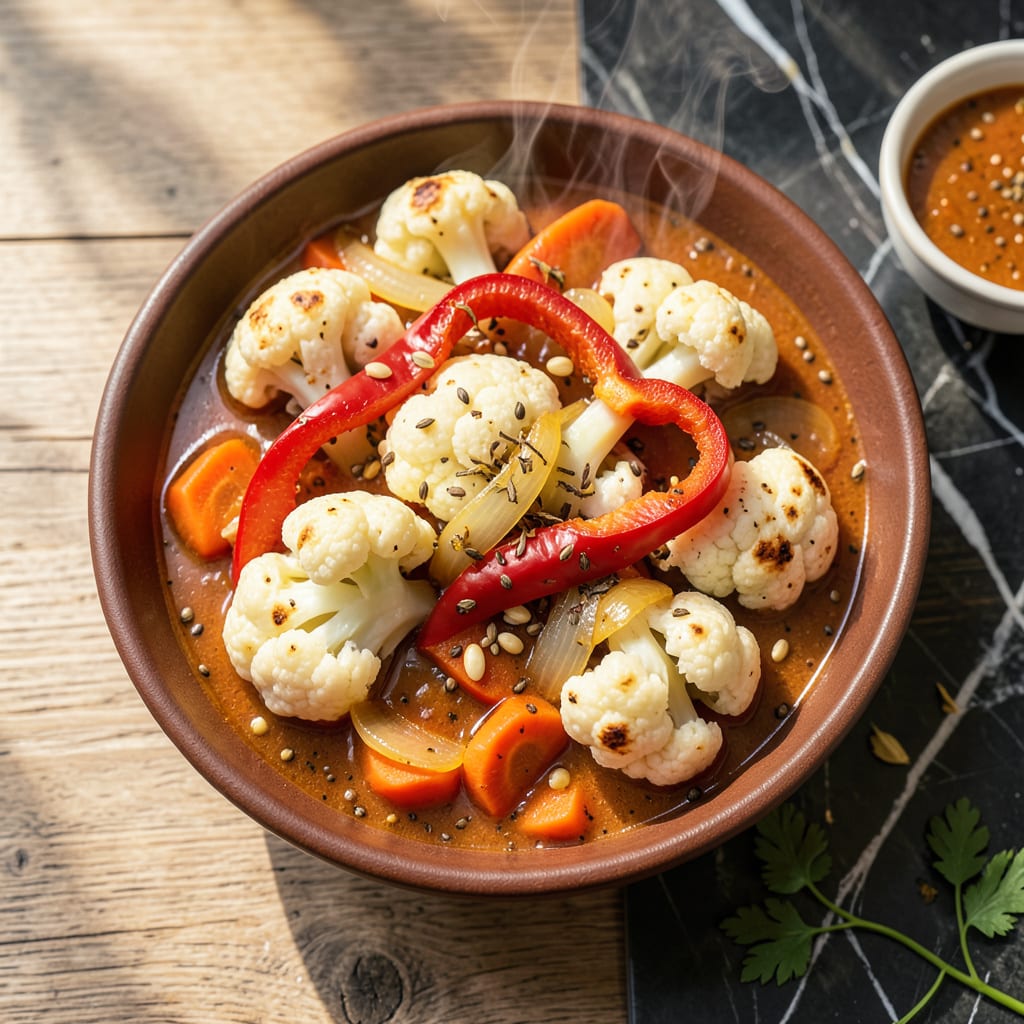
This oil-free curry proves bold flavors don’t need fat to shine. The secret lies in blooming whole spices in a dry pan to unlock their aroma before building layers with onions, garlic, and ginger.
You’ll achieve a rich, deeply seasoned vegetable curry where every bite delivers complexity. The vegetables absorb the spiced broth, creating a satisfying dish without compromise.
Ingredients for Fat Free Vegetable Curry
Pantry staples plus fresh veggies. Bold flavors without the oil.
| Ingredient | Amount | Notes |
|---|---|---|
| Cauliflower 🥦 | 4 cups | Cut into small florets |
| Carrots 🥕 | 2 whole | Peeled and diced |
| Red Bell Pepper 🌶️ | 1 whole | Seeded and chopped |
| Yellow Onion 🧅 | 1 whole | Finely diced |
| Garlic Cloves 🧄 | 4 cloves | Minced |
| Fresh Ginger 🌿 | 1 tbsp | Grated or minced |
| Cumin Seeds 🌿 | 1 tsp | Whole for blooming |
| Mustard Seeds 🌿 | 1 tsp | Yellow or black variety |
| Ground Coriander 🌿 | 1 tbsp | For depth of flavor |
| Ground Turmeric 🌿 | 1 tsp | Adds color and earthiness |
| Cayenne Pepper 🔥 | ¼ tsp | Adjust to heat preference |
| Diced Tomatoes 🍅 | 1 can | 14.5 oz size preferred |
| Vegetable Broth 💧 | 2 cups | Low-sodium or homemade |
| Coconut Milk 🥥 | 1 can | Light or full-fat, 13.5 oz |
| Fresh Cilantro 🌿 | ¼ cup | Chopped for garnish |
The whole spices are non-negotiable here. Cumin and mustard seeds bloom in a dry pan to unlock their aroma—look for them in the bulk section at Whole Foods or any Indian grocery store (they’ll be cheaper and fresher). The turmeric and coriander add depth, so don’t skip them. Fresh ginger and garlic are a must; jarred stuff just doesn’t cut it for this dish.
No cauliflower? Potatoes or sweet potatoes soak up the broth beautifully. Swap red bell pepper for zucchini or eggplant if that’s what’s in season. Out of fresh cilantro? Skip it or use parsley (it’s not the same, but it’s fine). For heat, adjust the cayenne—or leave it out entirely if you’re sensitive. The coconut milk can be light or full-fat; both work.
Leftovers taste even better the next day once the flavors meld. Stores in the fridge for 4-5 days or freezes for 3 months. Reheat on the stove with a splash of water to thin the sauce (it thickens as it sits).
Why You’ll Love This Recipe
- One Pot Wonder: I just toss the cauliflower, carrots, and bell pepper into a single pot—minimal cleanup, maximum flavor.
- Garlic Boost: The garlic cloves caramelize in the curry, giving it this rich, deep taste that’s honestly hard to resist.
- Meal Prep Hero: I make a big batch on Sunday and it keeps beautifully for lunches all week.
- Budget Friendly: Cauliflower and carrots stretch this curry far, so it’s kind to my wallet without skimming on taste.
Step-by-Step Instructions for Fat Free Vegetable Curry
No oil needed here—just bold flavors and a few simple techniques.
Step 1: Bloom the Whole Spices
Heat a large pot or Dutch oven over medium-high heat. Add the 1 tsp Cumin Seeds and 1 tsp Mustard Seeds to the dry pot and toast for 30-45 seconds, stirring constantly, until the seeds become fragrant and start to pop.
This dry toasting unlocks the essential oils in the spices, giving your curry maximum flavor without any fat. Watch closely—they burn easily. Once they’re golden brown and aromatic, immediately add the 1 whole Yellow Onion to prevent them from overcooking.
Step 2: Sauté Aromatics Until Soft
Stir the finely diced Yellow Onion into the toasted spices and cook for 4-5 minutes until it softens and turns translucent. Add the 4 cloves Garlic Cloves and 1 tbsp Fresh Ginger, cooking for another 1-2 minutes until the raw smell disappears.
If the mixture starts to stick, add a splash of the 2 cups Vegetable Broth to deglaze the pot. This builds a flavorful base for your curry. The onions should be soft but not browned—keep the heat at medium to avoid burning.
Step 3: Build the Curry Base
Add the 1 tbsp Ground Coriander, 1 tsp Ground Turmeric, and 0.25 tsp Cayenne Pepper to the pot, stirring for 30 seconds to toast the ground spices. This deepens their flavor and ensures they’re evenly distributed.
Pour in the 1 can Diced Tomatoes (with juices), 2 cups Vegetable Broth, and 4 cups Cauliflower, 2 whole Carrots, and 1 whole Red Bell Pepper. Stir well to combine, then bring to a gentle simmer.
Step 4: Simmer Until Vegetables Are Tender
Once simmering, reduce the heat to medium-low and cover the pot. Let the curry cook for 15-20 minutes, stirring occasionally, until the Carrots and Cauliflower are fork-tender.
Uncover and stir in the 1 can Coconut Milk, simmering for another 5 minutes to let the flavors meld. The curry should thicken slightly as it reduces, coating the vegetables in a rich, spiced sauce.
Step 5: Finish and Garnish
Taste and adjust seasoning if needed—though the spices should already be well-balanced. Remove from heat and let the curry sit for 5 minutes to allow the flavors to fully develop.
Garnish with the 0.25 cup Fresh Cilantro just before serving. The cilantro adds a bright, fresh contrast to the warm, earthy spices. Serve hot with rice or naan for a satisfying, oil-free meal.
Pro Tips For Making Fat Free Vegetable Curry
- Sweat the Onions: Cook the onions and garlic until soft and translucent—about 5-7 minutes on medium-low heat. I learned this the hard way: rushing this step leaves a raw, harsh taste in the curry.
- Cut Evenly: Chop the cauliflower, carrots, and bell pepper into uniform, bite-sized pieces. Sounds obvious, but uneven chunks mean some veggies turn mushy while others stay crunchy.
- Skip the Crowding: If sautéing the veggies first, do it in batches if your pan isn’t huge. Overcrowding steams them instead of browning, and your curry will taste flat.
- Bloom the Spices: Toast your curry spices in the dry pan for 30 seconds before adding liquids. This wakes up the flavors—yes, even without oil—and makes the dish taste richer than it has any right to.
Creative Variations of This Dish
Thai-Inspired Variation
Swap the cumin and coriander for 1 tbsp Thai red curry paste and add 1 stalk lemongrass (bruised) while simmering. Use light coconut milk and finish with 1 tbsp lime juice and ¼ cup Thai basil for a bright, fragrant twist. 🌶️
North Indian Style
Add 1 tsp garam masala and ½ tsp fenugreek leaves to the ground spices. Stir in 1 cup spinach and ½ cup chickpeas during the last 5 minutes of cooking. This creates a heartier, restaurant-style dish.
South Indian Flavor
Increase mustard seeds to 1½ tsp and add 1 tsp urad dal and 5 curry leaves while blooming. Use tamarind paste (about 1 tsp) instead of tomatoes for tang. Garnish with 2 tbsp grated coconut for authenticity.
Creamy Cashew Version
Blend ½ cup soaked cashews with ½ cup water until smooth. Stir this into the curry with the coconut milk for extra richness without oil. I love this trick for special occasions—it feels decadent but stays light. ✨
Protein-Packed Additions
For extra staying power, add 1 cup cooked lentils or 1 block cubed firm tofu when you add the coconut milk. Both soak up the flavors beautifully and turn this into a complete protein-packed meal.
Quick Weeknight Version
Use 1 bag frozen mixed vegetables (about 4 cups) instead of fresh. Skip the blooming step and add all spices directly to the onions—it’s not traditional, but it saves 10 minutes on busy nights.
Nutrition Facts
Frequently Asked Questions
Can I use frozen vegetables instead of fresh?
Yes! Use 1 bag frozen mixed vegetables (about 4 cups). Skip the blooming step and add all spices directly to the onions to save 10 minutes.
How do I prevent the spices from burning?
Toast whole spices over medium-high heat for only 30-45 seconds, stirring constantly. Add onions immediately once they become fragrant to stop cooking.
What can I substitute for coconut milk?
Blend ½ cup soaked cashews with ½ cup water for creaminess. For lower calories, use 1 cup unsweetened almond milk but expect a thinner sauce.
How long can I store leftovers?
Keep in an airtight container in the fridge for 4-5 days or freeze for up to 3 months. Reheat with a splash of water to thin the sauce.

- 8 Bean Soup Recipe Crock Pot: Hearty Vegetable Medley in One Pot - September 25, 2026
- 4C Bread Crumbs Meatballs Recipe: Crispy Crust and Juicy Centers - September 25, 2026
- 6 Oz Chocolate Chip Cookie Recipe: Perfectly Balanced Crispy Edges and Chewy Hearts - September 25, 2026