
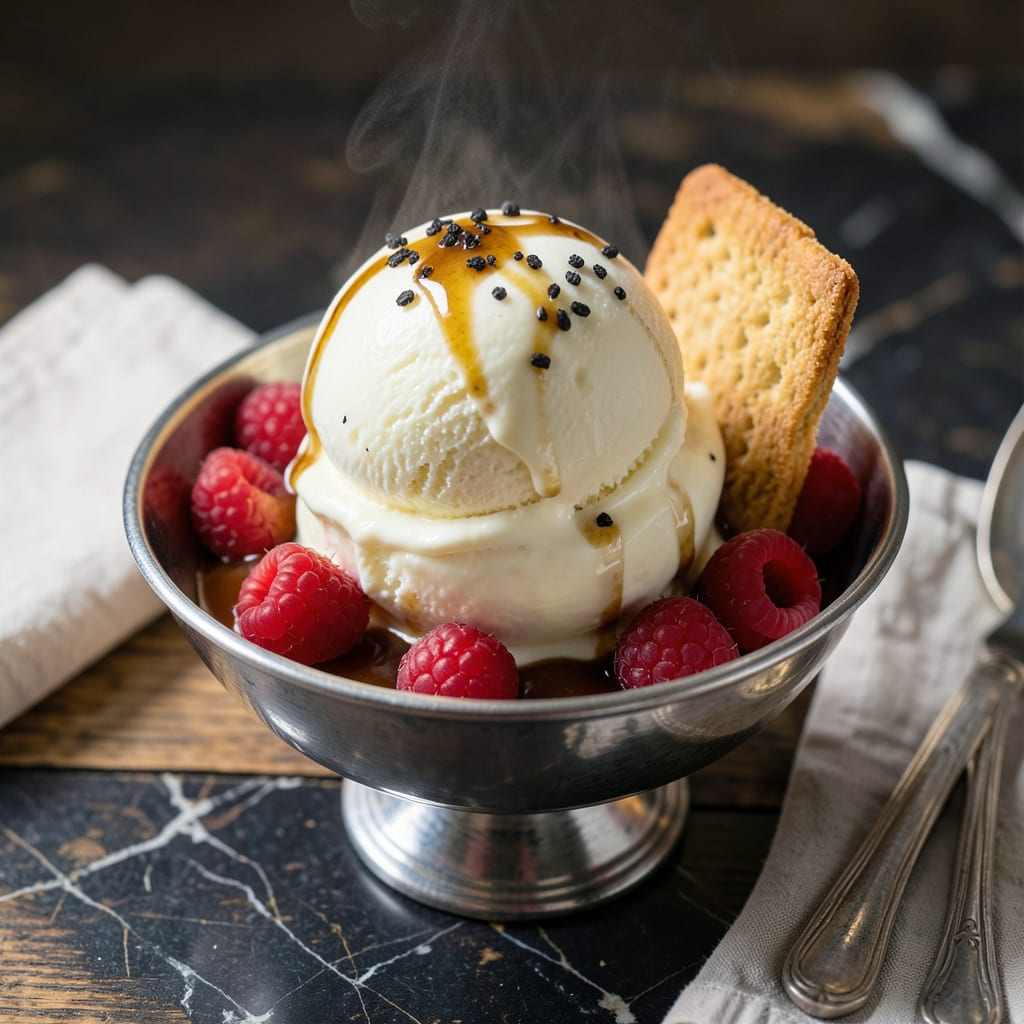
This ice cream delivers a luxurious mouthfeel that commercial brands can’t match. The secret lies in the high butterfat content that creates an unparalleled creaminess with every spoonful.
What sets this creation apart is the careful balance of rich dairy and precise churning. The result is velvety texture with a depth of flavor that lingers beautifully.
Ingredients for High Butterfat Ice Cream
Decadent dairy and precise ratios create that signature velvety texture you cannot replicate.
| Ingredient | Amount | Notes |
|---|---|---|
| Heavy Cream 🥛 | 2 cups | At least 36% butterfat |
| Whole Milk 🥛 | 1 cup | Full-fat for richness |
| Granulated Sugar 🍚 | ¾ cup | Fine white sugar preferred |
| Egg Yolks 🥚 | 6 whole | Large, fresh, room temperature |
| Vanilla Bean 🌿 | 1 whole | Split and scraped |
| Pure Vanilla Extract 💧 | 1 tsp | For enhanced vanilla flavor |
| Unsalted Butter 🧈 | 2 tbsp | High-quality, melted |
| Salt 🧂 | ¼ tsp | Fine sea salt preferred |
| Light Corn Syrup 🧈 | 2 tbsp | Prevents ice crystals |
| Whole Egg 🥚 | 1 whole | Optional, for stability |
The dairy is non-negotiable here. Heavy cream at 36-40% butterfat is essential—anything lower and you lose that luxurious mouthfeel the intro promises. Whole milk (not skim or 2%) balances the richness. For the cream, Organic Valley or local dairy farm sources deliver superior quality. Avoid ultra-pasteurized if possible—it churns differently. The vanilla bean should be plump and moist; Nielsen-Massey is the gold standard for extract.
No vanilla bean? Double the extract (2 tsp) but it won’t have those visual specks. Egg yolks are key for custard base richness—don’t substitute whole eggs entirely. For a lighter version (though not as luxurious), replace 1 cup cream with 1 cup whole milk. The corn syrup can be swapped for honey or glucose syrup at the same ratio, but avoid agave—it’s too thin. Salt is flexible; fleur de sel adds a nice finish if you’re feeling fancy.
The custard base keeps 3 days refrigerated before churning. Once churned, ice cream is best within 1 week but stays good for 2 weeks in an airtight container. Press plastic wrap directly on the surface to prevent ice crystals. Freeze for 4-6 hours before serving for optimal texture.
Why You’ll Love This Recipe
- One Bowl Wonder: I just whisk the yolks, sugar, and vanilla bean together—no fancy equipment, just a bowl and a spoon.
- Velvety Luxury: That heavy cream and whole milk combo gives it a richness that store-bought can’t touch.
- Make Ahead Magic: I churn a double batch on Sunday, and it keeps beautifully for up to a week.
- Budget Friendly Splurge: Honestly, egg yolks and cream are affordable, yet this tastes like a premium treat.
Step-by-Step Instructions for High Butterfat Ice Cream
Master the custard base and freezing technique for professional-quality results at home.
Step 1: Infuse the Dairy with Vanilla
In a heavy saucepan, combine the 2 cups Heavy Cream, 1 cup Whole Milk, and the seeds from the 1 whole Vanilla Bean (along with the pod). Heat over medium heat until the mixture reaches 180°F and small bubbles form at the edges—this is the ideal temperature for infusing flavor without scalding.
Remove from heat, cover, and let steep for 15 minutes to allow the vanilla to fully perfume the dairy. This gentle infusion extracts maximum aromatic compounds from the vanilla bean, ensuring a deep, complex vanilla flavor that synthetic extracts can’t replicate.
Step 2: Temper the Eggs and Create the Custard Base
In a separate bowl, whisk together the 6 whole Egg Yolks, 1 whole Whole Egg, 0.75 cup Granulated Sugar, 0.25 tsp Salt, and 2 tbsp Light Corn Syrup until pale and slightly thickened. The corn syrup here serves a critical function—it lowers the freezing point, preventing ice crystals from forming.
Slowly pour about 1 cup of the hot cream mixture into the egg mixture while whisking constantly—this tempering process prevents the eggs from curdling. Return the tempered egg mixture to the saucepan with the remaining cream and cook over medium-low heat, stirring constantly with a wooden spoon, until the mixture thickens and coats the back of the spoon at 170-175°F.
Step 3: Finish the Custard with Butter and Vanilla Extract
Remove the custard from heat and stir in the 2 tbsp Unsalted Butter and 1 tsp Pure Vanilla Extract. The butter enhances the mouthfeel and richness, while the extract boosts the vanilla profile. Strain the custard through a fine-mesh sieve into a clean bowl to remove the vanilla pod and any cooked egg bits—this ensures a silky-smooth texture.
Press plastic wrap directly onto the surface of the custard to prevent a skin from forming. Chill in the refrigerator for at least 4 hours, preferably overnight. This extended chilling time allows the flavors to meld completely and the custard to reach the optimal temperature for churning.
Step 4: Churn to Perfection
Pour the chilled custard into your ice cream maker and churn according to the manufacturer’s instructions, typically 20-25 minutes. The mixture should resemble soft-serve ice cream when done, with a pale, creamy consistency and no visible liquid remaining.
For the ultra-rich texture promised by this high-butterfat recipe, the custard’s high fat content (from the cream, egg yolks, and butter) creates smaller ice crystals and a denser, more velvety mouthfeel. The 36% butterfat in the heavy cream is non-negotiable for achieving this professional quality.
Step 5: Freeze to Optimal Consistency
Transfer the churned ice cream to a lidded container and freeze for at least 4 hours or until firm. The final texture should be dense and scoopable, with a smooth surface that glistens slightly—a hallmark of high-fat ice cream.
Let the ice cream sit at room temperature for 5-10 minutes before serving to soften slightly. This brief tempering makes scooping easier and enhances the creamy mouthfeel. The result should be a luxurious, slow-melting ice cream with intense vanilla flavor and a texture that lingers pleasantly on the palate.
Pro Tips For Making High Butterfat Ice Cream
- Temper the Yolks: Slowly whisk a ladle of hot cream mixture into the yolks before combining—dump them in too fast and you’ll scramble them. I learned this the hard way with a batch of sweetened egg drop soup.
- Use Full-Fat Dairy: Skip the low-fat milk or light cream; the higher the butterfat in your heavy cream and whole milk, the richer and smoother your ice cream will be. Sounds obvious, but I’ve seen people try to cut corners here.
- Chill Overnight: After churning, let the ice cream set in the freezer for at least 4 hours, but overnight is ideal. It firms up properly and lets the vanilla flavor fully develop—rushing this step gives you soupy, underwhelming results.
- Scrape the Bean: Split the vanilla bean lengthwise and scrape out every last bit of paste with the back of your knife. Those tiny seeds carry most of the flavor, and tossing the pod in while heating infuses even more depth.
Regional Styles of high butterfat ice cream
French Style
In France, this creation leans into crème fraîche instead of heavy cream for a tangy depth. I use 30% fat crème fraîche from Vermont Creamery, which gives a subtle cultured note. The custard base remains rich but with a sophisticated finish. 💫
Italian Gelato
Italian versions focus on lower air incorporation and higher sugar content. I replace 1 cup cream with whole milk and add ¼ cup extra sugar for that dense, elastic texture. Carrara marble churning stones can enhance smoothness.
American Southern
Down south, we often add 1 tbsp bourbon or peach preserves to the custard before churning. The alcohol lowers the freezing point, creating an ultra-creamy result. I recommend Maker’s Mark for its caramel notes. 🔥
British Clotted Cream
For a British twist, swap 1 cup heavy cream with clotted cream (about 55% butterfat). The result is decadently thick with a golden hue. Look for Devon or Cornish clotted cream at specialty grocers.
German Eis
German ice cream often includes egg whites whipped to stiff peaks and folded in post-churn. This lightens the texture while maintaining richness. I add 2 whipped egg whites for a fluffier version.
Mexican Helado
Try infusing the dairy with 1 cinnamon stick and 1 strip of lime zest during heating. The warm spice and citrus brighten the creamy base beautifully. Remove the cinnamon and zest before churning.
Nutrition Facts
Frequently Asked Questions
Why do I need to temper the eggs?
Tempering prevents the eggs from curdling when mixed with hot cream. Slowly adding hot liquid while whisking brings the eggs up to temperature gently. Skipping this can result in scrambled egg bits in your custard.
Can I use a lower-fat cream?
No, 36% butterfat cream is essential for that ultra-rich texture. Lower-fat versions won’t deliver the same velvety mouthfeel. The high fat content creates smaller ice crystals and a denser result.
How long can I store the custard before churning?
The custard keeps in the fridge for up to 3 days. This actually improves flavor as it melts. Press plastic wrap on the surface to prevent a skin from forming.
What if my ice cream turns icy?
This usually means the custard wasn’t chilled enough before churning or the freezer is too cold. Ensure your custard is 40°F or below and churn at 0°F to 5°F.

- 8 Bean Soup Recipe Crock Pot: Hearty Vegetable Medley in One Pot - September 25, 2026
- 4C Bread Crumbs Meatballs Recipe: Crispy Crust and Juicy Centers - September 25, 2026
- 6 Oz Chocolate Chip Cookie Recipe: Perfectly Balanced Crispy Edges and Chewy Hearts - September 25, 2026