
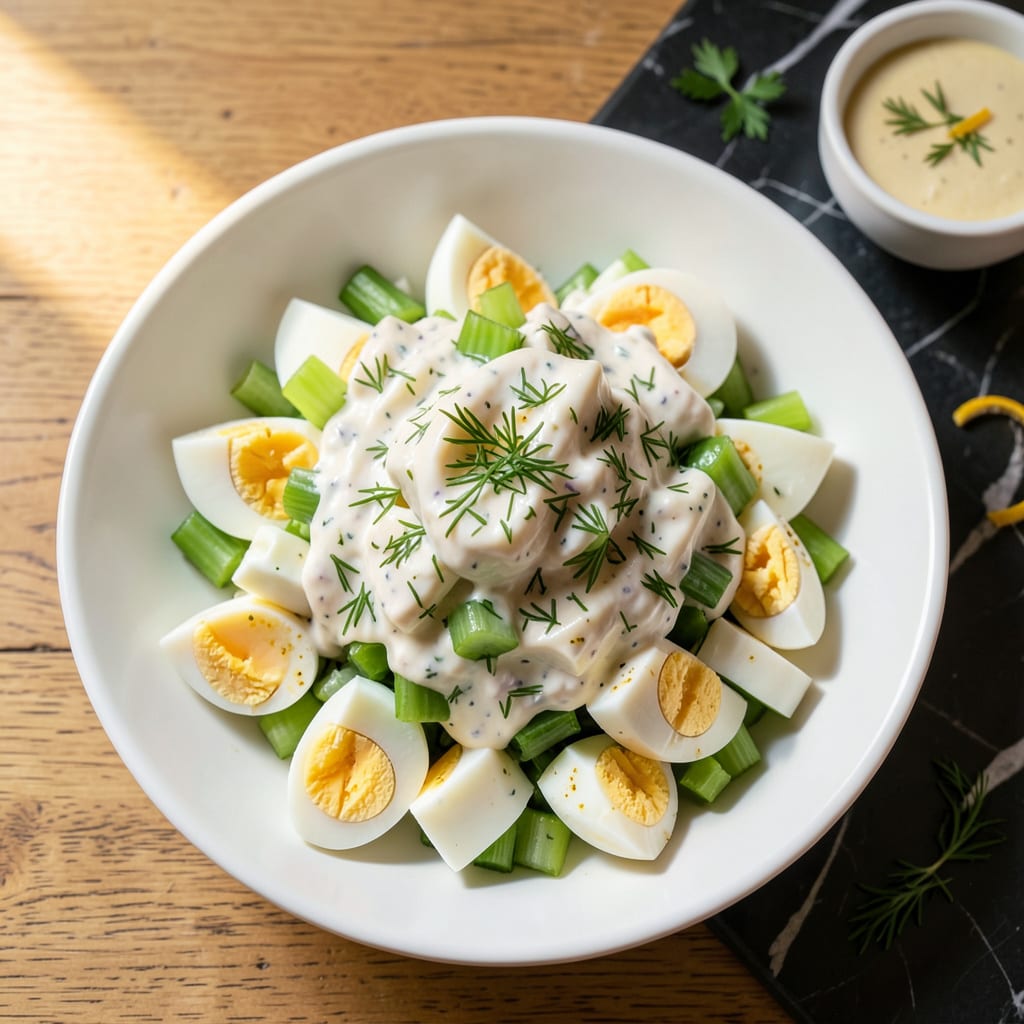
This egg salad delivers all the creamy satisfaction without the guilt, using Greek yogurt as a smart substitute for mayo.
Hard-boiled eggs, fresh herbs, and a touch of mustard create a protein-packed dish that’s light yet flavorful. Perfect for sandwiches or as a topping for greens.
Ingredients for Low Fat Egg Salad Recipe with Greek Yogurt
Hard-boiled eggs and Greek yogurt form the base of this protein-rich dish with fresh herbs.
| Ingredient | Amount | Notes |
|---|---|---|
| Large Eggs 🥚 | 8 whole | Hard-boiled and peeled |
| Plain Greek Yogurt 🥛 | ¾ cup | Non-fat or low-fat preferred |
| Dijon Mustard 🟡 | 1 ½ tbsp | Smooth, not whole grain |
| Fresh Dill 🌿 | 2 tbsp | Finely chopped, stems removed |
| Fresh Chives 🌱 | 2 tbsp | Thinly sliced for garnish |
| Celery 🥬 | ½ cup | Finely diced for crunch |
| Red Onion 🧅 | ¼ cup | Finely minced for mild bite |
| Lemon Juice 🍋 | 1 tbsp | Freshly squeezed for brightness |
| White Wine Vinegar 🍷 | 1 tsp | Adds subtle tang without overpowering |
| Sea Salt 🧂 | ½ tsp | Fine grain for even distribution |
| Black Pepper 🌶️ | ¼ tsp | Freshly ground for best flavor |
| Sweet Paprika 🌶️ | ¼ tsp | Optional, for color and depth |
The Greek yogurt is critical—Fage 2% or Chobani Non-Fat deliver the creamiest texture without excess fat. Eggs should be fresh but not too fresh (older eggs peel more easily). For the best flavor, seek out organic free-range eggs at your local market. The celery and onion provide necessary crunch, so don’t skip the fine dice—it distributes better throughout the salad.
No Greek yogurt? Low-fat sour cream works in a pinch, though the texture will be slightly thicker. Dried dill at one-third the amount can substitute for fresh, but fresh herbs really elevate this. The Dijon mustard is non-negotiable for that sharp tang—regular yellow mustard will taste flat. For extra creaminess, 1 tbsp light mayo can be added without compromising the low-fat promise.
Egg salad keeps 3-4 days in the fridge, but the herbs may wilt slightly. Store in an airtight container with a paper towel to absorb excess moisture. Best served chilled—don’t freeze, as the eggs become rubbery. Perfect for meal prep: make Sunday, enjoy through Wednesday.
Why You’ll Love This Recipe
- 10-Minute Meal: I can hard-boil the eggs while prepping the Greek yogurt and herbs—done before the kettle boils.
- Zesty Without Guilt: The Dijon mustard and fresh dill pack a punch that makes me forget it’s low fat.
- Lunchbox Hero: I pack it for picnics, work lunches, or even a quick dinner on toast—my kids devour it.
- Stretch Your Dollar: A dozen eggs and a tub of yogurt make multiple meals, and leftovers taste even better the next day.
Step-by-Step Instructions for Low Fat Egg Salad
Here’s the method that delivers a creamy texture while keeping it light and protein-rich.
Step 1: Prepare and Chop the Hard-Boiled Eggs
I start by roughly chopping the 8 whole Large Eggs into a large mixing bowl. The goal is uneven pieces for texture—some large chunks and some finely chopped. Don’t overmix here; you want visible egg pieces in the final dish.
Hard-boiled eggs should be completely cooled and peeled before chopping. If they’re still warm, they’ll turn gummy when mixed with the dressing. This step takes about 2 minutes with a sharp chef’s knife.
Step 2: Create the Creamy Base with Yogurt and Mustard
In a separate bowl, I whisk together the 0.75 cup Plain Greek Yogurt and 1.5 tbsp Dijon Mustard until completely smooth. This creates the creamy foundation without the fat of traditional mayonnaise.
The mustard emulsifies with the yogurt, preventing separation. I use the full 1.5 tbsp—it’s essential for that classic egg salad tang. Whisk vigorously for 30 seconds to ensure no lumps remain in the mixture.
Step 3: Incorporate Vegetables and Seasonings
Now I fold in the 0.5 cup Celery, 0.25 cup Red Onion, 2 tbsp Fresh Dill, and 2 tbsp Fresh Chives. The celery adds crunch, while the onion provides a mild bite. Fold gently to maintain the egg texture.
Next, I add the 1 tbsp Lemon Juice, 1 tsp White Wine Vinegar, 0.5 tsp Sea Salt, 0.25 tsp Black Pepper, and 0.25 tsp Sweet Paprika. The vinegar and lemon brighten the flavor, while the paprika adds a subtle depth. Taste and adjust salt if needed.
Step 4: Combine and Chill for Optimal Flavor
Pour the yogurt-mustard mixture over the egg-vegetable combination. Using a silicone spatula, I fold everything together with a light touch. The dressing should coat all ingredients without creating a mushy consistency.
Cover the bowl and refrigerate for at least 30 minutes. This chilling period allows the flavors to meld and the yogurt to thicken slightly. The salad is best served cold, and it will keep in the refrigerator for up to 3 days.
Step 5: Adjust Consistency and Serve
After chilling, I give it a final stir. If the mixture seems too thick, I add a teaspoon of water or lemon juice to reach the desired creaminess. The texture should be rich but not dry.
Serve on whole-grain bread, in lettuce wraps, or with crackers. The final dish should have visible flecks of dill and chives, with a balanced creamy-tangy flavor profile that highlights the eggs without heaviness.
Pro Tips For Making Low Fat Egg Salad Recipe With Greek Yogurt
- Cool Eggs First: Let hard-boiled eggs chill in ice water for 10 minutes before peeling—I learned this the hard way after ruining too many eggs with torn whites. The shock stops the cooking and makes them easier to handle.
- Drain the Yogurt: Place your plain Greek yogurt in a fine-mesh strainer for 15 minutes to remove excess liquid. Sounds tedious, but it keeps your egg salad from turning watery, especially with low-fat versions.
- Skip Overmixing: Fold the yogurt and mustard into the eggs just until combined—overmixing turns it into a mushy paste. I was skeptical until I tried it and saw the difference in texture.
- Chop Herbs Fine: Mince the dill and chives as finely as possible, about 1/16-inch pieces. Larger chunks can overpower a bite, and with fresh herbs, smaller pieces distribute the flavor evenly without the chew.
Essential Equipment for low fat egg salad recipe with greek yogurt
Mixing Bowls
I always use a large stainless steel mixing bowl for the eggs—it provides ample space for folding without spillage. A medium bowl works for whisking the yogurt-mustard base. Look for bowls with non-slip bases to prevent sliding on your countertop. 💡
Cutting Tools
A sharp 8-inch chef’s knife is essential for cleanly chopping the eggs and vegetables. I prefer Wüsthof or Victorinox brands for their durability. Pair it with a cutting board that has a groove to catch any stray pieces.
Whisking Essentials
For the yogurt-mustard mixture, a small wire whisk ensures smooth, lump-free results. I recommend a 9-inch whisk for better control. If you don’t have a whisk, a fork can work, but it takes more effort to achieve the same smoothness.
Folding and Mixing
A silicone spatula is my go-to for gently folding the egg mixture with the dressing. It scrapes the bowl cleanly and prevents overmixing. Look for heat-resistant spatulas, as they’re more durable and won’t stain from acidic ingredients like lemon juice.
Measuring Tools
Accurate measurements matter, so I use a set of stainless steel measuring spoons and cups. A 1-tablespoon measure is perfect for the Dijon mustard, while a ¼-cup measure helps with the Greek yogurt. Avoid plastic measures, as they can warp over time.
Storage Containers
After mixing, transfer the salad to an airtight glass container for chilling. I love Pyrex with snap-on lids—they’re leak-proof and easy to clean. A 3-4 cup container is ideal for this recipe size. ❄️
Nutrition Facts
Frequently Asked Questions
Can I use regular yogurt instead of Greek?
Regular yogurt will work but may make the salad runny. Strain it through a cheesecloth for 10 minutes to thicken. Greek yogurt’s thickness is ideal for binding without extra liquid.
How do I prevent a watery texture?
Pat dry the chopped celery and onion with a paper towel before mixing. Also, let boiled eggs cool completely to avoid releasing excess moisture. Store in an airtight container with a paper towel to absorb any liquid.
What can I add for extra flavor without fat?
Try 1 tsp of capers, a dash of hot sauce, or smoked paprika. Fresh herbs like tarragon or parsley also add depth without extra calories. Avoid high-fat add-ins like cheese or bacon.
How long does this keep in the fridge?
It stays fresh for 3-4 days in an airtight container. The yogurt base can separate slightly over time—just stir before serving. Don’t freeze, as eggs become rubbery.

- 8 Bean Soup Recipe Crock Pot: Hearty Vegetable Medley in One Pot - September 25, 2026
- 4C Bread Crumbs Meatballs Recipe: Crispy Crust and Juicy Centers - September 25, 2026
- 6 Oz Chocolate Chip Cookie Recipe: Perfectly Balanced Crispy Edges and Chewy Hearts - September 25, 2026