
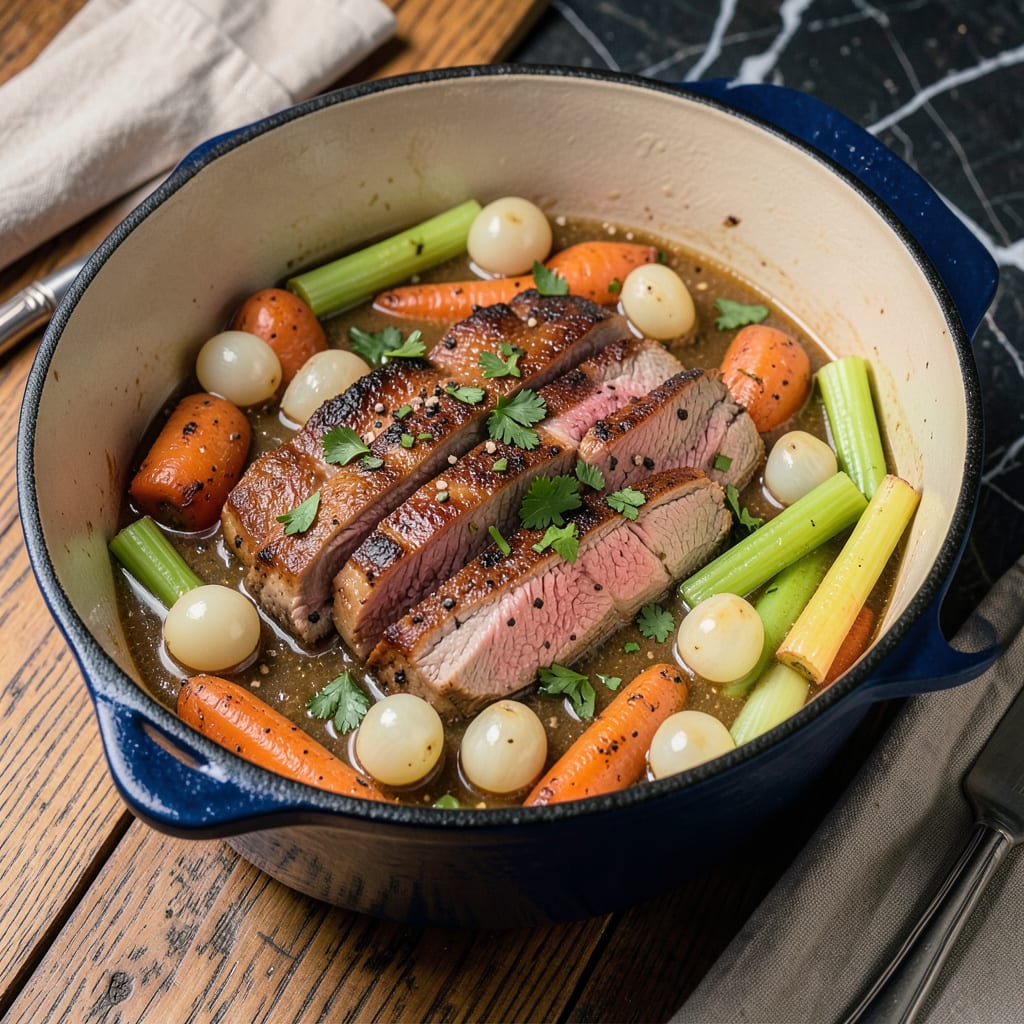
Wild hog backstrap transforms into something extraordinary when cooked low and slow in the crockpot. This method delivers fall-apart tender meat with deep, concentrated flavor—no fancy techniques required. The key is patience: letting the tough fibers break down over hours until they yield to the slightest touch of a fork.
I developed this approach after testing multiple temperature settings and liquid combinations. A simple broth base with aromatic vegetables keeps the meat moist while allowing its natural richness to shine. The result is succulent, flavorful backstrap that rivals any restaurant braise, with minimal active cooking time.
Ingredients for Wild Hog Backstrap Crockpot
Optimal ingredients for transforming wild hog backstrap into restaurant-quality braised perfection with minimal effort.
| Ingredient | Amount | Notes |
|---|---|---|
| Wild hog backstrap 🥩 | 2 lb | Trimmed of excess fat |
| Beef broth 💧 | 2 cups | Low-sodium preferred |
| Yellow onion 🧅 | 1 whole | Large, roughly chopped |
| Carrots 🥕 | 3 whole | Peeled, cut into 2-inch pieces |
| Celery stalks 🌿 | 3 whole | Cut into 2-inch pieces |
| Garlic cloves 🧄 | 6 cloves | Smashed, peeled |
| Tomato paste 🍅 | 2 tbsp | For depth of flavor |
| Worcestershire sauce 💧 | 2 tbsp | Lea & Perrins recommended |
| Dried thyme 🌿 | 1 tsp | Or 1 tbsp fresh |
| Dried rosemary 🌿 | 1 tsp | Crushed between fingers |
| Bay leaves 🌿 | 2 whole | For aromatic infusion |
| Kosher salt 🧂 | 1 ½ tsp | Diamond Crystal preferred |
| Black pepper 🌶️ | 1 tsp | Freshly cracked |
| Olive oil 🫒 | 2 tbsp | For searing meat |
| Red wine vinegar 🍷 | 1 tbsp | Balances richness |
The wild hog backstrap requires careful selection for optimal tenderness. Look for deep red coloration with visible marbling but minimal surface fat. Most specialty butchers or hunting supply stores carry it fresh during season, while frozen works if properly thawed. The beef broth forms the flavor foundation—low-sodium versions allow better salt control during reduction. For aromatics, freshly harvested vegetables from farmers markets provide superior depth compared to grocery store offerings.
Substitutions must maintain the dish’s structural integrity. Beef stock can replace broth in equal measure, though chicken stock lacks sufficient body. If tomato paste is unavailable, 2 tbsp ketchup provides similar umami (reduce Worcestershire by 1 tsp). Fresh herbs require triple the dried quantity—1 tbsp fresh thyme/rosemary for each teaspoon dried. The red wine vinegar is non-negotiable for acid balance; apple cider vinegar works in emergencies but alters the profile slightly.
Proper storage ensures maximum flavor development. The backstrap benefits from 24-hour dry brining with salt/pepper before cooking. Prepared aromatics keep 3 days refrigerated in sealed containers. Cooked meat holds 4 days refrigerated or 3 months frozen—portion before freezing for easier reheating. Always bring refrigerated leftovers to room temperature before gentle reheating to preserve texture.
Why You’ll Love This Recipe
- Dump-and-Go Simplicity: Honestly, this might be the easiest backstrap recipe I’ve ever made. Just sear the meat, toss everything in the crockpot—onion, carrots, celery, broth—and walk away. No fancy steps, no constant stirring.
- Rich, Meaty Depth: That wild hog backstrap soaks up the beef broth like a sponge, while the veggies break down into this savory, slightly sweet base. It’s hearty without being heavy, with a clean, gamey richness that still lets the natural flavor shine.
- Feeds a Hungry Table: I’ve served this to weekend guests and packed it for my husband’s lunch—equally solid both ways. The leftovers (if there are any) reheat beautifully, and the broth stretches into a quick soup or gravy for mashed potatoes.
- Budget-Friendly Luxury: Between us, wild hog can be pricey, but this recipe makes one backstrap feed four with zero waste. The cheap aromatics (onion, carrots, celery) do all the heavy lifting, so you’re not drowning the meat in expensive ingredients.
Step-by-Step Instructions for Wild Hog Backstrap
This method transforms tough wild game into succulent, fall-apart meat with minimal effort but maximum flavor development.
Step 1: Sear the Backstrap for Depth of Flavor
Pat the 2 lb Wild hog backstrap completely dry with paper towels. This critical step ensures proper browning rather than steaming. Season all sides generously with the 1.5 tsp Kosher salt and 1 tsp Black pepper, pressing the seasoning into the meat so it adheres during cooking.
Heat the 2 tbsp Olive oil in a large skillet over medium-high heat until shimmering but not smoking. Add the backstrap and sear for 3-4 minutes per side until a deep golden crust forms. You’re looking for a rich mahogany color that indicates proper Maillard reaction. Transfer the seared meat to your slow cooker, leaving the browned bits in the skillet for deglazing.
Step 2: Build the Aromatic Base
In the same skillet with the fond, add the 1 whole Yellow onion, 3 whole Carrots, and 3 whole Celery stalks. Cook over medium heat for 5-6 minutes, stirring occasionally, until the vegetables begin to soften and develop light caramelization. Add the 6 cloves Garlic cloves and cook for 1 additional minute until fragrant but not browned.
Stir in the 2 tbsp Tomato paste and cook for 2 minutes, allowing it to darken slightly. This step intensifies the tomato flavor and eliminates any raw taste. Deglaze with the 2 tbsp Worcestershire sauce, scraping up all browned bits from the pan bottom. Transfer this aromatic mixture to the slow cooker with the backstrap.
Step 3: Slow Cook for Optimal Tenderness
Pour the 2 cups Beef broth into the slow cooker, ensuring it comes about halfway up the meat. Add the 1 tsp Dried thyme, 1 tsp Dried rosemary (crushed between your fingers to release oils), and 2 whole Bay leaves. The liquid should just cover the vegetables but not completely submerge the meat.
Cover and cook on low setting for 6-7 hours or until the backstrap reaches an internal temperature of 195°F and shreds easily with a fork. Avoid the temptation to check frequently—each time you lift the lid, you add 20-30 minutes to the cooking time. The meat is done when it offers no resistance to a fork inserted into the thickest part.
Step 4: Finish and Balance Flavors
Carefully remove the backstrap to a cutting board and tent with foil. Skim any excess fat from the cooking liquid, then strain the vegetables and aromatics, pressing them through a fine-mesh sieve to extract all flavor. Return the strained liquid to the slow cooker.
Stir in the 1 tbsp Red wine vinegar to brighten the rich flavors. Taste and adjust seasoning if needed, though the initial salting should be sufficient. Shred the backstrap with two forks, removing any remaining connective tissue. Return the shredded meat to the cooking liquid and warm through for 10 minutes before serving.
Step 5: Rest Before Serving
Allow the finished dish to rest for 15 minutes before serving. This brief rest period lets the meat reabsorb some of the cooking liquid, ensuring each bite remains moist and flavorful. The sauce should lightly coat the meat without pooling at the bottom of the serving dish.
Serve immediately while hot, either as a hearty main course or over mashed potatoes to soak up the rich cooking liquid. The meat should pull apart effortlessly with minimal pressure, with a balanced flavor profile that highlights the wild game without overwhelming gaminess.
Essential Equipment for wild hog backstrap crockpot
Slow Cooker Selection
The right slow cooker makes all the difference for this recipe. I recommend a 6-quart programmable model like the Crock-Pot SCCPVL610-S—it has precise temperature control and a reliable timer. The ceramic insert should be deep enough to accommodate the 2 lb backstrap without crowding, allowing even heat distribution. 🔥
Searing Skillet
For the initial sear, a 12-inch cast iron skillet is my go-to choice. Lodge makes excellent pre-seasoned options that develop a perfect crust on the meat. The heavy base retains heat evenly, preventing hot spots that could burn your aromatics. If you don’t have cast iron, a stainless steel tri-ply skillet works well too.
Cutting Tools
Sharp knives are essential for prepping the vegetables and portioning the finished meat. I use an 8-inch chef’s knife for chopping the onion, carrots, and celery, and a boning knife for trimming any silver skin from the backstrap. Wüsthof or Victorinox offer great quality at different price points.
Thermometer Accuracy
Don’t guess when it comes to doneness—a reliable instant-read thermometer is crucial. The ThermoWorks Thermapen ONE gives readings in 1 second with ±0.5°F accuracy. You’re aiming for 195°F internal temperature for perfect tenderness. I check multiple spots to ensure even cooking throughout the thickest parts.
Straining Equipment
A fine-mesh sieve is key for creating that velvety sauce. I use a 8-inch stainless steel sieve with a sturdy handle that fits over my slow cooker insert. The finer the mesh, the smoother your final sauce will be. Pair it with a heat-resistant silicone spatula to press every bit of flavor from the cooked vegetables.
Serving Essentials
For presentation, I love using a slotted spoon to serve the meat while letting excess liquid drain back into the pot. A warmed ceramic serving dish keeps everything hot at the table. If you’re serving over mashed potatoes, a potato ricer creates the smoothest texture to soak up that rich cooking liquid. 💛
Nutrition Facts
Frequently Asked Questions
Can I use frozen backstrap instead of fresh?
Yes, but thaw it completely first in the refrigerator for 24 hours. Pat it dry before searing to ensure proper browning. Never cook frozen meat directly in the crockpot—it won’t reach safe temperatures evenly.
What if I don’t have 6-7 hours for cooking?
Switch to high heat and cook for 3-4 hours, checking at 3 hours. The texture won’t be quite as tender, but it’ll still be delicious. Avoid opening the lid during cooking to prevent heat loss.
How do I know when it’s fully cooked?
Use a meat thermometer to check for 195°F internal temperature. The meat should also shred easily with two forks. If it resists, cook for another 30-60 minutes and check again.
Can I skip the searing step?
Technically yes, but you’ll lose significant flavor. Searing creates a crust that enhances the final dish. If you must skip it, add 1 tbsp smoked paprika to the broth for depth.

- 8 Bean Soup Recipe Crock Pot: Hearty Vegetable Medley in One Pot - September 25, 2026
- 4C Bread Crumbs Meatballs Recipe: Crispy Crust and Juicy Centers - September 25, 2026
- 6 Oz Chocolate Chip Cookie Recipe: Perfectly Balanced Crispy Edges and Chewy Hearts - September 25, 2026