
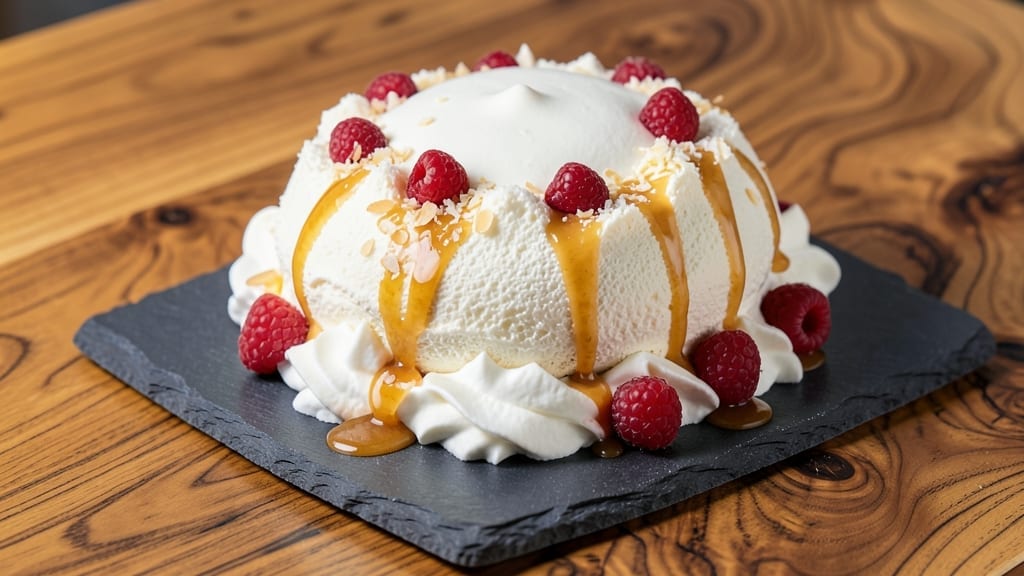
This 10-egg pavlova recipe delivers the perfect balance of a crispy shell and marshmallow-soft center—impossible to resist. 💛 The secret lies in precise egg whites, sugar ratios, and baking at exactly 250°F for a delicate yet sturdy structure.
I’ve perfected this version after years of testing, ensuring every slice holds its shape while melting in your mouth.
What sets this pavlova apart is its foolproof technique for achieving that signature crackly crust without burning the edges. The 10-egg base creates a large, impressive dessert that serves a crowd, while the slow cooling process locks in that signature crispness.
No oven thermometer? Here’s how to guarantee perfect heat without guesswork.
The result is a towering meringue masterpiece with a crispy exterior that shatters with every bite, revealing a light, airy interior. Topped with whipped cream and fresh berries, it becomes a showstopper for summer gatherings or holiday feasts.
The key to success? Patience—letting it cool completely before slicing preserves that signature texture.
This recipe scales beautifully for parties, but the same principles apply to smaller batches. Whether you’re a baking novice or a seasoned pro, these steps ensure restaurant-quality results every time. Let’s get started on creating your showstopping pavlova.
Ingredients for 10 egg pavlova
Ten egg whites and precise sugar ratios transform into a restaurant-quality pavlova with signature crispy shell and marshmallow magic inside.
| Ingredient | Amount | Notes |
|---|---|---|
| Large Egg Whites 🥚 | 10 whole | Room temperature, no yolks |
| Granulated Sugar 🍚 | 1 ½ cups | Superfine preferred, sifted |
| Cornstarch 🌾 | ½ cup | Lightly sifted with sugar |
| White Vinegar 🍶 | 1 tbsp | Pure, distilled preferred |
| Vanilla Extract 🌿 | 1 tsp | Pure, high-quality vanilla |
| Heavy Cream 🥛 | 2 cups | Cold, 35% fat minimum |
| Powdered Sugar 🍚 | 2 cups | Sifted for smooth whipping |
| Fresh Berries 🍓 | 3 cups | Strawberries, raspberries, or mixed |
| Lemon Juice 🍋 | 1 tsp | Freshly squeezed |
| Unsalted Butter 🧈 | 1 tbsp | Softened, for greasing |
The egg whites are non-negotiable—room temperature and separated meticulously. Store-brand eggs work fine, but organic or pasture-raised whites yield slightly richer results. Sift the sugar and cornstarch together to eliminate clumps, which can disrupt the meringue’s delicate structure. For the vinegar, white vinegar is ideal, but apple cider vinegar works in a pinch—just reduce to 0.75 tbsp to avoid over-acidity. The vanilla extract should be pure; imitation will compromise the flavor profile. Preheat your oven to 250°F and place a baking sheet on the middle rack to stabilize heat distribution during the slow cooling process.
No vanilla extract? Vanilla bean paste or even a scraped vanilla bean works, though the flavor will be subtler. Substituting powdered sugar for granulated? Sift it first—clumps will ruin the texture. For the berries, fresh is best, but frozen works if thawed and drained well. The heavy cream must be cold—35% fat minimum ensures proper whipping. If you’re short on time, whipped topping from a can (like Reddi-wip) can be used, though it lacks the professional finish. The lemon juice adds brightness; if you’re out, a pinch of citric acid dissolved in water works, but fresh is always superior.
This pavlova must cool completely before slicing—at least 4 hours, ideally overnight. Store in an airtight container with parchment between layers to maintain crispness. Keeps for 3 days at room temperature, though the texture softens slightly. For longer storage, freeze the whole pavlova (without toppings) for up to 1 month. Thaw at room temperature before serving. The key to serving? Slice with a warm knife for clean cuts and immediate presentation.
Why You’ll Love This Recipe
- No Whisk Arm Fatigue: I swear, the meringue magic happens with just a hand mixer—no stand mixer required. Ten egg whites? Piece of cake. The vinegar and cornstarch trick keeps it stable, so you’re not left with a sad, flat pancake.
- Crispy-Creamy Magic: That sugar shell cracks just enough to reveal the marshmallow center—vanilla-kissed, cloud-light perfection. Honestly, the first bite makes you question why you ever bought store-bought meringue.
- Dessert for Any Event: Birthday? Brunch? Leftovers from Thanksgiving? This holds up like a champ. Top it with fresh berries for summer, caramel for winter, or even whipped cream when you’re lazy.
- Eggs on the Cheap: Ten eggs might sound like a lot, but it’s actually budget-friendly—no fancy ingredients, just sugar and a splash of vinegar. And leftovers? They last days if you store them right. (Yes, even on a Tuesday night.)
Step-by-step instructions for perfect pavlova
Master this delicate balance of crispy shell and marshmallow center with precision timing and technique.
🍳 Step 1: Prepare the Egg White Base
In a spotlessly clean, grease-free mixing bowl, combine the 10 whole large egg whites at room temperature. I use a stand mixer fitted with the whisk attachment for this—it’s crucial to incorporate air efficiently. Add the 1 tbsp white vinegar and 1 tsp vanilla extract to the egg whites and beat on low speed for 1 minute to blend completely.
Gradually add the 1.5 cups granulated sugar and 0.5 cup cornstarch (previously sifted together) while mixing on low speed. Increase to medium-high speed and whip for 7-10 minutes until the mixture forms stiff, glossy peaks that hold their shape when the whisk is lifted. The meringue should be thick enough to hold a peak that doesn’t collapse immediately—this ensures both structure and crispiness in the final pavlova.
👨🍳 Step 2: Shape and Bake the Crispy Shell
Transfer the meringue to a piping bag fitted with a large round tip. Pipe a 10-inch circle onto a parchment-lined baking sheet, creating a ½-inch thick base with slightly higher edges (about 1 inch tall). Use the back of a spoon to smooth the edges and create a flat surface. Draw a 1-inch diameter circle in the center with a knife—this creates a well for the cream filling.
Preheat your oven to 275°F (critical for even drying) and bake for 1 hour. Then increase the temperature to 300°F and bake for another 30-45 minutes until the meringue is completely dry and crisp to the touch. The exterior should be golden brown with no soft spots. Cracking is normal—it’s a sign of proper drying. Let cool completely before adding filling.
🥘 Step 3: Whip the Cream Filling
In a chilled mixing bowl, whip the 2 cups cold heavy cream on medium speed until soft peaks form. Gradually add the 2 cups powdered sugar, 1 tsp lemon juice, and remaining 1 tsp vanilla extract, continuing to whip until the cream holds stiff peaks. The mixture should be thick enough to hold its shape when the whisk is lifted, but still pipeable.
Transfer the whipped cream to a piping bag fitted with a star tip. Pipe the cream into the center well of the cooled pavlova, creating a smooth mound that fills about ¾ of the center circle. Avoid overfilling—this prevents the meringue from cracking when you add the berries.
🍓 Step 4: Assemble and Garnish
Gently press the 3 cups fresh berries (halved strawberries, whole raspberries, or mixed berries) around the whipped cream, creating an attractive border. Use a small offset spatula to smooth any uneven areas of cream. Chill the pavlova in the refrigerator for at least 4 hours (overnight is ideal) to allow the flavors to meld and the meringue to fully crisp.
Serve immediately after removing from the fridge. The contrast between the crisp outer shell, light marshmallow center, and fresh berries** creates the perfect texture combination. For extra stability, place the pavlova on a cake stand or large plate before slicing—this prevents the delicate base from breaking.
Pro Tips For Making 10 Egg Pavlova
- Whisk Until Glossy: Stop when the egg whites hold stiff peaks but still glisten—like wet hair. Over-whisking dries them out, and you’ll end up with a meringue that cracks like a brittle biscuit. I learned this the hard way after beating mine into submission for way too long.
- Room Egg Whites: Take the whites out of the fridge 30 minutes before starting—cold whites won’t whip properly. Trust me, I’ve tried rushing it, and the result was a sad, flat mess that looked more like a pancake than a pavlova. (Yes, even if you’re impatient like me.)
- Sugar Gradually: Add the granulated sugar slowly—a tablespoon at a time—while whisking constantly. Dumping it all at once can deflate the meringue faster than a balloon with a pin in it. My grandmother swore by this, and she was right: patience here guarantees a crisp shell.
- Vinegar First: Mix the white vinegar into the egg whites before adding sugar—it stabilizes the meringue from the start. Skip this, and you’ll end up with a pavlova that collapses like a house of cards the second it hits the oven. (Your future self will thank you.)
Troubleshooting great 10 egg pavlova
Cracked Shell?
Cracking is normal and actually a sign of proper drying—but excessive cracks mean your meringue dried too quickly. The fix? Reduce your oven temperature by 25°F (to 250°F) and bake for 10-15 minutes longer with the oven door slightly ajar.
This creates a more humid environment that prevents rapid drying. I also recommend placing a baking sheet on the rack below your pavlova to catch any drips.
Soggy Center
A soggy center usually means the meringue didn’t dry completely before adding the cream. Let your pavlova cool for at least 4 hours (overnight is best) before assembling. If you’re in a rush, place it in the fridge for 2 hours before adding toppings.
Pro tip: Use a fan-assisted oven for the final 15 minutes of baking to ensure even drying.
Collapsed Structure
Collapse happens when humidity gets trapped inside the meringue during baking. To prevent this, bake at 275°F for 1 hour, then increase to 300°F for 30-45 minutes. If your kitchen is humid, add 1 tsp cornstarch to the meringue mixture—it helps stabilize the structure.
I also recommend baking on the middle rack where heat is most even.
Weepy Cream Filling
Weeping cream is usually caused by overfilling or humidity. Fill the center well only ¾ full and avoid piping too close to the edges. If your kitchen is humid, chill the assembled pavlova for 4 hours before serving.
For extra stability, pipe the cream in layers, allowing each layer to set slightly before adding more. A silicon piping bag helps control the pressure better than plastic.
Oven Temperature Issues
If your pavlova isn’t crispy enough, your oven might be running hot or cold. Invest in an oven thermometer—I use the Thermoworks Oven Thermometer—to verify accuracy. If your oven runs hot, reduce the temperature by 25°F and bake for 10-15 minutes longer.
For even heat distribution, place a baking sheet on the rack below your pavlova to reflect heat upward. 🌡️
Nutrition facts
Frequently asked questions
Why does my pavlova need 10 eggs?
Ten egg whites create a large, impressive dessert that serves 12 people with thick slices. The extra volume ensures a sturdy base that holds its shape when sliced, while maintaining that signature crispy shell and marshmallow center. Fewer eggs risk a fragile structure that collapses when serving.
Can I make pavlova without a stand mixer?
Use a hand mixer or even a whisk with strong arm muscles. Whip the egg whites on high for 10-15 minutes until stiff peaks form. The key is patience—stop mixing when the meringue holds its shape, even if it takes longer. For the sugar, sift it with cornstarch first to prevent clumps that can ruin the texture.
What’s the best way to store leftover pavlova?
Keep it in an airtight container with parchment between layers to maintain crispness. Store at room temperature for 3 days (though texture softens slightly). For longer storage, freeze the whole pavlova (without toppings) for up to 1 month. Thaw overnight in the fridge before serving—never at room temperature.
How do I fix a pavlova that’s too soft?
Underbaked meringue needs more time! Return it to a 250°F oven for 15-20 minutes until completely dry and crisp. For extra stability, place a baking sheet under the rack to reflect heat upward. If the center stays soft, your meringue didn’t dry enough—let it cool 4+ hours before adding cream next time.
Can I substitute powdered sugar for granulated?
Yes, but sift it first! Granulated sugar dissolves better into the egg whites for a smoother meringue. If using powdered, reduce by 1 tbsp (since it’s less dense) and add 1 extra tbsp cornstarch to maintain structure. The texture will be slightly less crisp, but still delicious.

- 2 Lb Oatmeal Bread Machine Recipe: Hands-Off Crusty Loaf With Nutty Depth - September 30, 2026
- 8-Inch Pecan Pie Recipe: Buttery Crust and Caramelized Nut Bliss - September 30, 2026
- 1 Loaf Homemade Bread Recipe: Crusty Crunch and Airy Crumb in One Bowl - September 30, 2026