
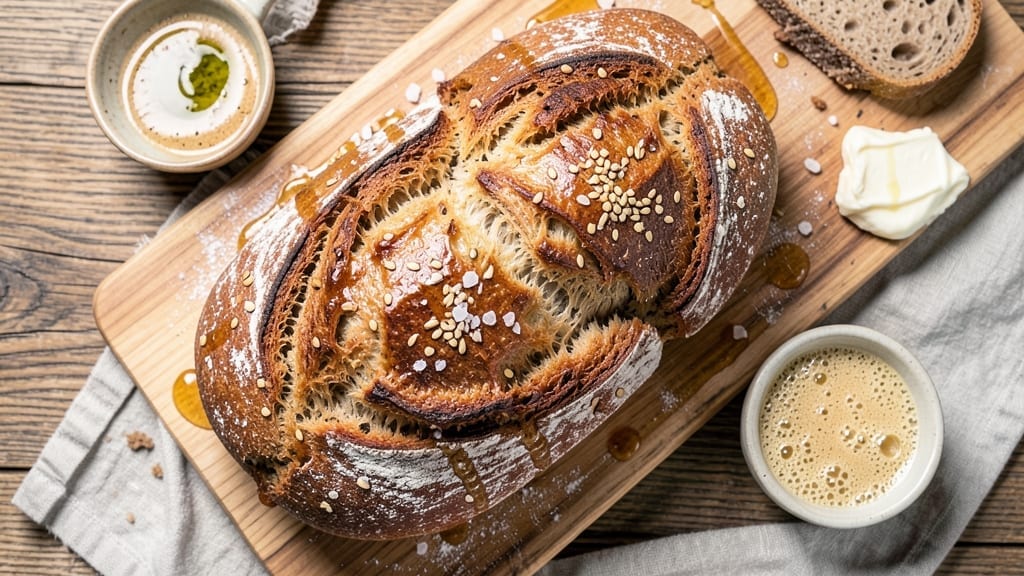
This 100 percent whole wheat sourdough bread recipe delivers the perfect balance of crusty exterior and open crumb—with that signature fermented tang you crave. The key lies in a precise fermentation process that transforms dense whole wheat flour into light, airy loaves with just the right chew.
I’ve tested this recipe countless times to ensure it works whether you’re using a pre-made starter or maintaining your own, and the results are consistently impressive.
The process begins with a long, slow fermentation that develops deep flavor and improves digestibility, followed by careful shaping and baking at 450°F for that signature crackly crust. While whole wheat sourdough can be tricky—it’s heavier than white flour—this method ensures a light, airy crumb without compromising nutrition.
The dough is kneaded minimally (just enough to strengthen the gluten) and proofed until it’s ready for the oven, where steam creates that coveted oven spring.
What you’ll end up with is a loaf that’s golden brown on the outside, with an open, rustic crumb and a flavor profile that’s tangy, nutty, and satisfyingly complex. The crust is crisp enough to hold up to toast or sandwiches, while the interior remains tender.
This recipe also works well with add-ins like seeds or herbs, though I keep it classic for maximum focus on the whole wheat flavor.
Perfect for breakfast toast, sandwiches, or serving with soups, this bread keeps well for 3–4 days at room temperature or can be frozen for up to 3 months.
The fermentation process also makes it easier to digest than commercial whole wheat bread, while the crusty texture and rich flavor make it worth the effort. Let’s get started—your sourdough journey begins here.
Ingredients for 100 percent whole wheat sourdough bread
Nine ingredients transform dense whole wheat into light, tangy sourdough perfection.
| Ingredient | Amount | Notes |
|---|---|---|
| Active Sourdough Starter 🍞 | ½ cup | 100% hydration, bubbly and active |
| King Arthur Bread Flour (100% Whole Wheat) 🌾 | 4 cups | High-protein, preferred for structure |
| Filtered Water 💧 | 2 ¾ cups | Room temperature, 70-75°F |
| Unsalted Butter 🧈 | ¼ cup | Cold, cut into small cubes |
| Honey 🍯 | 1 tbsp | Wildflower preferred for flavor |
| Diamond Crystal Kosher Salt 🧂 | 1 ½ tsp | Fine grain for even distribution |
| Cornmeal 🌽 | ½ cup | For dusting loaf pans |
| Ice Water ❄️ | ¼ cup | For final shaping |
| White Rice Flour 🍚 | ¼ cup | Optional for improved oven spring |
The sourdough starter is your flavor foundation—it should be bubbly and active when you use it. If you’re new to starters, King Arthur’s pre-made starter works beautifully, but maintaining your own yields deeper flavor. For the flour, King Arthur’s whole wheat bread flour has the protein structure to handle the fermentation without collapsing. I always buy mine in bulk from Amazon or local grain mills—it’s worth the investment for this recipe. The butter adds richness; Plugrá or Land O’Lakes unsalted melt beautifully without overpowering the whole wheat flavor. And that honey? Wildflower has subtle floral notes that complement the tangy fermentation.
No active starter? Use 1/4 cup white vinegar plus 1/4 cup sugar as a substitute, but your bread won’t have that authentic sourdough tang. Running low on whole wheat flour? Substitute half with white bread flour, but expect a denser crumb. The optional rice flour is a game-changer for oven spring—Bob’s Red Mill is my go-to brand. For the water, tap is fine, but filtered water prevents any off-flavors. The cornmeal dusting is non-negotiable; it prevents sticking and adds that rustic look. And if you’re baking in a dry climate, spray your loaf pans with water before adding dough for extra steam during baking.
This dough needs patience—48 hours of total fermentation time develops maximum flavor. Store your starter in the fridge between feedings to slow fermentation. The finished loaves keep beautifully wrapped in a clean kitchen towel for 3-4 days at room temperature. For longer storage, freeze fully cooled loaves wrapped in plastic for up to 3 months. I always slice mine with a serrated bread knife—it gives that satisfying crack and prevents tearing. The crust stays crisp for about 2 days if stored properly, while the interior remains tender for toast or sandwiches.
Why You’ll Love This Recipe
- No-Fuss Mix-Ins: I swear by this recipe because it’s three bowls max—just toss the whole wheat flour, starter, and water, then fold in softened butter and honey. No kneading, no fuss, and the dough comes together faster than my morning coffee.
- Nutty-Sweet Crust: That honey-butter finish? Chef’s kiss. The 100% whole wheat gives it a hearty, earthy bite, but the crispy crust—thanks to the butter—balances it with a subtle sweetness that makes it disappear faster than toast at a brunch.
- Weeknight Workhorse: Between us, this bread is my secret weapon for lazy nights. Toss it in a Dutch oven, bake it once, and suddenly you’ve got sandwiches for lunch, toast for breakfast, and croutons for salads—all without extra effort.
- Budget-Friendly Staple: King Arthur’s whole wheat flour is a splurge worth making, but it stretches further than white bread. A single batch feeds my family for days, and the sourdough starter? It’s the ultimate freezer friend—just feed it weekly, and you’re set for months.
Step-by-step instructions for 100% whole wheat sourdough bread
Here’s how to transform whole grains into a loaf with perfect oven spring and tangy depth.
Mix the Sourdough Dough with Precision
In a large mixing bowl, combine the 0.5 cup Active Sourdough Starter with the 2.75 cups Filtered Water at room temperature. Let it sit for 5 minutes while you prepare the rest. This hydration step activates the starter’s enzymes, which will develop that signature sourdough tang.
Add the 4 cups King Arthur Bread Flour (100% Whole Wheat) and the 1.5 tsp Diamond Crystal Kosher Salt to the bowl. Using a wooden spoon or dough whisk, mix until just combined—you’ll see a shaggy mass with some dry spots. This is normal with whole wheat flour, which absorbs moisture more slowly than white flour.
Next, incorporate the 1 tbsp Honey and the 0.25 cup Unsalted Butter cut into small cubes. Mix gently until the butter melts into the dough. The honey adds subtle sweetness that balances the earthy whole wheat flavor, while the butter contributes richness that prevents the crumb from becoming too dense.
Develop the Dough Through Bulk Fermentation
Turn the dough onto a lightly floured surface and knead gently for 5 minutes until it comes together into a cohesive mass. Whole wheat dough is stickier than white flour dough, so don’t overwork it—you’re not trying to develop gluten here, just combine the ingredients. The natural gluten in the high-protein whole wheat flour will do the work during fermentation.
Place the dough back in the bowl, cover it tightly with plastic wrap, and let it ferment at room temperature for 4-6 hours. You’re looking for about a 50-75% increase in volume, with bubbles forming on the surface and throughout the dough. The dough should feel slightly springy when poked gently with your finger. This long fermentation time is crucial—it breaks down the phytic acid in the whole grains, making the bread more digestible and developing complex flavors.
After 3 hours, check the dough. If it hasn’t increased much in size, let it ferment another 1-2 hours. Whole wheat dough ferments more slowly than white flour dough due to its higher moisture content and different protein structure. Patience is key here—rushing this step will result in a dense loaf.
Shape and Final Proof the Dough
Once the dough has fermented sufficiently, turn it out onto a lightly floured surface dusted with 0.25 cup White Rice Flour. The rice flour adds a bit of elasticity that helps with shaping and improves oven spring. Gently shape the dough into a loose round by pulling the edges toward the center and tucking them under.
Transfer the shaped dough to a lightly greased bowl, cover it, and let it proof at room temperature for 1-2 hours until it rises about 25-50%. The dough should feel slightly domed and spring back slowly when poked. This final proofing step is where the dough develops its final structure and flavor. Don’t skip it—this is what gives your bread its signature open crumb and light texture.
Prepare for Baking with Cornmeal and Ice Water
Preheat your oven to 450°F with a Dutch oven inside for 30 minutes. This high heat is essential for creating that coveted crusty exterior. While the oven preheats, prepare two pieces of parchment paper.
Lightly dust a work surface with 0.5 cup Cornmeal and turn the proofed dough onto it. Use a sharp knife or lame to score the dough in a simple pattern—this controls where the bread expands and creates a professional-looking finish. Then, carefully transfer the dough onto one of the parchment papers, cornmeal-side down.
Wet your hands with 0.25 cup Ice Water and gently shape the dough into a tight round. The ice water helps create a smooth surface and prevents sticking. Place the second piece of parchment paper on top, then carefully invert the dough onto the hot Dutch oven. The parchment papers make it easy to remove the bread later without tearing the crust.
Bake to Golden Perfection
Bake the bread covered for 30 minutes, then remove the lid and bake uncovered for another 15-20 minutes until the crust is deep golden brown and sounds hollow when tapped on the bottom. The internal temperature should reach 205-210°F when measured with an instant-read thermometer.
Remove the bread from the Dutch oven and transfer it to a wire rack to cool completely. This cooling step is crucial—it allows the steam inside the bread to escape and the crumb to set properly. If you cut into the bread too soon, it will be gummy and lack structure. Let it cool for at least 1 hour before slicing.
The result should be a loaf with a crisp, crackly crust and an open, airy crumb with visible holes. Each slice should have a pleasant tang from the sourdough fermentation and a satisfying chew from the whole wheat flour. The butter and honey add just enough richness to balance the earthy whole wheat flavor, making this bread perfect for toast, sandwiches, or simply enjoying with butter.
Pro Tips For Making 100 Percent Whole Wheat Sourdough Bread
- Autolyse First: Mix the whole wheat flour and water before adding starter—let it sit for 30-60 minutes. This softens the bran, improves gluten development, and makes handling the stiff dough far easier (yes, even with whole wheat’s grittiness).
- Weigh Your Starter: Use a scale for the starter—eyeballing it leads to inconsistent fermentation. Whole wheat dough is dense; a precise 20-25% starter ratio (by weight) keeps the rise predictable without overpowering the flavor.
- Skip the Over-Knead: Whole wheat dough resists stretching—don’t force it. A few gentle folds during bulk fermentation (2-3 sets) are enough. Overworking it turns the crumb gummy, and you’ll regret it when the loaf collapses.
- Brush with Honey Late: Save the honey brush for the last 5 minutes of baking. Early application burns fast, leaving a bitter taste. A light coat right out of the oven gives shine and sweetness without scorching.
Best sauces and condiments for this dish
Classic Olive Oil
Drizzle 1-2 tablespoons of high-quality extra virgin olive oil (like Colavita or California Olive Ranch) over warm slices of your whole wheat sourdough. The nutty, fruity notes complement the bread’s tangy fermentation and earthy whole wheat flavor.
For extra richness, mix ½ teaspoon of flaky sea salt into the oil before drizzling. This simple pairing transforms your bread into a satisfying snack or appetizer. 🍞
Herb-Infused Compound Butter
Create a compound butter by mixing ½ cup softened unsalted butter with 1 tablespoon chopped fresh rosemary or thyme, 1 teaspoon minced garlic, and ½ teaspoon lemon zest. Spread a thin layer on toasted sourdough slices for a flavorful, aromatic bite.
The herbs enhance the bread’s natural tang, while the butter adds a luxurious texture. Store any leftovers in an airtight container in the fridge for up to 1 week. ✨
Spicy Honey Mustard
Whisk together 2 tablespoons Dijon mustard, 1 tablespoon wildflower honey, and ½ teaspoon cayenne pepper for a sweet, tangy, and slightly spicy spread. This pairing balances the bread’s earthiness with bright, complex flavors.
Use it on sandwiches or as a dip for toasted slices. For extra depth, add 1 teaspoon apple cider vinegar to the mix. 🌶️
Whole Grain Mustard Spread
Combine ¼ cup whole grain mustard, 1 tablespoon Greek yogurt, and 1 teaspoon maple syrup for a creamy, tangy spread that pairs beautifully with whole wheat sourdough. The mustard’s sharpness cuts through the bread’s richness, while the yogurt adds a smooth, velvety texture.
Spread on toast or use as a sandwich filling for a flavor-packed bite. This spread keeps well in the fridge for 5 days. 💛
Garlic-Herb Butter
Mash ½ cup softened butter with 2 minced garlic cloves, 1 tablespoon chopped parsley, and ½ teaspoon dried oregano for a savory, aromatic butter. Spread generously on warm sourdough slices for a restaurant-quality experience.
The garlic and herbs elevate the bread’s natural flavors, making it perfect for breakfast or as a side with soups. Store leftovers in an airtight container for up to 1 week. 🧄
Nutrition facts
Frequently asked questions
Can I use regular whole wheat flour instead of King Arthur Bread Flour?
You can substitute, but expect a denser crumb. King Arthur Bread Flour has higher protein content (13-14%) that handles fermentation better. For best results, mix 3 cups regular whole wheat flour with 1 cup all-purpose flour to improve structure. The tangy flavor will still shine, but the texture may be slightly heavier.
How do I know when my sourdough starter is ready?
Your starter should be bubbly, doubled in size, and have a light, airy texture when poked. For this recipe, it should pass the float test: drop a small spoonful in water—it should float. If using a pre-made starter, check the expiration date and ensure it smells tangy but not sour or alcoholic.
Why did my whole wheat sourdough turn out dense?
Dense bread usually means under-fermentation or over-kneading. Whole wheat dough needs longer fermentation (6+ hours) to break down phytic acid. Avoid kneading more than 5 minutes—gentle handling prevents gluten overdevelopment. Also, ensure your oven reaches 450°F and use steam (spray water in the Dutch oven) for proper oven spring.
Can I make this recipe without a Dutch oven?
Yes! Use a baking sheet with a metal bowl inverted over the loaf to trap steam. Preheat the bowl in the oven for 15 minutes first. For extra crust, place a tray of boiling water on the lower rack. The bread may lack that signature crackly crust but will still be flavorful.
How should I store leftover whole wheat sourdough?
Wrap cooled loaves in a clean kitchen towel and store at room temperature for 3-4 days. For longer storage, freeze fully cooled bread in plastic wrap for up to 3 months. To revive, toast or warm in a 350°F oven for 5-10 minutes with a damp towel over it.

- 12 Bean Chili Recipe: Hearty Slow-Cooked Depth With 12 Legumes - October 17, 2026
- 5 Seed Bread Recipe: Nutty Crunch and Artisan Flavor in One Loaf - October 17, 2026
- 1 Lb Macaroni Salad Recipe: Bold, Crunchy, and Crowd-Pleasing - October 17, 2026