
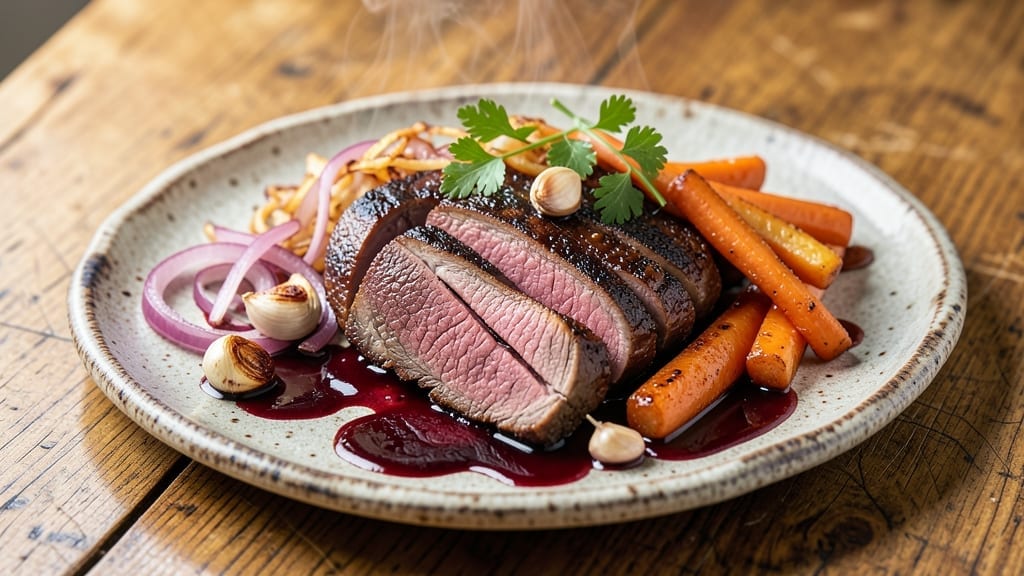
A 2-pound boneless chuck roast transforms into melt-in-your-mouth perfection when slow-cooked with rich umami flavors—this recipe delivers restaurant-quality results at home. The secret lies in searing the meat first to lock in juices, then braising it low and slow until tender enough to fall apart.
I’ve perfected this method over years of testing, ensuring every bite stays succulent while developing deep, savory notes from the slow cooking process.
This approach works beautifully for weeknight dinners or meal prep, requiring just 3 hours of active time (plus hands-off cooking) and minimal effort. The technique combines classic French braising with modern convenience—no fancy equipment needed, just a heavy pot or slow cooker.
A simple blend of garlic, herbs, and red wine creates the flavor base, while onions and carrots add natural sweetness that balances the meat’s richness.
By the end, you’ll have fork-tender beef with a caramelized exterior and a sauce so flavorful it deserves its own bowl. The dish pairs perfectly with mashed potatoes, crusty bread, or roasted vegetables, making it versatile enough for any meal.
Whether you’re feeding a family or planning leftovers, this recipe delivers maximum flavor with minimal fuss.
Pro tip: Let the roast rest for 10 minutes after cooking—this ensures juices redistribute for the most tender slices. The slow-cooked method also makes it forgiving for beginners, as the long cooking time corrects any initial searing inconsistencies. Ready to master this crowd-pleaser?
Ingredients for 2 lb boneless chuck roast
Restaurant-quality beef starts with these carefully chosen ingredients for melt-in-your-mouth chuck roast perfection.
| Ingredient | Amount | Notes |
|---|---|---|
| Boneless Chuck Roast 🥩 | 2 lb | Look for good marbling and even thickness |
| Yellow Onion 🧅 | 1 whole | Cut into 1-inch chunks for even cooking |
| Carrots 🥕 | 4 medium | Peeled and cut into 2-inch pieces |
| Garlic Cloves 🧄 | 6 cloves | Smashed for deeper flavor infusion |
| Dry Red Wine 🍷 | 1 cup | Bold variety like Cabernet Sauvignon |
| Beef Broth 💧 | 2 cups | Low-sodium preferred for flavor control |
| Fresh Thyme 🌿 | 2 sprigs | Or 1 tsp dried thyme if fresh unavailable |
| Fresh Rosemary 🌿 | 1 sprig | Woody stems removed for cooking |
| Olive Oil 🫒 | 2 tbsp | Extra-virgin for searing and richness |
| All-Purpose Flour 🌾 | 1 tbsp | For dusting roast before searing |
| Salt 🧂 | 1 ½ tsp | Diamond Crystal kosher preferred |
| Ground Black Pepper 🌶️ | 1 tsp | Freshly ground for optimal flavor |
| Tomato Paste 🍅 | 1 tbsp | For depth of flavor and color |
The chuck roast is non-negotiable here—look for cuts with good marbling at Whole Foods or local butchers for superior texture. Pre-cut chuck roasts save time, but a whole roast lets you trim excess fat for a leaner result. The onions and carrots should be firm with no soft spots—organic produce from the grocery store’s fresh section works best. For the wine, Cabernet Sauvignon or Merlot add the perfect bold backbone, while Trader Joe’s or Costco offer great value for quality reds. Fresh herbs elevate the dish, so buy thyme and rosemary from the grocery’s fresh herb section—they hold up better than dried for this recipe.
No red wine? Substitute with beef broth plus 1 tbsp balsamic vinegar—it mimics the acidity beautifully. Fresh thyme unavailable? Use one-third the amount of dried thyme, but toast it first in a dry pan for 30 seconds to wake up the flavor. The tomato paste can be skipped if you’re sensitive to acidity, but it adds that restaurant-quality depth that takes this dish to the next level. For the olive oil, avoid the cheap stuff—look for extra-virgin with a peppery finish that stands up to the rich beef flavors. The carrots can be swapped for parsnips if you prefer a nuttier taste, though they’ll take slightly longer to cook.
This dish tastes even better the next day as the flavors meld together. Store leftovers in an airtight container in the fridge for up to 5 days, or freeze portions for 3 months. For meal prep, divide into individual containers—each portion reheats beautifully with a splash of broth. The sauce thickens as it cools, so add a splash of water or broth when reheating if it becomes too concentrated. The roast itself keeps well in the fridge for 3-4 days before the texture starts to degrade, making this an ideal recipe for busy weeks.
Why You’ll Love This Recipe
- One-Pot Magic: I swear by this for nights when I’d rather not scrub three pans. Toss the roast, onions, carrots, and garlic in a deep skillet with the wine, add some broth, and let it simmer. By the time the house smells like a French bistro, I’ve done less cleanup than a takeout bag.
- Wine-Infused Richness: That splash of dry red wine doesn’t just add flavor—it transforms the dish. The roast gets this deep, savory depth while the carrots caramelize into sweet, melt-in-your-mouth perfection. Honestly, I’ve made this blindfolded and still knew it was a winner.
- Leftovers That Don’t Suck: Between us, most slow-cooked roasts turn into sad, dry bricks by day three. Not this one. The wine keeps it juicy, and the tender meat falls apart with a fork—perfect for wraps, salads, or just reheating with a splash of broth. (Yes, even on a Tuesday night.)
- Budget Feast for Four: A 2 lb roast stretches to feed four with sides, or two with extra carbs, and costs half what you’d pay for takeout. The onions and carrots bulk it up, so you’re not just paying for meat—you’re getting a full meal that still feels special. My college self would’ve cried.
Step-by-step instructions for slow-cooked chuck roast
Transform a simple chuck roast into melt-in-your-mouth perfection through precise technique and patience.
Sear the Roast for Maximum Flavor
Pat the 2 lb boneless chuck roast completely dry with paper towels—this ensures a perfect crust. Heat 2 tbsp olive oil in a Dutch oven over medium-high heat until shimmering. Add the roast and sear on all sides for 4-5 minutes per side until deeply browned. I press down gently on the roast during the first minute to prevent curling and ensure even contact with the pan.
While the roast sears, prepare the vegetables: Cut the 1 whole yellow onion into 1-inch chunks and peel the 4 medium carrots, cutting them into 2-inch pieces. Add these to the Dutch oven along with the 6 smashed garlic cloves, 1 tbsp tomato paste, and 1 tbsp all-purpose flour. Stir to coat everything in the browned fond at the bottom of the pot—this creates the flavor base for your sauce.
Deglaze and Build the Base
Pour in the 1 cup dry red wine, scraping up all the browned bits from the bottom of the pot with a wooden spoon. This deglazing step captures all the concentrated meaty flavor that would otherwise burn. Let the wine simmer for 3-4 minutes until reduced by half, then add the 2 cups beef broth, 2 sprigs fresh thyme, and 1 sprig fresh rosemary. Bring to a gentle boil, then reduce heat to low and cover partially.
Here’s the thing—chuck roast benefits from slow cooking, but it needs to stay submerged in liquid. If the roast floats above the liquid, weigh it down with a small plate or lid. The goal is to cook it at 325°F for 3-4 hours until fork-tender. This low-and-slow approach breaks down the connective tissue, resulting in incredibly tender meat.
Season and Finish the Cook
After 2 hours, check the internal temperature with a meat thermometer. It should read 190-195°F—this is when the collagen fully converts to gelatin, creating that velvety texture. If not there yet, continue cooking. When ready, remove the roast and let it rest on a cutting board for 15 minutes, tented loosely with foil. This resting period allows the juices to redistribute.
While the roast rests, skim any excess fat from the cooking liquid and season it with 1.5 tsp salt and 1 tsp ground black pepper. If the sauce is too thin, simmer it uncovered for 5-10 minutes to reduce slightly. The sauce should coat the back of a spoon—this ensures each bite of roast is coated in rich, flavorful liquid.
Slice and Serve with Confidence
Slice the roast against the grain into ¼-inch thick pieces. The grain direction will be visible as you cut—you want to cut perpendicular to these lines for maximum tenderness. Serve the sliced roast over the reduced sauce, garnished with fresh thyme leaves if desired.
Each bite should deliver a perfect balance of tender meat, deep umami flavor from the wine and tomato paste, and aromatic herbs. The sauce should cling beautifully to the meat, creating a harmonious combination of textures and flavors. This method guarantees restaurant-quality results at home with minimal effort.
Pro Tips For Making 2 Lb Boneless Chuck Roast
- Sear Before Braising: Cut the chuck into 1.5-inch chunks—yes, even if it’s boneless—and sear them in batches for 3-4 minutes per side in a hot pan with 1 tablespoon of oil. I used to skip this for speed, but the Maillard reaction from the crust makes the wine-based sauce cling to the meat like it’s supposed to.
- Slice Carrots Lengthwise: Toss those carrots into the pot whole, but cut them in half lengthwise first. They’ll soften faster and release their sweetness into the wine, which actually changes the flavor profile. My grandmother swore by this, and she was right: the dish tastes richer when the carrots break down evenly.
- Deglaze with Wine First: After searing the onions and garlic, pour in the full glass of red wine before adding any liquid. Let it bubble for 2 minutes to cook off the alcohol—this concentrates the flavor and prevents a boozy aftertaste. I learned this the hard way after a dinner where the wine just sat there, untouched by heat.
- Check Internal Temp Early: Pull the meat at 190°F—yes, even though it’ll keep cooking in the liquid. Chuck roast is forgiving, but if you wait until 203°F, it’ll turn to mush. A meat thermometer is non-negotiable here, and I’ve ruined a batch by eyeballing it. Trust the numbers.
Regional styles of these flavors
French Classic Braise
In France, this dish is known as bœuf bourguignon when made with red wine, but the technique translates perfectly to chuck roast. The key difference is using dry red wine (like Cabernet Sauvignon) instead of the traditional Burgundy, which adds boldness.
French chefs often include mushrooms (like cremini or button) for earthiness—add 8 oz sliced mushrooms with the onions and carrots. Serve with crusty baguette to soak up the sauce. 🍷
Texas-Style Smoked Roast
Texans take this dish to the next level by smoking the chuck roast instead of braising. Use a Traeger or Weber Smoker set to 225°F and add hickory or oak chips for a deep, smoky flavor.
Wrap the roast in butcher paper after 2 hours and continue smoking until it reaches 195°F internal temperature. Finish with a sprinkle of smoked paprika and serve with cornbread for a true Southern experience. 🔥
Italian Osso Buco Style
For an Italian twist, pound the roast lightly to even thickness and sear until deeply browned. Instead of wine, use 2 cups beef broth with 1 cup whole milk and 1 tbsp tomato paste for a creamy, velvety sauce.
Add 1 sprig fresh sage and 1 bay leaf to the cooking liquid. Serve with risotto or polenta to soak up the rich sauce. The milk adds a luxurious texture that feels distinctly Italian. 🌿
Mexican-Style Carnitas
Turn your chuck roast into carnitas by cooking it until fork-tender, then shredding it. Add 1 tbsp ground cumin, 1 tbsp smoked paprika, and 1 tsp oregano to the cooking liquid.
Once the roast is done, shred it and crisp it in a skillet with 1 tbsp lard or vegetable oil over medium-high heat for 3-4 minutes. Serve in tortillas with avocado, lime, and cilantro for a flavor-packed twist. 🌶️
German Rouladen Adaptation
For a German-inspired version, roll the chuck roast into a tight cylinder and secure it with toothpicks or kitchen twine. Stuff the center with sliced pickles, mustard, and thinly sliced onions before searing.
Cook it in a Dutch oven with 2 cups beer (like Dortmunder Export) instead of wine, and add 2 tbsp caraway seeds for a distinct German flavor. Serve with red cabbage and spätzle for a hearty meal. 🍺
Nutrition facts
Frequently asked questions about slow-cooked chuck roast
Can I use a different cut of beef instead of chuck roast?
Chuck roast is ideal for slow cooking due to its marbling and connective tissue, but you can substitute with brisket or short ribs. Avoid leaner cuts like sirloin—they dry out during long cooking. If using brisket, trim excess fat first and add 15-20 minutes to cooking time to reach 195°F internal temperature.
How do I know when the roast is fully tender?
Use a meat thermometer to check for 190-195°F—this is when collagen converts to gelatin for fork-tender meat. If you don’t have one, pierce with a fork: juices should run clear, and the meat should easily shred. For extra assurance, press a toothpick into the thickest part—it should slide in like butter.
Can I make this in a slow cooker instead of a Dutch oven?
Brown the roast first in a skillet, then transfer it to your slow cooker with all ingredients. Cook on low for 7-8 hours or high for 4-5 hours. Add ½ cup water if the liquid seems too thin. The slow cooker’s gentle heat works perfectly for breaking down tough fibers.
Why did my chuck roast turn out dry?
Overcooking or skipping the rest time are the most common causes. Chuck roast needs 3-4 hours at 325°F—any hotter dries it out. Always let it rest 15 minutes before slicing. Also, avoid cutting against the grain too soon—juices need time to redistribute. For extra moisture, add ½ cup broth during cooking if needed.
What’s the best way to reheat leftovers?
Slice leftovers and reheat in a skillet with 1 tbsp broth over medium-low heat for 3-4 minutes until warmed through. Never microwave—it makes the meat tough. For extra richness, stir in 1 tsp butter or 1 tbsp cream while reheating. Store leftovers in an airtight container for up to 5 days.

- 12 Bean Chili Recipe: Hearty Slow-Cooked Depth With 12 Legumes - October 17, 2026
- 5 Seed Bread Recipe: Nutty Crunch and Artisan Flavor in One Loaf - October 17, 2026
- 1 Lb Macaroni Salad Recipe: Bold, Crunchy, and Crowd-Pleasing - October 17, 2026