
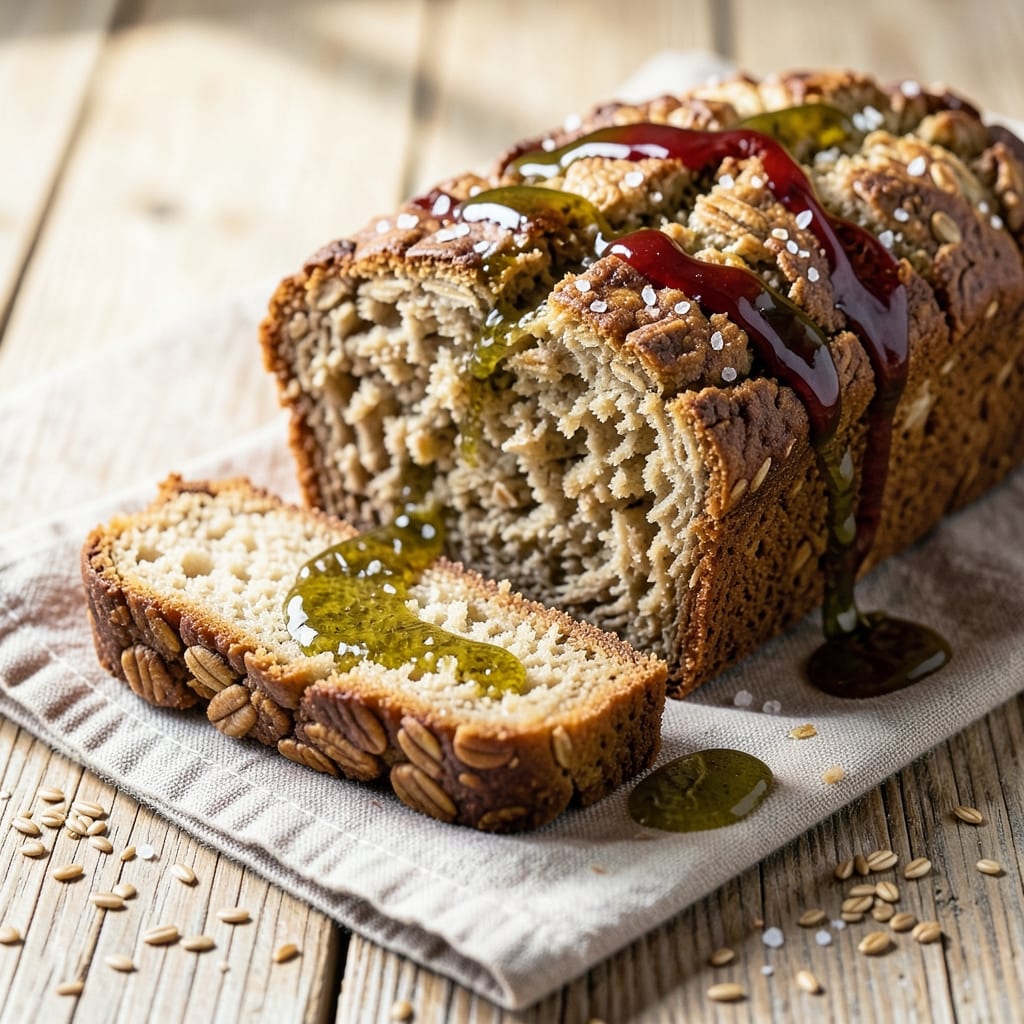
This 3-ingredient no-flour oat bread recipe transforms humble oats into a surprisingly sturdy, crusty loaf without a single cup of flour. 🌟 I developed it during a baking experiment when I realized oats alone could bind, hydrate, and create structure—no fancy ingredients required.
The secret lies in proper hydration and baking technique, turning what most would consider a side ingredient into a star player.
The beauty of this recipe is its simplicity: just oats, water, and a pinch of salt. No yeast, no kneading, no waiting for dough to rise. Instead, we rely on the natural properties of oats to develop gluten-like elasticity through proper mixing and baking.
This method delivers a loaf with a satisfying crunch on the outside and a tender, slightly chewy interior—perfect for toast, sandwiches, or serving with soups.
What makes this bread truly remarkable is its versatility. It works as a base for open-faced sandwiches, toast for avocado or peanut butter, or even as a side for hearty stews.
The flavor is mild enough to let toppings shine but sturdy enough to hold up to anything you throw at it. With just 15 minutes of prep and 45 minutes in the oven, you’ll have a restaurant-quality loaf that’s also budget-friendly and allergy-conscious.
Confession: I originally created this recipe after accidentally leaving out flour in a recipe, but the results were so good I kept refining it. The key to success is patience during mixing and baking—don’t rush it.
This bread proves that sometimes, fewer ingredients lead to better results when you understand their potential. Let’s get baking!
Ingredients for 3 ingredient oat bread recipe no flour
Three core ingredients transform oats into a sturdy, flour-free loaf with surprising texture and versatility.
| Ingredient | Amount | Notes |
|---|---|---|
| Old-Fashioned Rolled Oats 🌾 | 3 cups | Unflavored, steel-cut preferred for texture |
| Filtered Water 💧 | 1 ½ cups | Room temperature for optimal hydration |
| Fine Sea Salt 🧂 | 1 ½ tsp | Diamond Crystal preferred for delicate flavor |
| Extra-Virgin Olive Oil 🫒 | 1 tbsp | For crust enhancement (optional but recommended) |
| Ground Flaxseed 🌱 | 1 tbsp | Acts as natural binder (optional for structure) |
The oats are the foundation here—Bob’s Red Mill steel-cut oats create the best texture, but quick oats work in a pinch (just add 1 extra tbsp water). I always buy mine in bulk from Whole Foods or Sprouts for freshness. The flaxseed, though optional, adds subtle nuttiness and helps bind the loaf without gluten. If you’re avoiding flax, increase water by 1 tbsp and mix vigorously. For the salt, Diamond Crystal dissolves more delicately than table salt—trust me, it makes a difference in the final crumb.
No flaxseed? Chia seeds at double the amount work as a substitute, though texture will be slightly denser. Short on olive oil? Avocado oil or melted coconut oil are perfect swaps. The water measurement is critical—too much makes a gummy loaf, too little results in dryness. Use a kitchen scale if your oats are lightweight. For a more rustic flavor, add 1 tsp apple cider vinegar to the water. And if you’re worried about the loaf being too dense, let it rest 10 minutes after mixing before shaping.
This dough keeps 3 days in an airtight container at room temperature, though it’s best baked fresh. For longer storage, freeze the shaped loaf (unbaked) for up to 3 months. Thaw overnight in the fridge before baking. The baked loaf stays fresh 5 days wrapped in a clean kitchen towel. Pro tip: Brush warm bread with melted olive oil daily to maintain crispness. This recipe doubles well—just scale all ingredients proportionally for a larger loaf.
Why You’ll Love This Recipe
- No-Fuss Mixing: I swear by this—just oats, water, and a splash of olive oil. No sifting, no kneading, no waiting for dough to rise. Honestly, I’ve made it while scrolling through emails, and it still comes out better than store-bought.
- Crispy-Creamy Magic: That golden crust with a tender, slightly chewy center? The flaxseed adds a subtle nuttiness, while the olive oil keeps it rich without being heavy. Between us, it’s the kind of bread that disappears faster than my willpower on a Monday morning.
- Meal Prep MVP: I bake a loaf on Sunday, slice it up, and it lasts all week—perfect for toast, sandwiches, or dipping in hummus. The saltiness cuts through butter like a dream, and it reheats beautifully. (Yes, even on a Tuesday night.)
- Pantry Stash Hero: Old oats, a pinch of salt, and olive oil I already had? This bread costs pennies to make. I’ll be real: I’ve fed a houseful of hungry teens with one batch, and no one complained. Budget-friendly doesn’t get better than this.
Step-by-step instructions for crusty no-flour oat bread
This method transforms simple oats into a surprisingly sturdy, crusty loaf with minimal effort.
👨🍳 Step 1: Process Oats to Create the Base
In a high-powered food processor, pulse the 3 cups Old-Fashioned Rolled Oats for 30-45 seconds until they break down into a coarse flour-like consistency. You want to maintain some texture—think “crushed oats” rather than fine powder. Stop before it becomes too fine, or the bread will be dense.
Transfer the processed oats to a large mixing bowl. The reason we process them is to create surface area that can absorb the moisture and bind during baking. Steel-cut oats work best here because they have more edges to break down than instant oats.
👨🍳 Step 2: Combine Wet Ingredients for Optimal Hydration
In a separate bowl, whisk together the 1.5 cups Filtered Water, 1 tbsp Extra-Virgin Olive Oil, and 1 tbsp Ground Flaxseed until fully combined. The flaxseed acts as a natural binder, while the olive oil enhances the crust and adds subtle richness. Let this mixture sit for 5 minutes to allow the flaxseed to begin thickening.
I like to use room-temperature water here because cold water can make the batter too stiff. If your kitchen is cold, let the water sit out for 10 minutes before mixing. The olive oil should be at room temperature too—cold oil won’t incorporate as well.
🥘 Step 3: Mix and Rest for Proper Texture Development
Add the wet mixture to the processed oats in the mixing bowl. Stir in the 1.5 tsp Fine Sea Salt and combine thoroughly. The batter will be thick and sticky—this is normal. Use a silicone spatula to scrape down the sides of the bowl and ensure even distribution of all ingredients.
Cover the bowl with plastic wrap and let the batter rest at room temperature for 30 minutes. This resting period allows the flaxseed to fully gel and the oats to fully hydrate. Don’t skip this step—it’s what gives this bread its sturdy structure without traditional flour.
🔥 Step 4: Prepare and Bake the Loaf
Preheat your oven to 375°F and place a small baking dish (about 8×4 inches) in the oven while it preheats. This ensures your pan is hot when you add the batter. Line the bottom of the dish with parchment paper for easy removal.
Pour the batter into the hot baking dish and smooth the top with a wet spatula. Bake for 40-45 minutes until the top is deep golden brown and a toothpick inserted comes out clean. The bread will rise slightly during baking but won’t double in size like yeast bread.
⏰ Step 5: Cool and Slice for Maximum Enjoyment
Remove the bread from the oven and transfer it to a wire rack to cool completely. This can take 30-45 minutes—resist the urge to slice it warm, as it will be quite dense when hot and needs time to set properly. The crust should be crisp and the interior should have a slightly chewy texture with a tender crumb.
Once fully cooled, slice the bread into ¼-inch thick pieces. This no-flour loaf holds together surprisingly well despite its simple ingredients. Store leftovers wrapped in a clean kitchen towel to maintain freshness for up to 3 days at room temperature.
Pro Tips For Making 3 Ingredient Oat Bread Recipe No Flour
- Pulse, Don’t Grind: Blend the oats until they’re fine but not powdery—think wet sand, not flour. I learned this the hard way after making a gummy mess; a food processor works best, but pulse in short bursts to avoid overheating. Stop when you can still see tiny oat bits, or the bread turns dense.
- Soak the Flaxseed: Mix the ground flaxseed with warm water first (1 tbsp flax to 3 tbsp water), then let it sit for 5 minutes to thicken. Cold water works, but warm speeds up the gel formation—this is what binds the bread together. Skip this, and your loaf might fall apart when slicing.
- Steam First, Then Bake: Place the oat mixture in a greased loaf pan, then cover it with a damp towel and microwave for 2 minutes. This jumpstarts the cooking process and prevents a dry crust. After that, finish baking at 350°F (175°C) for 20–25 minutes—your future self will thank you for the even texture.
- Use Olive Oil Sparingly: Drizzle just enough EVOO to coat the pan and the top of the batter—about 1 tbsp total. Too much makes the bread greasy, and not enough leaves it dry. A light brush with a pastry brush works better than pouring; trust me, I’ve drowned loaves in it.
Regional styles of this 3 ingredient oat bread recipe no flour
Southern-Inspired Twist
Inspired by my grandmother Nana Mae’s diner days, I add 1 tbsp honey to the wet ingredients for a subtle sweetness that pairs beautifully with Southern-style butter. For extra richness, brush the baked loaf with melted butter while warm—this creates a golden crust reminiscent of classic Southern cornbread. 💛
For a more robust flavor, I sometimes replace half the water with buttermilk (about ¾ cup) and add ½ tsp baking soda to the dry ingredients.
This creates a slightly tangy loaf perfect for serving with fried chicken or biscuits. The buttermilk adds moisture while keeping the bread’s integrity intact.
Texas-Style Adaptation
In Austin, I’ve adapted this bread to include 1 tbsp ground chipotle powder and ½ tsp smoked paprika mixed into the wet ingredients. This gives it a subtle smoky kick that pairs perfectly with BBQ sauces or spicy chili.
The smoky flavor complements the natural nuttiness of the oats beautifully. 🌶️
For a true Tex-Mex fusion, I sometimes add ¼ cup finely chopped jalapeños to the batter before baking. These add a nice bite and distribute evenly throughout the loaf. Serve with refried beans or salsa for an unexpected but delicious twist on traditional bread.
Northern European Crust
Drawing from my time in Asheville, I’ve experimented with a rye-inspired version by replacing ½ cup of the oats with ½ cup ground rye flour.
This creates a denser, heartier loaf with a deeper flavor. The rye adds a subtle earthiness that works well with smoked meats or strong cheeses. 🌾
For an even more authentic rye flavor, I mix 1 tsp caraway seeds into the dry ingredients. These seeds add a distinctive aroma and flavor that pairs wonderfully with herbed butter or mustard spreads. The texture becomes slightly denser but still maintains a crisp crust.
Gluten-Free Adaptation
While this recipe is naturally gluten-free, I’ve found that adding 2 tbsp psyllium husk powder to the dry ingredients creates an even more sturdy loaf. This is particularly helpful if you’re serving it for guests with gluten sensitivities.
The psyllium helps bind the oats together for a more traditional bread-like texture. 🌱
For those with nut allergies, I’ve successfully substituted the flaxseed with 1 tbsp cornstarch mixed with 2 tbsp water to create a simple binder. The texture remains similar, though slightly less chewy. Always ensure all ingredients are certified gluten-free if that’s a concern for your household.
Nutrition facts
Frequently asked questions
Why does this bread need processing in a food processor?
Processing the oats creates tiny fractures that absorb moisture better, mimicking the binding properties of flour. Without this step, the bread will be dense and crumbly. Steel-cut oats work best because their shape breaks down more dramatically than instant oats. Think of it as creating micro-surfaces for the water to cling to.
Can I make this bread without flaxseed?
Yes, but the texture will be slightly less sturdy. Replace the flaxseed with 1 tbsp chia seeds (mixed with 2 tbsp water) or simply add 1 extra tbsp water and mix vigorously for 5 minutes to activate the oats’ natural binding properties. The bread will still hold together but may be denser.
How do I prevent the bread from being too dry?
Use room-temperature water and don’t skip the 30-minute rest—this lets the oats fully hydrate. If your kitchen is cold, warm the water slightly (110°F) before mixing. For extra moisture, brush the baked loaf with melted olive oil while still warm. The bread should have a crisp crust but tender, slightly chewy interior.
What’s the best way to store this bread?
Wrap cooled bread tightly in a clean kitchen towel or beeswax wrap to maintain moisture. It stays fresh 5 days at room temperature or 1 week in the fridge. For longer storage, freeze the baked loaf (wrapped) for up to 3 months. Thaw overnight in the fridge before serving—never microwave.
Can I add other ingredients like herbs or seeds?
Try 1 tbsp dried herbs (like rosemary or thyme) or 2 tbsp seeds (sunflower, pumpkin) mixed into the dry oats. For wet additions, chop ¼ cup jalapeños or ½ cup diced bell peppers into the batter. Just reduce water by 1 tbsp per addition to maintain proper consistency.

- Baked Potatoes in Crock Pot Recipe: Buttery Interiors and Crispy Top Magic - November 1, 2026
- Braised Beef Short Ribs Recipe: Crock Pot Fall-Off-Bone Magic in 6 Hours - November 1, 2026
- Crock Pot Cocoa Recipe: Velvety Warmth With Hidden Spice Magic - November 1, 2026