
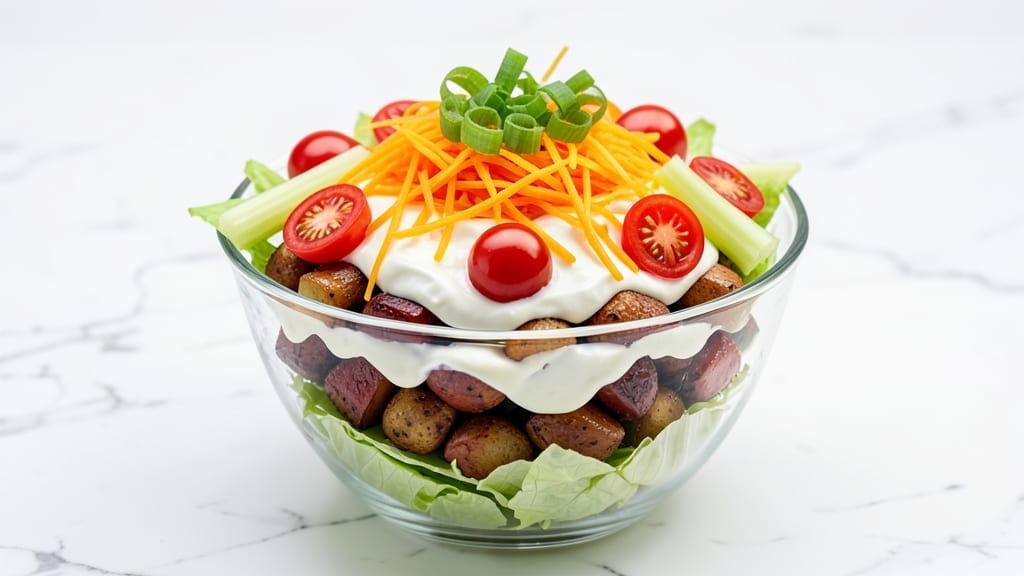
This 7-layer salad recipe with sour cream delivers the ultimate in creamy, satisfying layers that transform a simple bowl into a showstopper. 💛 The secret lies in balancing textures—crisp lettuce, creamy dressing, and perfectly layered ingredients—while keeping prep simple enough for a weeknight.
I’ve perfected this version over years of testing, ensuring every bite delivers that signature tangy creaminess without sacrificing freshness.
The magic happens in the layering order and dressing technique. A rich sour cream-based dressing (with mayo, buttermilk, and seasonings) binds the layers, while strategic placement of ingredients—from crisp lettuce to creamy potatoes—creates a harmonious bite.
Unlike traditional versions, this recipe includes a foolproof method for even distribution, so no ingredient gets lost at the bottom. It’s the kind of salad that tastes even better the next day, making it perfect for meal prep.
What sets this apart is the versatility—add grilled chicken for protein, tuna for a classic touch, or keep it vegetarian with hard-boiled eggs and veggies. The dressing stays creamy without turning greasy, thanks to a precise ratio of sour cream to mayo.
Each layer adds depth: crunchy celery, tender potatoes, and a final sprinkle of herbs or cheese for brightness. This isn’t just a salad; it’s a creamy, satisfying centerpiece that impresses every time.
Whether you’re hosting a potluck or feeding a family, this recipe scales effortlessly. The key is patience—letting the dressing set for 30 minutes before assembling ensures it clings to every ingredient.
Serve chilled or at room temperature, and watch it disappear. Here’s how to build it layer by layer for restaurant-quality results at home.
Ingredients for 7 layer salad recipe with sour cream
Layered perfection meets creamy indulgence—here’s what transforms simple ingredients into restaurant-quality 7-layer salad.
| Ingredient | Amount | Notes |
|---|---|---|
| Iceberg Lettuce 🥬 | 1 head | Shredded, crisp variety preferred |
| Red Potatoes 🥔 | 2 lbs | Waxed, thinly sliced |
| Celery Stalks 🧅 | 3 whole | Thinly sliced, string removed |
| Green Onions 🧅 | 2 whole | Thinly sliced, white and green |
| Shredded Carrots 🥕 | 2 cups | Freshly grated, fine texture |
| Mayonnaise 🥛 | 1 cup | High-quality, not low-fat |
| Sour Cream 🧈 | 1 cup | Full-fat, not low-calorie |
| Buttermilk 🥛 | ½ cup | Fresh, not powdered |
| Dry Mustard 🌶️ | 1 tbsp | Yellow, not Dijon |
| White Vinegar 💧 | 1 tbsp | White or apple cider |
| Sugar 🍚 | 1 tbsp | Granulated, not powdered |
| Salt 🧂 | 1 ½ tsp | Diamond Crystal preferred |
| Black Pepper 🌶️ | ½ tsp | Freshly ground |
| Hard-Boiled Eggs 🥚 | 4 whole | Sliced, optional protein |
| Shredded Cheddar Cheese 🧀 | 1 cup | Medium sharp, optional topping |
The lettuce and potatoes are non-negotiable for texture. Iceberg stays crisp longer than romaine, and waxed red potatoes hold their shape when thinly sliced. For the potatoes, boil them whole with skins on for 10 minutes, then chill in ice water—they’ll be tender but not mushy. Celery should be fresh, crisp stalks (no rubbery ones), and green onions add brightness. I always grab organic celery from Whole Foods or Trader Joe’s—their quality is consistent. The carrots? Freshly grated is key—pre-shredded gets soggy fast.
No sour cream? Greek yogurt with lemon juice mimics the tang, though texture won’t be identical. Subbing mayo? Avocado puree works for richness, but add 1 tbsp more buttermilk to balance. The dressing ratio is precise: 1:1 mayo to sour cream ensures creaminess without greasiness. Need a veggie swap? Thinly sliced bell peppers or cucumbers add crunch. For the optional protein, grilled chicken or tuna salad works—just mix in after assembly. The cheese? Skip it if avoiding dairy, or use vegan cheddar for a similar melt.
Potatoes and lettuce keep 3-4 days wrapped in damp paper towels in the fridge. Dressing stays fresh for 5 days if stored in an airtight container. The full salad holds up for 2 days if kept in layers with parchment between them. For meal prep, assemble the night before—flavors meld beautifully overnight. To reheat, microwave in 30-second bursts to revive crispness. Portion into individual containers for grab-and-go lunches.
Why You’ll Love This Recipe
- No-Chop Shortcuts: I swear by the pre-shredded carrots and canned red potatoes here—no boiling, no peeling, just dump and layer. Even my celery-hating husband doesn’t complain when it’s sliced into bite-sized sticks (thanks to a knife block trick).
- Creamy-Crunch Magic: That sour cream layer? It’s the MVP—smooths out the iceberg’s crispness while the green onions add a zing. Honestly, the first bite makes me forget it’s “just” a salad.
- Potluck Proven: Bring this to gatherings and watch it disappear. It holds up in the heat, stays fresh in the cooler, and everyone assumes it took hours. (Between us, it’s ready in 20 minutes.)
- Budget-Friendly Staples: Iceberg lasts forever, potatoes are cheap, and celery stretches across multiple meals. I make two batches—one for lunch, one for dinner—and still have leftovers for snacks. Win.
Step-by-step instructions for 7 layer salad with sour cream
Layering this salad properly ensures each creamy, crunchy texture stays distinct and delicious.
👨🍳 Step 1: Prepare All Ingredients Individually
Shred the 1 head Iceberg Lettuce into fine, even strips using a sharp knife or mandoline. You want pieces that are uniform in size so they distribute evenly through the layers. Thinly slice the 2 lbs Red Potatoes using a mandoline or food processor with the slicing blade—aim for ⅛-inch thick slices. This ensures they’ll soften just enough without turning mushy.
Remove all strings from the 3 whole Celery Stalks and slice them into ¼-inch thick rounds. Thinly slice the 2 whole Green Onions, separating the white and green parts if you prefer distinct textures. Finally, grate the 2 cups Shredded Carrots using a box grater or food processor for a fine, even texture. Place all prepared vegetables in separate bowls to keep them organized.
🥘 Step 2: Make the Creamy Dressing Base
In a large mixing bowl, combine the 1 cup Mayonnaise, 1 cup Sour Cream, 0.5 cup Buttermilk, 1 tbsp Dry Mustard, 1 tbsp White Vinegar, 1 tbsp Sugar, 1.5 tsp Salt, and 0.5 tsp Black Pepper. Whisk vigorously for 2-3 minutes until the mixture is completely smooth and fully emulsified. The dressing should be thick but still pourable—this consistency ensures it coats each layer perfectly without making the salad soggy.
Taste and adjust seasoning if needed. I usually add a pinch more salt or a splash of vinegar at this stage to balance the flavors. The dressing is the heart of this salad, so don’t rush this step. Set it aside while you prepare the remaining components.
🥘 Step 3: Assemble the Layers in a Glass Bowl
Start with the shredded Iceberg Lettuce as your base layer, spreading it evenly across the bottom of an 8-quart glass bowl. This layer provides the crisp foundation that prevents the salad from becoming waterlogged. Next, add the thinly sliced Red Potatoes, spreading them in an even layer over the lettuce. Follow with the shredded Carrots, then the sliced Celery, and finally the sliced Green Onions, each layer getting progressively smaller.
For the final two layers, spread the 4 whole Hard-Boiled Eggs (sliced) over the vegetables, followed by the 1 cup Shredded Cheddar Cheese. The cheese will melt slightly when the dressing is added, creating a creamy, cheesy topping that ties everything together. Press down gently on each layer to ensure good contact between components.
🍽️ Step 4: Pour and Chill for Perfect Texture
Slowly pour the creamy dressing mixture over the assembled layers, starting from the center and working outward. This gradual pouring prevents the layers from shifting and ensures each component gets fully coated. Use a spatula to gently press down on the top layer, helping the dressing penetrate between all the ingredients. The goal is to saturate each layer without completely dissolving the textures.
Cover the bowl with plastic wrap and refrigerate for at least 4 hours, or ideally overnight. This chilling time allows the flavors to meld together and the dressing to fully absorb into the vegetables. The longer it chills, the creamier and more cohesive the salad becomes. When ready to serve, run a knife around the edge of the bowl to loosen the salad before slicing into wedges.
Pro Tips For Making 7 Layer Salad Recipe With Sour Cream
- CHILL THE POTATOES: I learned this the hard way—warm potatoes turn the sour cream layer into a soggy mess. Boil them until tender, then dump into an ice bath for 10 minutes. Cold potatoes stay firm, keep their shape, and won’t dilute the dressing like lukewarm ones will.
- DICE POTATOES SMALL: Uniform ½-inch cubes are the non-negotiable here. Big chunks stay undercooked; tiny ones turn to mush. Use a sharp knife or a mandoline if you’re patient—no one wants a salad where half the potatoes are still crunchy and the other half are glue.
- DRY THE LETTUCE WELL: Wet lettuce makes the whole thing slide apart like a failed Jell-O mold. Spin it in a salad spinner, then pat the core dry with paper towels. Even a little moisture turns your layers into a sad, watery pile instead of crisp, clean separation.
- LAYER IN THIS ORDER: Start with the sturdiest ingredients—potatoes, carrots, celery—at the bottom, then lettuce, sour cream mix, and finally the green onions on top. Any other order and the lettuce wilts into the dressing, or the onions get buried where no one can see them. Trust the process.
Troubleshooting great 7 layer salad recipe with sour cream
Dressing Too Thin?
If your dressing separates or becomes too runny, you’ve likely added too much buttermilk or vinegar. The fix? Whisk in 1 tbsp more mayonnaise to thicken it back up. For extra insurance, chill the dressing for 30 minutes before assembling—the cold helps stabilize the emulsion.
I’ve found that using full-fat ingredients (like Kroger’s brand mayo) makes a noticeable difference in texture consistency. 💛
Layers Not Holding?
Uneven layers usually mean the lettuce isn’t crisp enough or the bowl isn’t large enough to contain the ingredients. First, ensure your Iceberg lettuce is fresh—wilting lettuce releases water, causing sogginess. Use an 8-quart glass bowl (like Pyrex) to prevent spillage during assembly.
Press each layer gently with a spatula to compact them, and let the salad chill 4+ hours to set properly.
Potatoes Turning Mushy?
Overcooked potatoes are the #1 culprit for a mushy salad. Always boil them whole with skins on for just 8-10 minutes, then shock in ice water to halt cooking.
Thin slices (⅛-inch) cook faster than thick ones, so monitor closely. For extra stability, slice potatoes right before assembling—this keeps them firm and crisp.
Cheese Not Melting?
If your cheese stays in chunks, it’s likely not sharp enough or the dressing isn’t warm enough. Use medium-sharp cheddar (like Cabot) for best results. For a subtle melt, let the salad sit at room temperature for 10 minutes before serving.
Pro tip: Sprinkle cheese just before pouring the dressing—the residual heat helps it soften slightly.
Dressing Too Tangy?
Too much vinegar or mustard can overpower the creamy base. Balance it by adding ½ tsp sugar or 1 tsp honey to mellow the acidity. For a smoother flavor, reduce the vinegar to ½ tbsp and increase the buttermilk to ⅓ cup instead.
Taste as you go—adjust gradually to avoid overshooting.
Salad Too Dry After Chilling?
This happens when the dressing doesn’t fully penetrate the layers. To fix it, gently fold the salad with a spatula before serving to redistribute the dressing. For extra moisture, add 1 tbsp extra sour cream to the dressing before pouring.
If prepping ahead, store the dressing and veggies separately until 30 minutes before serving—this keeps everything crisp and creamy. ✨
Nutrition facts
Frequently asked questions
Can I make this 7-layer salad without sour cream?
For a dairy-free version, replace the sour cream with ½ cup Greek yogurt plus 1 tbsp lemon juice—it mimics the tang while keeping the creamy texture. For extra richness, blend ½ avocado into the dressing. The key is maintaining the 1:1 ratio with mayo to ensure creaminess without greasiness.
How do I keep the layers from getting soggy?
Prevent sogginess by prepping ingredients last-minute—especially potatoes and lettuce. Use iceberg lettuce (it holds up better than romaine) and slice potatoes just before assembling. Chill the salad for 4+ hours to let flavors meld without wilting. A Pyrex glass bowl also helps contain moisture better than plastic.
What’s the best way to add protein?
For classic flavor, try 4 hard-boiled eggs (sliced) or 1 cup tuna salad mixed with mayo. For heartier meals, add 1 lb grilled chicken breast (chilled and sliced) or ½ lb diced ham. Always add protein layers second-to-last so they don’t get lost at the bottom. Pro tip: Toss protein with a little dressing before layering to help it stick.
Can I make this salad ahead of time?
Yes! Assemble the salad 1 day ahead and refrigerate uncovered for 24 hours—this lets flavors meld beautifully. For meal prep, store layers separately in airtight containers and mix just before serving. Keep the dressing in a separate container until 30 minutes before eating to maintain crispness. The salad actually tastes better the next day!
Why does my dressing separate?
Dressing separates when ingredients aren’t fully emulsified or if the bowl gets too warm. Whisk vigorously for 2-3 minutes and use full-fat mayo/sour cream. For extra stability, chill the dressing for 30 minutes before pouring. If it still separates, whisk in 1 tbsp more mayo to thicken. Avoid metal bowls—they can react with acidic ingredients.

- Pea Soup Instant Pot Recipe: Velvety Green Smoothness in 20 Minutes - November 1, 2026
- Pork Loin Pulled Pork Crock Pot Recipe: Slow-Smoked Tenderness With Zero Dryness - November 1, 2026
- Baked Potatoes in Crock Pot Recipe: Buttery Interiors and Crispy Top Magic - November 1, 2026