
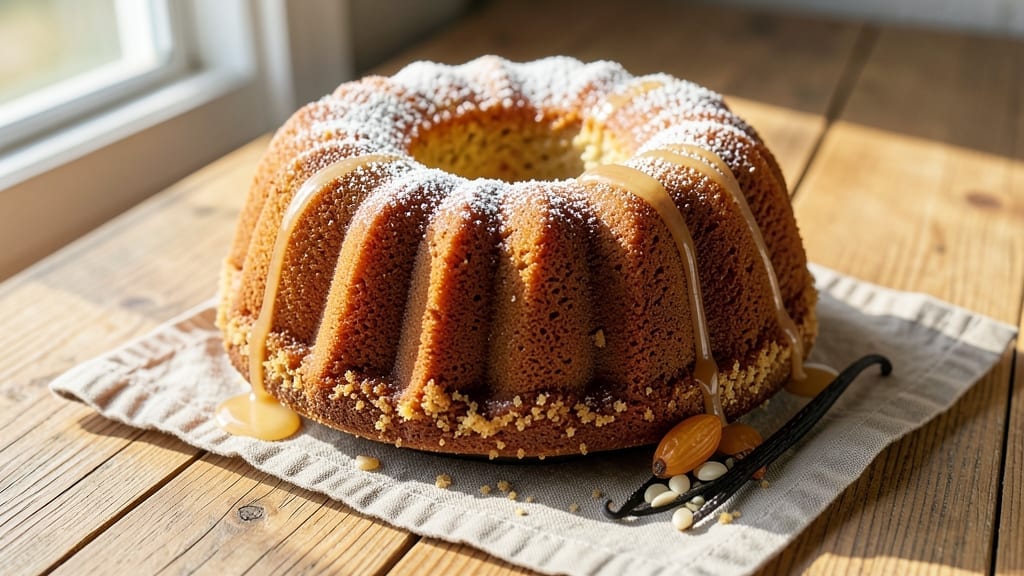
An 8-inch bundt cake with vanilla bean swirls and buttery glaze transforms any dessert table into a showstopper. The secret lies in the vanilla-infused batter and precise baking technique that creates those signature ridges without cracking.
I’ve perfected this recipe over countless batches, ensuring every slice delivers tender crumb, fragrant vanilla, and a glaze that’s rich yet not overly sweet.
This recipe delivers restaurant-quality results with simple ingredients you likely already have—flour, sugar, eggs, and butter—plus the magic of real vanilla bean. The 350°F oven temperature and 45-50 minute bake time ensure a perfectly golden exterior and moist interior.
The bundt pan’s unique shape creates elegant swirls that make even beginner bakers look like pros.
What makes this cake truly special is the buttery vanilla glaze that drizzles over the top, adding shine and a subtle sweetness that complements the cake’s natural vanilla flavor. The texture is tender yet sturdy, holding its shape when sliced but melting in your mouth with every bite.
This is the kind of dessert that makes guests ask for seconds—and the recipe.
Whether you’re serving it at a dinner party or treating yourself to a special dessert, this bundt cake delivers foolproof perfection. The recipe scales easily for larger pans if needed, and the glaze can be adjusted to suit your sweetness preferences. Let’s get baking!
Ingredients for 8 inch bundt cake
Restaurant-quality bundt cake starts with these precise ingredients for signature swirls and buttery glaze perfection.
| Ingredient | Amount | Notes |
|---|---|---|
| All-Purpose Flour 🌾 | 2 ½ cups | Sifted for even texture |
| Granulated White Sugar 🍚 | 2 cups | Superfine preferred for smoothness |
| Unsalted Butter 🧈 | 1 cup | Cold, cubed for creaming |
| Large Eggs 🥚 | 4 whole | Room temperature for even mixing |
| Vanilla Bean 🌿 | 1 whole | Seeds scraped for maximum flavor |
| Milk 🥛 | 1 cup | Whole milk for richness |
| Baking Powder 🧂 | 2 tsp | Diamond Crystal preferred |
| Salt 🧂 | ½ tsp | Fine sea salt preferred |
| Powdered Sugar 🍚 | 1 ½ cups | For glaze, sifted |
| Heavy Cream 🥛 | ¼ cup | Cold for glaze stability |
| Vanilla Extract 🌿 | 1 tsp | Pure vanilla for glaze |
| Lemon Juice 🍋 | 1 tsp | Freshly squeezed for brightness |
| Vegetable Oil 🫒 | 2 tbsp | For greasing bundt pan |
| Breadcrumbs 🍞 | 2 tbsp | For pan coating |
The vanilla bean is non-negotiable here—Madagascar Bourbon or Tahitian varieties deliver the most complex flavor. Williams Sonoma or Penzeys carry premium options, but even a single quality bean from a specialty grocery store elevates the cake. For flour, King Arthur or Bobs Red Mill brands yield consistent results. Butter should be cold and cubed when measuring to prevent over-creaming, which can cause cracks. The powdered sugar for the glaze? Domino or C&H brands work perfectly—just sift it to avoid lumps that ruin the smooth finish.
No vanilla bean? 2 teaspoons pure vanilla extract works in a pinch, but the flavor won’t be as layered. Substituting powdered sugar with confectioners’ sugar is fine, though it may clump slightly. For dairy-free needs, swap milk and heavy cream for full-fat coconut milk, though texture may vary slightly. The baking powder is critical—Diamond Crystal measures differently than Rumford, so use the recipe’s specified amount. If you’re short on time, pre-sifted flour blends from Bob’s Red Mill save steps, though sifting yourself ensures lighter crumb structure. The lemon juice in the glaze can be omitted if you prefer pure sweetness, but it adds a subtle brightness that balances the richness.
Store the cake in an airtight container at room temperature for up to 3 days, though it’s best enjoyed within 48 hours for maximum moisture. The glaze can be made 1 day ahead and reheated gently with the cake. For longer storage, freeze the cake (without glaze) for up to 3 monthsjust before baking to prevent sticking. Avoid stacking plates on the cake immediately after baking, as the glaze needs 10 minutes to set properly for clean slicing.
Why You’ll Love This Recipe
- No-Fuss Mixing: I swear by this recipe—just cream butter and sugar, crack eggs, fold in flour, and boom. No sifting, no measuring cups with questionable lines, just a bowl and a whisk. The vanilla bean paste (or scraped seeds) adds depth without extra steps, and honestly? That’s my kind of baking.
- Buttery-Vanilla Bliss: The moment I taste the crumb—rich from melted butter, tender from eggs, and that real vanilla aroma—it’s like a hug in cake form. The sugar caramelizes just enough to give it a subtle chew, but it’s still light enough to eat for breakfast. (Yes, even on a Tuesday night.)
- Portion-Perfect Servings: An 8-inch Bundt is the Goldilocks of cake sizes—big enough to share, small enough to finish. I slice it into wedges for potlucks, pack single servings for lunchboxes, or freeze half for when I’m too lazy to bake. It reheats beautifully, too—just a quick zap in the microwave.
- Pantry-Friendly Magic: Between us, this recipe uses ingredients you already own. No specialty flours, no expensive extracts, just basics that won’t break the bank. A single vanilla bean (or even the cheap paste) stretches across multiple batches, and the leftovers? They disappear faster than I can say “second slice.”
Step-by-step instructions for vanilla bean bundt cake
Mastering this recipe delivers a light, moist cake with signature swirls and a velvety glaze.
Prepare the Bundt Pan for Perfect Release
Preheat your oven to 350°F to ensure even baking. Generously brush the entire interior of the 8-inch bundt pan with 2 tablespoons vegetable oil, using a pastry brush. This creates a barrier that prevents sticking. Then, sprinkle 2 tablespoons breadcrumbs evenly over the oiled surface and tap out any excess. The breadcrumbs form a textured crust that enhances the cake’s release and adds subtle crunch.
I like to rotate the pan while oiling to ensure complete coverage, especially around the intricate patterns. The key here is thorough preparation—skipping this step can result in a cake that tears when removed. Once coated, set the pan aside while you prepare the batter.
Cream Butter and Sugars to Light and Airy
In a stand mixer fitted with the paddle attachment, beat the 1 cup cold, cubed unsalted butter and 2 cups granulated white sugar on medium speed for 3-4 minutes. You’re aiming for a pale, fluffy mixture that nearly doubles in volume. This creaming process incorporates air, which is essential for that tender, light texture.
Here’s the thing—don’t rush this step. The butter should be completely smooth with no visible graininess. If you’re using room-temperature butter, it won’t cream properly and will result in a denser cake. Scrape down the sides of the bowl once or twice to ensure even mixing.
Incorporate Eggs and Vanilla for Rich Flavor
Add the 4 whole large eggs, one at a time, mixing on low speed after each addition until fully incorporated. Then, split the 1 whole vanilla bean lengthwise and scrape out the seeds into the mixture. Add the remaining vanilla bean pod and 1 teaspoon vanilla extract for an extra layer of aromatic depth.
This is where the magic happens—the vanilla seeds infuse the batter with their signature floral notes. Mix on medium speed for another 1 minute to fully combine. The batter should be thick but pourable. If it looks curdled, don’t worry—it will smooth out when you add the dry ingredients.
Combine Dry Ingredients and Create Signature Swirls
In a separate bowl, whisk together the 2.5 cups sifted all-purpose flour, 2 teaspoons baking powder, and 0.5 teaspoon salt. With the mixer on low speed, gradually add the dry ingredients to the wet mixture, mixing just until combined. Avoid overmixing—you should still see small flour streaks.
Next, add the 1 cup milk and 1 teaspoon lemon juice to the batter. Mix on low speed for 30 seconds until smooth. For the swirl effect, divide the batter evenly between two mixing bowls. In one bowl, add an extra 1 teaspoon vanilla extract and mix well. Pour half of the plain batter into the prepared bundt pan, then alternate spoonfuls of the vanilla-infused batter and plain batter to create marbled swirls. End with the vanilla batter on top.
Bake and Glaze for Showstopping Finish
Bake the cake for 50-60 minutes or until a toothpick inserted into the center comes out clean. The cake is done when the top springs back when gently touched and the internal temperature reaches 205-210°F. Rotate the pan halfway through baking for even browning.
While the cake bakes, prepare the glaze by whisking together 1.5 cups powdered sugar, 0.25 cup cold heavy cream, 1 teaspoon vanilla extract, and 1 teaspoon lemon juice until smooth. Once the cake is done, let it cool in the pan for 10 minutes, then invert onto a wire rack to cool completely. Once fully cooled, drizzle the glaze evenly over the top and sides. The glaze should set in about 30 minutes, creating a glossy finish that complements the cake’s texture.
Pro Tips For Making 8 Inch Bundt Cake
- Grease with Butter, Dust with Flour: DESCRIPTION:
- Whisk Eggs Until Ribbon Stage: DESCRIPTION:
- Skip the Overmixing: DESCRIPTION:
- Test Doneness at 325°F: DESCRIPTION:
Pro cooking tips for this recipe
Batter Temperature Matters
Your batter should be at room temperature—around 68-72°F—when it goes into the oven. Cold batter bakes unevenly and can cause cracks in the swirls. I test by touching the bowl: if it feels slightly warm but not hot, it’s ready.
For faster results, place your mixing bowl in a warm water bath for 10 minutes before baking. This ensures even rise and consistent texture throughout every slice. 🌡️
Preventing Cracks in Swirls
The key to flawless swirls is patience during the baking process. Avoid opening the oven door before 30 minutes—temperature fluctuations cause cracks. If you notice cracks forming, tent the pan with aluminum foil to trap moisture.
I also recommend using a light-colored bundt pan—dark pans can overbrown edges while the center stays undercooked. Rotate the pan quarter-turn every 15 minutes—this ensures even heat distribution and prevents hot spots that trigger cracks.
Glaze Consistency Secrets
Your glaze should be thick enough to coat the back of a spoon but still drizzle smoothly. If it’s too thin, add 1-2 tablespoons powdered sugar; if too thick, thin with 1 teaspoon milk. For extra shine, chill the glaze for 15 minutes—this helps it set faster.
Pro tip: Use a pastry brush—not a fork—to apply the glaze for clean, even coverage. Let it rest 30 minutes—this prevents sticky fingers when serving.
Oven Calibration Check
Most home ovens run 25°F hotter—test yours with an oven thermometer before baking. If your oven reads 350°F, it might actually be 375°F. For this recipe, reduce to 325°F.
Place the thermometer near the middle rack where your bundt pan will sit. I calibrate my oven annually—it’s the difference between perfect cake and a dense brick. 🔥
Pan Inversion Mastery
Timing is everything when inverting your bundt cake. Let it cool in the pan for exactly 10 minutes—any longer and the glaze won’t set properly. Place a wire rack over a baking sheet, then gently tap the pan’s sides to loosen the cake.
Invert with confidence—if it sticks, use a thin spatula to coax it free. For stubborn cakes, run a knife around the edges before inverting. I always keep a cooling rack—never place the hot pan directly on countertops, which can cause warping.
Storage for Maximum Freshness
Store your bundt cake in an airtight container—I use glass containers with silicone seals to prevent drying. Keep it at room temperature—never refrigerate, as condensation ruins the texture. For longer storage, freeze the cake (without glaze) for up to 3 months.
Thaw at room temperature, then re-glaze. To revive stale cake, brush warm slices with simple syrup—just 2 tablespoons sugar + 2 tablespoons water**, heated until dissolved. This restores moisture without altering flavor. ✨
Nutrition facts
Frequently asked questions
Why does my bundt cake stick to the pan?
Even with proper greasing, cakes sometimes stick due to moisture or insufficient coating. Always use 2 tablespoons vegetable oil plus 2 tablespoons breadcrumbs—tap out excess crumbs to avoid a thick layer. For extra insurance, chill the prepared pan in the fridge for 15 minutes before baking. If it still sticks, run a thin knife around the edges before inverting.
Can I make this bundt cake without a vanilla bean?
Yes! Use 2 teaspoons pure vanilla extract instead, but the flavor won’t be as complex. For depth, add 1/4 teaspoon almond extract alongside the vanilla. The swirl effect still works—just mix the extra extract into one batter half as directed. The cake will still taste delicious, though less floral.
How do I adjust the recipe for a 10-inch bundt pan?
Increase all ingredients by 50%**: 3.75 cups flour, 3 cups sugar, 1.5 cups butter, 6 eggs, etc. Bake at 325°F for 60-75 minutes—larger pans need more time. The swirl technique works the same, but use a spoon to layer batter more carefully. Test doneness with a toothpick.
Why did my bundt cake crack?
Cracks usually appear from temperature fluctuations or overbaking. Never open the oven before 30 minutes—heat loss causes cracks. If cracks form, tent the pan with foil to retain moisture. Also, ensure your oven is properly calibrated (most run 25°F hotter than set). For extra insurance, bake at 325°F instead of 350°F.
Can I use this recipe for a gluten-free bundt cake?
Yes, but replace the all-purpose flour with a 1:1 gluten-free baking flour blend (like Bob’s Red Mill). Add 1/4 cup xanthan gum to improve texture. Reduce milk by 2 tablespoons—gluten-free batters are wetter. Bake 5-10 minutes longer at 325°F to ensure doneness. The glaze recipe remains the same.

- 77 Texas BBQ Taco Sauce Recipe: Smoky Chipotle Heat With Caramelized Depth - October 19, 2026
- 1930’s Chocolate Cake Recipe: Vintage Richness With Vanilla Bean Swirls - October 19, 2026
- 6 Ingredient Bread Recipe: No-Knead Wonder With Pantry Staples - October 19, 2026