
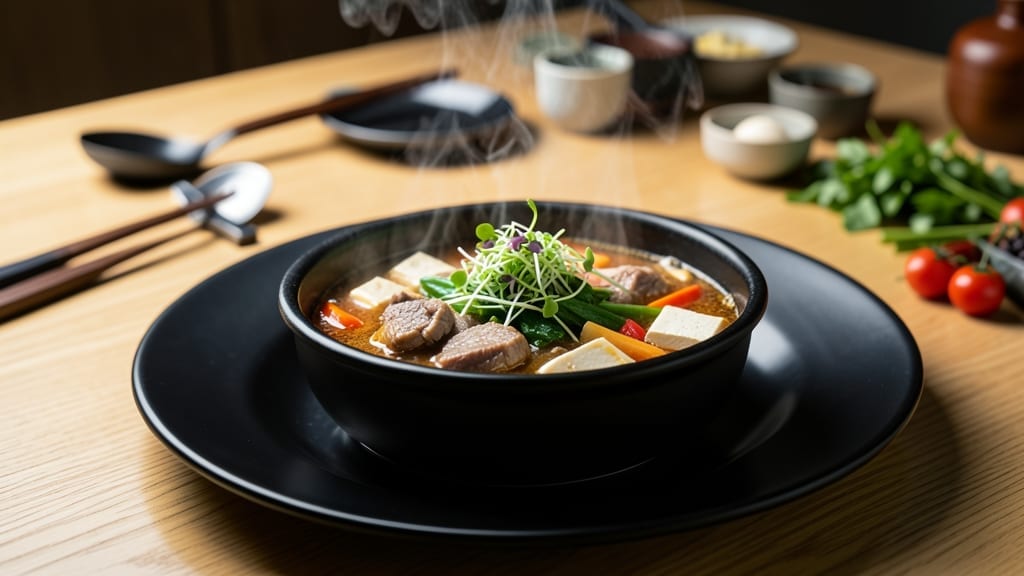
This Cambodian hot pot recipe brings the aromatic magic of Southeast Asia to your kitchen with its fragrant coconut-herb broth and bold flavors.
The dish centers on a rich, velvety broth infused with lemongrass, galangal, and kaffir lime leaves, creating layers of complexity that transform simple proteins and vegetables into something extraordinary. I’ve perfected this version after years of experimenting with traditional techniques and modern shortcuts that deliver restaurant-quality results at home.
The beauty of Cambodian hot pot lies in its versatility—you can customize it with your favorite proteins like shrimp, chicken, or beef, and pair them with fresh vegetables that cook quickly in the simmering broth.
The key to achieving that signature depth of flavor is properly balancing the spices and allowing the broth to develop its aromatic profile through slow simmering. This isn’t just a meal; it’s an experience that brings the warmth of Cambodian cuisine to your table.
What makes this recipe truly special is the harmony of textures and flavors: tender meats, crisp vegetables, and delicate rice noodles all bathed in that fragrant coconut broth. The dish is completed with fresh herbs and a tangy dipping sauce that adds another dimension of brightness.
Whether you’re hosting a dinner party or cooking for family, this hot pot will impress with its depth and authenticity.
Ready in about 45 minutes with prep time included, this recipe delivers a complete dining experience that’s both satisfying and elegant. The broth can be made ahead, allowing you to focus on grilling proteins and assembling everything at the last moment.
Let’s create this fragrant, comforting dish that captures the heart of Cambodian cuisine.
Ingredients for cambodian hot pot
Sixteen ingredients for a fragrant Cambodian hot pot experience that’s restaurant-quality at home.
| Ingredient | Amount | Notes |
|---|---|---|
| Chicken Breast 🍗 | 2 lb | Boneless, skinless, cut into bite-sized pieces |
| Shrimp 🦐 | 1 ½ lb | Large, peeled, deveined, tails on |
| Beef Flank Steak 🥩 | 1 ½ lb | Thinly sliced against the grain |
| Lemongrass Stalks 🌿 | 4 whole | Bruised, bottom 4 inches only |
| Galangal 🍃 | 1 piece | About 4 oz, sliced thinly |
| Kaffir Lime Leaves 🍋 | 6 whole | Lightly bruised |
| Coconut Milk 🥥 | 2 cans | Full-fat, 13.5 oz each |
| Fish Sauce 🍶 | 3 tbsp | Red Boat preferred |
| Palm Sugar 🍬 | ½ cup | Or substitute brown sugar |
| Thai Chili Paste 🌶️ | 2 tbsp | Maesri or Sriracha for heat |
| Garlic Cloves 🧄 | 8 cloves | Minced finely |
| Shallots 🧅 | ½ cup | Minced finely, about 2 medium |
| Red Bell Pepper 🌶️ | 1 whole | Thinly sliced, seeds removed |
| Baby Bok Choy 🥬 | 4 whole | Whole heads, stems trimmed |
| Rice Noodles 🍜 | 1 lb | Flat, medium-width |
| Fresh Basil Leaves 🌿 | ½ cup | For garnish |
| Fresh Mint Leaves 🍃 | ¼ cup | For garnish |
| Lime Wedges 🍋 | 4 whole | For serving |
The broth is where the magic happens, so don’t skimp on the aromatics. Red Boat fish sauce is the gold standard—it’s got that deep umami punch without overpowering. For galangal, Asian markets usually carry it fresh, but if you can’t find it, ginger works in a pinch (though it won’t be identical). Kaffir lime leaves are essential—they add that bright citrus aroma that sets this dish apart. I always grab extra because they’re hard to find once you’re in the middle of cooking. The lemongrass should be bruised gently with the side of your knife to release its oils without turning to mush. Trader Joe’s often carries pre-bruised lemongrass if you’re in a hurry.
No galangal? Ginger plus a pinch of cardamom gets you close, though the flavor won’t be exactly the same. Running out of kaffir lime leaves? Double the lime juice and zest from regular limes. For the proteins, chicken thighs work better than breasts—they stay juicier in the broth. The beef should be sliced thinly against the grain for tenderness. If you can’t find rice noodles, vermicelli or even udon will work in a pinch, though the texture will differ slightly. The Thai chili paste can be adjusted to taste—Maesri is my go-to for that authentic heat, but Sriracha works if you’re in a hurry.
This broth tastes even better the next day—make a double batch if you can. Store it in the fridge for up to 5 days, or freeze portions for 3 months. The proteins and veggies should be added fresh when serving. For a shortcut, par-cook the proteins in the broth for 5 minutes before serving, then finish them quickly when ready to eat. The fresh herbs should be added at the very end—toss them in just before serving so they stay vibrant. Lime wedges on the side let everyone squeeze to taste.
Why You’ll Love This Recipe
- Lemongrass-Loaded Simplicity: Honestly, the prep is ridiculously easy—just slice the beef and chicken into thin strips (no fancy knife skills needed), toss in whole shrimp, and let the lemongrass and galangal do the heavy lifting. You’re basically simmering, not slaving.
- Umami Bomb in a Bowl: That first bite? The galangal’s peppery kick meets the beef’s richness, while the shrimp soaks up the broth like a sponge. It’s the kind of flavor that makes you pause mid-bite and think, “Wait, why don’t I cook this more often?”
- Weeknight to Weekend Workhorse: Between us, this is my go-to for busy nights (20 minutes, start to finish) and the one dish I pull out when friends ask, “What’s Cambodian food like?” No stress—just hearty, satisfying steam.
- Broth That Stays Perfect: The secret? The broth gets better the next day—deepens, richer, like a slow-cooked hug. I make a double batch on Sundays, freeze half, and still have leftovers I’ll fight my roommate over. (Worth it.)
Step-by-step instructions for Cambodian hot pot
Here’s how to build this aromatic broth from scratch—layer by layer, until every spoonful bursts with coconut, herbs, and chili.
Prepare the Aromatic Base
In a large pot, combine the 2 cans coconut milk, 4 whole lemongrass stalks (bruised), 1 piece galangal (sliced), 6 whole kaffir lime leaves, 8 cloves garlic (minced), and 0.5 cup shallots. Bring to a gentle simmer over medium heat for 10 minutes, stirring occasionally. You want the lemongrass and galangal to release their citrusy, peppery oils into the milk.
Here’s the thing—don’t rush this step. The longer these aromatics steep, the deeper the flavor. I press down on the galangal with a wooden spoon every few minutes to help it break down. After 10 minutes, the mixture should smell like a Cambodian market—bright, herbal, and slightly spicy.
Build the Broth
Reduce heat to low and add the 3 tbsp fish sauce, 0.5 cup palm sugar, and 2 tbsp Thai chili paste. Stir well to dissolve the sugar completely—it should melt into a smooth, caramelized syrup. Let the broth simmer uncovered for 20 minutes, skimming off any foam that rises to the surface. This reduces the coconut milk slightly and concentrates the flavors.
Taste the broth now. It should be rich, slightly sweet, and tangy with a slow-building heat. If it needs more depth, add 1 more tbsp fish sauce. If it needs more sweetness, add 1 tablespoon palm sugar. The balance is key—this is the foundation of your hot pot.
Cook the Protein
Add the 2 lb chicken breast (cut into bite-sized pieces) and 1.5 lb shrimp to the simmering broth. Bring to a gentle boil, then reduce heat to medium-low. Cook for 8-10 minutes until the chicken is fork-tender and the shrimp turn pink and opaque. Remove the chicken and shrimp with a slotted spoon and set aside.
Next, add the 1.5 lb beef flank steak (sliced against the grain) to the broth. Simmer for 5-6 minutes until the beef is just cooked through—it should still have a slight bite. Remove the beef and set aside with the other proteins. The broth should now be fragrant with layers of umami, coconut, and spice.
Prepare the Noodles and Vegetables
While the broth simmers, prepare the 1 lb rice noodles by soaking them in hot water for 10-12 minutes until pliable but still slightly firm. Drain and set aside. In a separate bowl, toss the 4 whole baby bok choy (stems trimmed) and 1 whole red bell pepper (sliced) with 1 tbsp fish sauce. Keep them separate until ready to cook.
Here’s the moment that matters: when serving, divide the rice noodles among bowls. Ladle the hot broth over the noodles, then add the cooked chicken, shrimp, and beef. Top with the baby bok choy and red bell pepper, then cover with a lid. Let everything steam together for 3-4 minutes—this finishes the vegetables and infuses them with the broth’s flavors.
Finish and Serve
Uncover the bowls and garnish each with 0.5 cup fresh basil leaves and 0.25 cup fresh mint leaves. Serve immediately with the 4 whole lime wedges on the side. The lime brightens the rich, coconutty broth and cuts through the heat if needed.
Real talk: the first bite should deliver a perfect balance—creamy coconut, herbal galangal, a whisper of chili, and the tender proteins melting in your mouth. If the broth seems too thin after serving, simmer it for 5 more minutes to reduce it slightly. This hot pot gets better as it sits, so don’t wait to dig in.
Pro Tips For Making Cambodian Hot Pot
- CHAR THE GALANGAL: I learned this the hard way—grating galangal raw makes the broth bitter and muddy. Instead, slice it thinly, then lightly char it over a gas flame (or under a broiler for 2-3 minutes) until the edges blacken slightly. That smoky depth is what balances the broth’s sharpness without overpowering it.
- SEAR MEAT IN BATCHES: Crowd the pan with beef flank and chicken, and you’ll steam them instead of sear. Work in two batches—start with the beef (it’s thicker), then the chicken—using the same oil. The crust on the beef is non-negotiable for flavor, and the chicken won’t dry out if you give it a minute per side.
- JULIENNE THE LEMONGRASS: My grandmother swore by this, and she was right: skip the whole stalks. Instead, trim off the tough lower ends, then julienne the rest into matchsticks. They infuse faster, release more aroma, and you can fish them out cleanly at the end—no one wants to bite into a stringy lemongrass stalk.
- SIMMER LOW AND COVERED: After burning three batches, I finally figured out that Cambodian hot pot isn’t a race. Once the broth starts boiling, drop the heat to a bare simmer, cover, and let it work for 20 minutes. The shrimp will poach gently, the beef stay tender, and the broth won’t turn into a thin, flavorless sauce. Patience here makes all the difference.
Creative variations of cambodian hot pot
Vegetarian Adaptation
Swap proteins for tofu or mushrooms—I use extra-firm tofu pressed for 30 minutes and sliced into thick strips. Marinate them in 2 tbsp fish sauce, 1 tbsp lime juice, and 1 tbsp palm sugar for 20 minutes before adding to the broth.
For mushrooms, shiitake or oyster mushrooms work best—they absorb the broth’s flavors beautifully. 🌱
Seafood-Only Version
Load up the pot with 1.5 lb shrimp, 1 lb white fish fillets (like cod or snapper), and ½ lb squid for a seafood lover’s dream.
Cook the shrimp and fish together for 6-8 minutes until just done, then add the squid for the final 2 minutes—this keeps it tender. Garnish with extra Thai basil and a squeeze of lime. 🦞
Spicy Thai Fusion
Boost the heat with 1 tbsp additional Thai chili paste and add 1 tbsp shrimp paste (kapi) to the broth for a funky depth. Toss in 1 cup sliced Thai eggplant and ½ cup sliced cherry tomatoes to cook with the proteins.
Finish with fresh Thai basil and a drizzle of chili oil. 🌶️
Herb-Forward Variation
Double the fresh herbs—use ½ cup Thai basil, ¼ cup cilantro, and ¼ cup mint—and add them to the broth during the final 5 minutes of simmering.
This infuses the broth with bright, herbal notes. Serve with extra herbs on the side for guests to customize their bowls. 🌿
Coconut Curry Twist
Turn this into a curry by adding 1 tbsp curry powder and 1 tsp turmeric to the broth base. Swap the rice noodles for jasmine rice and serve with naan or roti on the side.
The coconut milk already provides creaminess, so the curry spices meld perfectly into the broth. 🥥
Quick Weeknight Hack
Use store-bought coconut curry paste (like Maesri) instead of individual spices—just mix 2 tbsp paste with 1 cup water and add it to the broth. Simmer for 15 minutes to let the flavors blend. This cuts prep time by 20 minutes without sacrificing flavor. Perfect for busy nights! ⏰
Nutrition facts
Frequently asked questions
What makes Cambodian hot pot different from Thai or Vietnamese hot pots?
The key difference lies in the aromatic base and balance of flavors. Cambodian hot pot relies heavily on galangal and kaffir lime leaves for that signature citrusy, peppery depth, while Thai and Vietnamese versions often use more lemongrass and coriander. The Cambodian version also tends to be slightly sweeter from palm sugar and less spicy upfront—though you can always adjust the Thai chili paste to taste. The coconut milk creates a creamier texture than the lighter broths of its neighbors.
Can I make the broth ahead of time?
The broth actually tastes better the next day as the flavors meld. Store it in an airtight container in the fridge for up to 5 days or freeze for 3 months. Reheat gently over low heat—never microwave directly from frozen. For the best results, add fresh proteins and vegetables when serving to keep them tender. The noodles should always be cooked fresh to maintain their texture.
What if I can’t find galangal or kaffir lime leaves?
No problem! For galangal, substitute with ginger plus a pinch of cardamom (it won’t be identical but works in a pinch). For kaffir lime leaves, double the lime juice and zest from regular limes. If you’re missing both, boost the garlic and shallots slightly—they’ll add more aromatic depth. The dish will still be delicious, though the authentic Cambodian flavor profile will shift slightly.
How do I prevent the broth from getting too thin when serving?
Simmer the broth uncovered for 20 minutes during preparation to reduce it naturally. If it still seems thin when serving, simmer it for an additional 5-10 minutes before adding the proteins. For extra richness, stir in 1 tbsp coconut cream at the end. The proteins and vegetables will also absorb some of the liquid as they cook, helping to thicken the broth slightly in the bowls.
What’s the best way to serve this hot pot for a dinner party?
Set up a DIY hot pot station! Keep the broth warm in a slow cooker or chafing dish at the center of the table. Provide individual bowls with rice noodles pre-portioned, and arrange the cooked proteins and vegetables in serving dishes. Let guests assemble their own bowls with fresh herbs, lime wedges, and dipping sauce on the side. This interactive approach makes it a fun, communal dining experience that’s perfect for gatherings.

- Baked Potatoes in Crock Pot Recipe: Buttery Interiors and Crispy Top Magic - November 1, 2026
- Braised Beef Short Ribs Recipe: Crock Pot Fall-Off-Bone Magic in 6 Hours - November 1, 2026
- Crock Pot Cocoa Recipe: Velvety Warmth With Hidden Spice Magic - November 1, 2026