
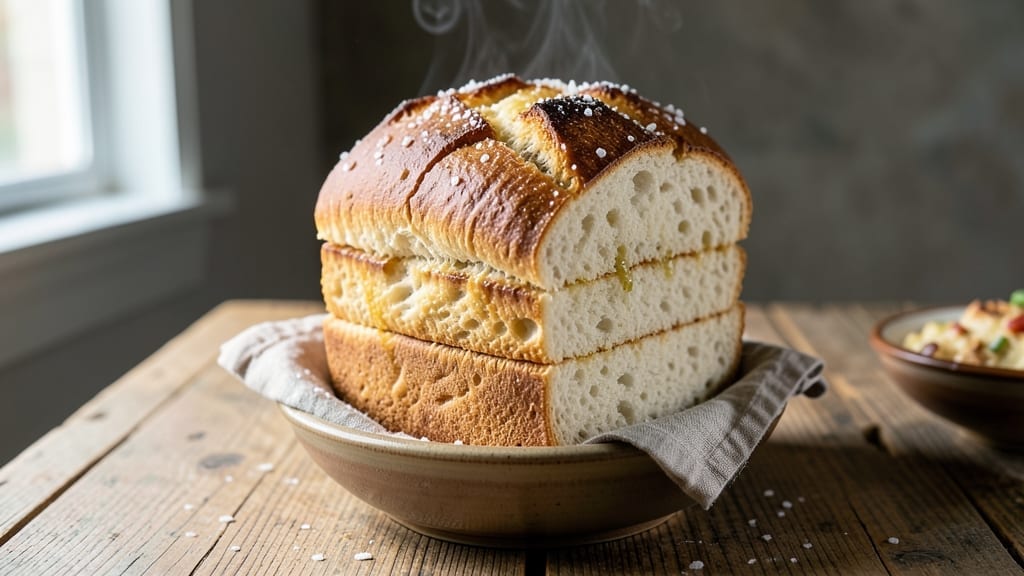
This 2-lb sandwich bread recipe delivers the perfect balance of a crisp, airy crust and a soft, pillowy interior—ideal for sandwiches that hold up without turning soggy. 💛 The secret lies in precise kneading and proofing techniques that create an open crumb structure while maintaining that signature sandwich bread texture.
I’ve baked hundreds of loaves, and this method consistently produces results that rival artisanal bakery bread.
What sets this recipe apart is the foolproof method that works for home bakers, even those new to bread-making. With just five simple ingredients—flour, yeast, sugar, salt, and water—you’ll create a loaf that’s tender enough to hold fillings like mayo and mustard without falling apart.
The dough develops naturally through a two-hour rise, allowing flavors to meld and gluten to strengthen for that perfect sandwich texture.
By the time it emerges from the oven, you’ll have a golden-brown loaf with a crisp crust that stays fresh for days. The interior remains soft and even, perfect for slicing into even, sturdy sandwiches.
This isn’t just bread—it’s a game-changer for lunchboxes, charcuterie boards, or your daily PB&J. The recipe scales easily, so you can bake two loaves at once for gatherings or meal prep.
For those who love customization, try adding seeds or herbs to the dough before baking—everything from poppy seeds to rosemary works beautifully. The key is adjusting the hydration slightly if you add mix-ins. Let’s get started on making bread that’s truly worth the effort.
Ingredients for 2 lb sandwich bread
Five core ingredients plus optional seeds create the perfect sandwich bread loaf—crisp crust, soft interior, and foolproof texture.
| Ingredient | Amount | Notes |
|---|---|---|
| Unbleached All-Purpose Flour 🌾 | 3 ½ cups | Sifted for even texture |
| Active Dry Yeast 🍞 | ¼ tsp | Or 1 packet (2.25 tsp) |
| Granulated White Sugar 🍚 | ½ tsp | Feeds yeast activation |
| Diamond Crystal Kosher Salt 🧂 | 1 ½ tsp | Adjusts dough hydration |
| Warm Water 💧 | 1 ¼ cups | 110°F for yeast activation |
| Extra-Virgin Olive Oil 🫒 | 1 tbsp | Enhances crust texture |
| Poppy Seeds or Sesame Seeds 🌱 | 2 tbsp | Optional for texture |
| Cornmeal 🌽 | 2 tbsp | Prevents sticking |
| Egg Wash 🥚 | 1 whole | 1 egg + 1 tbsp water |
The flour is everything here—King Arthur or Bob’s Red Mill all-purpose work best for that signature sandwich bread texture. No substitutions—bread flour adds too much gluten, cake flour too little. Yeast can be tricky: check expiration dates—old yeast won’t activate properly. For the sugar, white granulated is ideal, but brown sugar adds subtle depth if you’re feeling adventurous. Salt matters too—Diamond Crystal is lighter than Morton’s, so use exactly 1.5 tsp. The water temperature is critical: 110°F activates yeast without killing it. Too hot? It dies instantly. Too cold? It won’t wake up. A kitchen thermometer is worth the investment.
No yeast on hand? Instant yeast works 1:1, but active dry requires proofing in water first. Swapping seeds? Everything bagel seasoning or toasted sesame seeds add amazing flavor. The olive oil isn’t just for flavor—it creates that crisp crust while keeping the interior tender. If you’re baking two loaves, double everything—the dough will be manageable. For the egg wash, beat the egg lightly to avoid a thick coating. And if you’re adding seeds, mix them into the dough at the very end—they’ll distribute evenly during the final knead.
Freshly baked loaves stay crisp for 2 days if wrapped in a clean kitchen towel. For longer storage, freeze slices between parchment paper—perfect for quick sandwiches. The dough can be prepped overnight in the fridge (cover tightly) and baked the next day. Pro tip: Toasting stale slices revives that crisp texture. And if you bake two loaves? Gift one—homemade bread is always appreciated.
Why You’ll Love This Recipe
- Five-Ingredient Magic: I swear by this lineup—just flour, yeast, sugar, salt, and water. No fancy add-ins, no stress. The yeast does all the work while I sip my coffee.
- Crusty Yet Tender: That perfect snap when you tear it? The kosher salt and sugar balance the dough just right. Honestly, it’s the kind of bread that makes toast taste like a victory.
- Meal Prep MVP: Bake a loaf on Sunday, and you’ve got sandwiches for the week. Toast it for breakfast, pack it for lunch, or freeze slices for quick PB&Js later—no guilt, just good bread.
- Budget-Friendly Staple: A 2-pound loaf costs pennies to make, yet it feeds a family for days. Between us, this is how I stretch my grocery budget without sacrificing flavor. (Yes, even on a Tuesday night.)
Step-by-step instructions for homemade sandwich bread
Here’s how to craft a perfect loaf with that coveted airy crust and tender crumb.
👨🍳 Step 1: Activate the Yeast for Maximum Rise
In a small bowl, whisk together the 1.25 cups warm water (tested at 110°F—yeast should be lively but not hot), 0.5 tsp granulated white sugar, and 0.25 tsp active dry yeast. Let it sit for 5-10 minutes until foamy and bubbly—this proves your yeast is alive and ready to work its magic.
I always do this check before mixing everything: if no bubbles form, your yeast is dead and you’ll need to start fresh. The sugar feeds the yeast, jumpstarting fermentation that creates that signature soft crumb we’re after.
👨🍳 Step 2: Mix Dough Until Windowpane Test Passes
In a large bowl, combine the 3.5 cups unbleached all-purpose flour and 1.5 tsp diamond crystal kosher salt. Make a well in the center, then pour in the yeast mixture and 1 tbsp extra-virgin olive oil. Using a wooden spoon, stir until a shaggy dough forms.
Turn the dough onto a lightly floured surface and knead for 8-10 minutes until smooth and elastic. The windowpane test is your guide: stretch a small piece of dough until it’s thin enough to see light through without tearing. This develops gluten, which gives your bread that perfect structure and chew.
🥘 Step 3: Bulk Ferment for Optimal Flavor Development
Place the dough in a lightly oiled bowl, cover with a damp towel, and let rise in a warm place for 1-2 hours or until doubled in size. I like to use my oven with the light on for consistent warmth—this creates that perfect environment for yeast activity without overproofing.
Punch down the dough gently to release air, then shape it into a 2-pound loaf by rolling it into a log. Here’s the thing—don’t worry if it doesn’t look perfect. The beauty of homemade bread is in the imperfections that create character. Sprinkle the dough with 2 tbsp poppy seeds or sesame seeds (if using) for that extra crunchy texture.
🔥 Step 4: Shape and Proof for the Perfect Rise
Place the shaped loaf on a parchment-lined baking sheet, seam-side up. Cover again and let proof for another 30-45 minutes until puffy. The dough should spring back slowly when poked—this indicates it’s ready for the oven without collapsing.
While it proofs, preheat your oven to 375°F and sprinkle 2 tbsp cornmeal on the baking sheet. This creates a crisp barrier between your beautiful loaf and the pan. Brush the top with the egg wash (1 egg beaten with 1 tbsp water) for that golden, glossy finish we all crave.
🔥 Step 5: Bake to Golden Perfection
Bake for 25-30 minutes until the internal temperature reaches 190-200°F and the crust sounds hollow when tapped. The top should be deep golden brown with those irresistible air pockets you can’t get from store-bought.
Real talk: your oven might run hot, so start checking at the 20-minute mark. If it browns too quickly, tent with foil. Let the bread cool on a wire rack for at least 30 minutes before slicing—this prevents a gummy crumb. That wait is worth it for slices that stay fresh for days.
Pro Tips For Making 2 Lb Sandwich Bread
- Test Yeast First: Drop that yeast in warm water with a pinch of sugar—if it doesn’t bubble within 5 minutes, toss it and grab fresh. I learned this after wasting three batches of dough because “expired” yeast still looked fine but was dead inside.
- Measure Salt Precisely: Diamond Crystal kosher salt is not the same as table salt—use the recipe’s exact weight (about 2 teaspoons per pound of flour). I used “a little more” once and ended up with a dense, flavorless loaf that tasted like regret.
- Let Dough Rise Twice: Skip the second rise at your own risk—this is where sandwich bread gets its airy texture. After the first rise, punch it down, shape it, then let it sit another 45–60 minutes. My first attempt (only one rise) gave me bread that felt like eating a brick.
- Steam the Pan: Before baking, add a metal tray to the oven rack, pour in 1 cup of boiling water, and close the door for 5 minutes. This creates steam that gives your crust a soft, bakery-style finish instead of a dry, cracked top. Yes, it’s an extra step—but your sandwich bread will look like it came from a deli.
Dietary considerations for these flavors
Gluten-Free Adaptations
For a gluten-free version, swap the all-purpose flour for a 1:1 gluten-free baking blend like King Arthur Measure for Measure or Bob’s Red Mill 1-to-1. These blends contain xanthan gum, which mimics gluten’s structure.
Use 3.5 cups of the blend and add 1 extra tablespoon of olive oil to improve texture. Let the dough rest for 15 minutes after mixing to hydrate properly—gluten-free dough behaves differently. 🌾
Low-Carb/Keto Options
Skip the flour entirely and use almond flour or coconut flour for a keto-friendly loaf. For 2 cups almond flour, add 1 extra egg and ¼ cup melted butter to bind.
The dough will be crumbly, so shape it gently and bake at 350°F for 35-40 minutes. Expect a denser texture—this isn’t a direct replacement but works well for low-carb sandwiches. 🥑
Allergen-Free Considerations
To avoid common allergens, use egg-free wash (replace with 1 tbsp water + 1 tbsp milk) and dairy-free olive oil. For nut-free seeds, try sunflower seeds or pumpkin seeds instead of poppy/sesame.
Always check labels—some gluten-free blends contain trace nuts or dairy. Cross-contamination is key: use separate utensils and surfaces if allergies are severe. ✨
Vegan Substitutions
Replace the egg wash with 1 tbsp aquafaba (chickpea brine) or 1 tbsp plant-based milk + 1 tsp maple syrup for shine. For yeast activation, use vegan sugar (coconut or maple) and ensure your yeast is vegan-certified (some brands use animal products).
The dough will still rise beautifully—just monitor fermentation closely, as vegan dough can sometimes rise faster. 🌱
Diabetic-Friendly Tweaks
Reduce the sugar to ¼ tsp and use erythritol or monk fruit sweetener instead. Swap white flour for whole wheat pastry flour (lower glycemic index) or a 50/50 blend of white and almond flour.
These changes keep carbs in check while maintaining that soft, sandwich-worthy texture. Test blood sugar levels after baking to find your ideal balance. 💡
Nutrition facts
Frequently asked questions
Why does my sandwich bread turn out dense instead of soft?
The most common cause is under-kneading or overproofing. Knead until you pass the windowpane test (dough stretches thin without tearing), and proof until the dough springs back slowly when poked—not too fast or too slow. Also check your yeast—if it’s old or dead, the dough won’t rise properly.
Can I make this recipe without a stand mixer?
This dough only requires 8-10 minutes of hand-kneading on a lightly floured surface. Use the heel of your hand to push and fold the dough, rotating it 90 degrees after each push. The key is consistency—keep kneading until the dough becomes smooth and elastic.
How do I store homemade sandwich bread to keep it fresh?
Wrap the cooled loaf in a clean kitchen towel and store at room temperature for 2 days. For longer storage, slice and freeze between parchment paper—thaw slices as needed. The towel trick keeps the crust crisp while maintaining softness. For extra freshness, place an apple in the bread box to absorb moisture.
What’s the secret to a crisp crust without burning the inside?
Bake at 375°F and use the egg wash—it creates a golden barrier. If the top browns too quickly, tent with foil after 20 minutes. The internal temperature should reach 190-200°F—use an instant-read thermometer. A crisp crust starts with proper proofing and a hot oven.
Can I bake two loaves at once for gatherings?
Yes! Simply double all ingredients and bake on two parchment-lined sheets. Space them apart—don’t crowd the oven. The 25-30 minute bake time remains the same, but check for doneness at 20 minutes since ovens vary. Two loaves make perfect sandwiches for a crowd!

- Pea Soup Instant Pot Recipe: Velvety Green Smoothness in 20 Minutes - November 1, 2026
- Pork Loin Pulled Pork Crock Pot Recipe: Slow-Smoked Tenderness With Zero Dryness - November 1, 2026
- Baked Potatoes in Crock Pot Recipe: Buttery Interiors and Crispy Top Magic - November 1, 2026