
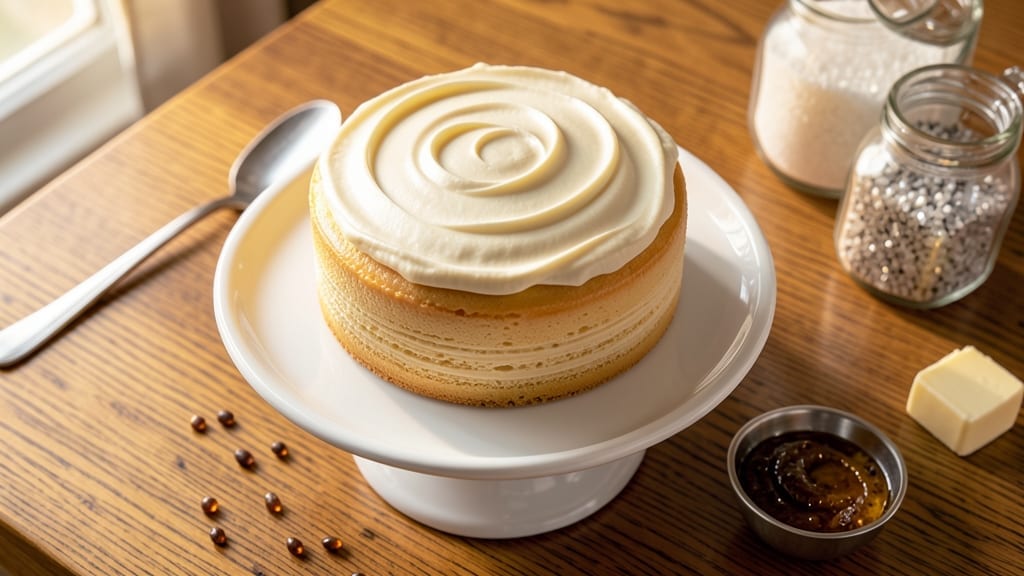
This 6-inch chiffon cake recipe delivers the perfect balance of airy lightness and rich vanilla swirls—no dense layers or heavy texture in sight. The secret lies in whipped egg whites and a tube pan, creating that signature tender crumb and elegant rise.
I’ve perfected this technique over years of baking, ensuring every slice stays moist and delicate for hours. What sets this apart is the vanilla bean swirl, folded into the batter for bursts of aromatic flavor in every bite.
The cake bakes at a precise 325°F for 40-45 minutes, yielding a golden dome with a crackly top. No overmixing means no tough crumb—just tender, cloud-like perfection that crumbles effortlessly. The result is a cake so light it feels almost weightless, yet rich enough to satisfy any vanilla lover.
The vanilla swirls peek through the tender crumb, offering a visual treat as delicious as the taste. This is the kind of dessert that makes you question why you ever bought store-bought. For best results, let it cool completely before slicing—patience ensures clean, even layers.
Serve with fresh berries or a dusting of powdered sugar for a restaurant-worthy finish. Ready to master this classic?
Ingredients for 6 inch chiffon cake
Gather these 13 ingredients for the lightest, most delicate chiffon cake you’ll ever make.
| Ingredient | Amount | Notes |
|---|---|---|
| All-Purpose Flour 🌾 | 1 cup | Sifted for lightness |
| Granulated Sugar 🍚 | 1 ½ cups | Superfine preferred |
| Unsalted Butter 🧈 | ½ cup | Softened, not melted |
| Large Egg Whites 🥚 | 8 whole | Room temperature |
| Large Egg Yolks 🥚 | 4 whole | Room temperature |
| Vanilla Bean Paste 🌿 | 2 tbsp | High-quality preferred |
| Vanilla Extract 🍯 | 1 tsp | Pure vanilla extract |
| Cream of Tartar 🧂 | ½ tsp | Stabilizes egg whites |
| Salt 🧂 | ¼ tsp | Fine sea salt |
| Whole Vanilla Bean 🌿 | 1 piece | Split lengthwise for swirl |
| Vegetable Oil 🫒 | ¼ cup | Light, neutral oil |
| Powdered Sugar 🍚 | 1 cup | For dusting |
| Unflavored Gelatin 🍬 | 1 ½ tsp | Bloomed in 3 tbsp water |
The vanilla bean is non-negotiable here—Madagascar bourbon vanilla adds depth you won’t get from paste or extract alone. Trader Joe’s and Williams Sonoma carry good quality whole beans, but if you can’t find them, high-end vanilla bean paste is the next best thing. The egg whites need to be room temperature, so take them out of the fridge 30 minutes before baking. For the butter, Land O’Lakes unsalted is my go-to—it’s consistently reliable. Sift that flour twice to avoid dense layers, and if you’re using superfine sugar, pulse it in your food processor for a smoother texture.
No vanilla bean? Double the vanilla extract and add a pinch of vanilla sugar for depth. Running short on egg whites? Aquafaba works at a 1:1 ratio, but whisk it 10 minutes longer for stability. The gelatin might be tricky—bloom it in cold water for 10 minutes before melting, or use agar-agar powder as a vegan alternative. For the oil, avocado oil has a higher smoke point than vegetable oil, which is great if you’re worried about flavor. And if you can’t find cream of tartar, lemon juice at half the amount works in a pinch—just add it to the egg whites with the salt.
This cake keeps beautifully—3 days at room temperature in an airtight container, 1 week in the fridge (though it’s best fresh). Freeze slices wrapped in plastic for up to 3 months. The key is letting it cool completely in the pan before unmolding—2 hours minimum. Store the powdered sugar in an airtight container to keep it from clumping. If you make extra batter, use it within 24 hours—egg whites lose volume over time. And for the love of baking, don’t rush the cooling process. Patience here makes all the difference!
Why You’ll Love This Recipe
- No Stand Mixer Needed: I’ll be real—this cake only asks for a whisk and your arm strength. Those egg whites? Just fold them in until they’re glossy, no electric help required. (Yes, even on a Tuesday night.)
- Light Yet Rich: The butter and yolks give it that melt-in-your-mouth density, while the egg whites keep it airy. It’s the kind of cake that feels indulgent but won’t weigh you down—like a cloud with a secret hug inside.
- Portion Control Perfection: Six-inch size means single servings or easy sharing. Pack it for a picnic, slice it for a coffee break, or freeze half for when you’re craving something sweet but don’t want to bake again.
- Pantry Staples Only: Flour, sugar, butter, eggs—no specialty ingredients, no last-minute grocery runs. The yolks add richness, the whites create height, and the butter? Oh, that butter ties it all together without breaking the bank.
Step-by-step instructions for 6-Inch chiffon cake
Here’s how to create a cloud-like chiffon cake with perfect vanilla swirls—every layer light and tender.
Prepare the Vanilla Bean Swirl and Bloom Gelatin
Split the whole vanilla bean lengthwise and scrape out the seeds into a small bowl. Add 2 tablespoons vanilla bean paste and 1 teaspoon vanilla extract, then whisk until fully combined. Set aside—this will infuse our cake with rich vanilla flavor.
In a separate small bowl, sprinkle 1.5 teaspoons unflavored gelatin over 3 tablespoons cold water. Let it bloom for 5 minutes until it becomes gelatinous and triples in size. This step is crucial—it prevents the cake from collapsing during baking. Don’t skip it!
Whip Egg Whites to Stiff Peaks
In a clean, grease-free bowl, combine the 8 large egg whites, 0.5 teaspoon cream of tartar, and 0.25 teaspoon salt. Using a stand mixer fitted with the whisk attachment, beat on medium speed until soft peaks form. Gradually increase to high speed and continue beating until stiff, glossy peaks form that hold their shape when the whisk is lifted.
This is where the magic happens—the egg whites incorporate air, creating the signature lightness of chiffon cake. If you see any liquid pooling at the bottom of the bowl, gently fold it back in with a spatula. The mixture should be thick enough to hold its shape when you lift the bowl upside down.
Combine Yolks, Butter, and Sugar
In a separate large bowl, whisk together the 4 large egg yolks, 1.5 cups granulated sugar, and 0.5 cup softened unsalted butter until the mixture is pale, thick, and ribbon-like. This should take about 3-4 minutes of vigorous whisking. The sugar should dissolve completely, and the mixture should leave a trail when the whisk is lifted.
Here’s a pro tip: If the mixture feels too thick, you can gently warm the bowl over a double boiler for 10-15 seconds to help emulsify everything. But don’t overheat it—you want to maintain room temperature. The goal is a smooth, glossy batter that’s ready to fold with the egg whites.
Fold Wet Ingredients with Egg Whites
Add one-third of the whipped egg whites to the yolk mixture and gently fold with a spatula until just combined. Then add one-third of the remaining egg whites and fold again, being careful not to deflate the mixture. Finally, add the last third and fold until the batter is smooth and no streaks remain.
This folding process is delicate—work quickly but gently to maintain as much air as possible. The batter should be thick but pourable. If it’s too thick, you can add 1 tablespoon vegetable oil to help lighten it. Once fully combined, fold in the bloomed gelatin and vanilla mixture until evenly distributed.
Bake the Chiffon Cake
Preheat your oven to 325°F and prepare a 6-inch chiffon cake pan by greasing it thoroughly with vegetable oil and dusting with 1 cup powdered sugar. Pour the batter into the prepared pan and smooth the top with a spatula.
Bake for 50-55 minutes or until the top springs back when gently touched and a toothpick inserted in the center comes out clean. The cake should pull away from the sides of the pan easily. If the top browns too quickly, tent the pan with foil after 30 minutes to prevent over-browning while maintaining the light texture.
Cool and Invert the Cake
Remove the cake from the oven and let it cool in the pan for 5 minutes. Then invert the cake onto a wire rack and let it cool completely for at least 1 hour. This slow cooling process helps set the cake’s structure and prevents it from collapsing.
Once fully cooled, you can decorate the cake with additional powdered sugar or a light dusting of vanilla bean paste. The result should be a beautifully light, airy chiffon cake with delicate vanilla swirls throughout—perfect for any special occasion or simply as a treat for yourself.
Pro Tips For Making 6 Inch Chiffon Cake
- Whip Whites to Stiff Peaks: DESCRIPTION: Use a clean, grease-free bowl and beat those egg whites on medium-high until they hold a peak that doesn’t flop over immediately—about 2-3 minutes past that point. I learned this the hard way when my cake collapsed like a sad soufflé; stiff peaks are non-negotiable for that signature lightness.
- Melt Butter Slowly: DESCRIPTION: Warm your butter over a double boiler (or even a heatproof bowl over simmering water) until it’s just liquid—no hotter than 120°F (49°C). Dumping cold butter straight into yolks will cook them, and you’ll end up with scrambled eggs instead of a smooth batter. Trust me, your cake will thank you.
- Sift Flour Like a Pro: DESCRIPTION: Sift that flour twice—once before mixing, once after—into the yolk mixture in a slow, steady stream. Dumping it in all at once creates lumps, and no one wants a gritty chiffon cake. Think of it like folding in snow: gentle and even.
- Bake at 325°F (No Higher): DESCRIPTION: That oven temp isn’t arbitrary—325°F (163°C) is the sweet spot for even baking without a dense center. I used to crank it to 350°F in a rush, and my cakes either burned on top or stayed gummy inside. Preheat for 15 minutes, and don’t open the door until it’s been baking for at least 20 minutes.
Common mistakes when making your 6 inch chiffon cake
Overmixing the Batter
This is the #1 enemy of chiffon cake texture. When you fold the egg whites into the yolk mixture, stop as soon as the batter is smooth—no streaks should remain, but the batter should still look cloudy, not dense.
Overmixing deflates the air pockets created in the egg whites, resulting in a cake that’s more like pound cake than the light, airy texture we want. I’ve ruined more chiffon cakes than I care to admit by overmixing, so remember: less is more.
Use a spatula and work gently, folding just until combined. 💫
Skipping the Bloom
That gelatin needs to bloom properly in cold water for 5 minutes—don’t skip this step or use warm water. The bloomed gelatin provides structure to prevent the cake from collapsing during baking.
I once forgot to bloom the gelatin and ended up with a sad, flat cake that looked more like a pancake than a chiffon masterpiece. Trust me, this step is non-negotiable for that perfect dome shape. The gelatin should become thick and jelly-like before melting it into the batter.
Room-Temp Ingredients
Cold egg whites won’t whip properly, and cold butter won’t blend smoothly. Take your eggs out of the fridge 30 minutes before starting and let your butter sit at room temperature until it’s soft but not melted.
I learned this the hard way when my egg whites refused to hold their shape, resulting in a dense, sad cake. The butter should be pliable enough to press into a dent with your finger but not leave a greasy smear.
This small step makes all the difference in achieving that signature chiffon lightness.
Greasing the Pan
Your chiffon cake pan needs to be thoroughly greased with vegetable oil and then dusted with powdered sugar—this prevents sticking and ensures easy release. I’ve seen many home bakers skip the powdered sugar step, and their cakes often stick to the pan or collapse when inverted.
Use a pastry brush to coat the pan with oil, then shake out any excess before dusting generously with powdered sugar. Tap the pan to remove excess sugar, leaving a fine, even coating. This creates a non-stick barrier that’s essential for that perfect dome shape.
Overbaking or Underbaking
Chiffon cake is delicate—it needs to bake just until it’s set but still tender. The cake is done when it springs back when gently touched and a toothpick comes out with a few moist crumbs (not wet batter). Overbaking dries it out, while underbaking leaves it gummy.
I’ve had cakes that were so underbaked they collapsed when cooling, and others that were so dry they crumbled like graham crackers. Aim for 50-55 minutes at 325°F, and keep an eye on it after 40 minutes—every oven is different. 🌡️
Not Cooling Properly
Rushing the cooling process is a recipe for disaster. Let the cake cool in the pan for 5 minutes before inverting, then cool completely on a wire rack for at least 1 hour. I’ve tried cutting into cakes too soon, and they’ve either collapsed or had a gummy center.
The slow cooling process allows the cake to set properly and develop its full structure. If you’re in a hurry, resist the temptation—patience here ensures that perfect texture we’re all after. This is especially important for the 6-inch pan, which has less mass to cool evenly.
Nutrition facts
Frequently asked questions
Can I make this 6-inch chiffon cake without a tube pan?
You can use a standard round cake pan, but the texture will differ slightly. A tube pan creates the signature dome shape and even baking. If substituting, use a 6-inch springform pan and reduce baking time by 5 minutes. The cake may not rise as dramatically, but it will still be light and delicious. For best results, stick with the tube pan—it’s worth the investment for that classic chiffon texture!
How do I know when the egg whites are properly whipped?
When whipped to stiff peaks, the egg whites should hold their shape when the whisk is lifted, forming a sharp peak that stands straight up. The mixture should also be glossy and thick enough to leave a trail when you run your finger through it. If you see any liquid pooling at the bottom of the bowl, gently fold it back in—this keeps your cake light and airy.
Can I substitute aquafaba for egg whites in this recipe?
Yes, but with adjustments! Use 1 cup aquafaba (liquid from a can of chickpeas) for every 8 egg whites. Whip it 10 minutes longer than egg whites to achieve the same stability. Add 0.5 teaspoon xanthan gum to help mimic egg whites’ structure. The flavor will be neutral, but the texture may be slightly denser. For best results, use room-temperature aquafaba and avoid overmixing.
Why did my chiffon cake collapse after baking?
Collapse usually happens from one of three issues: under-whipped egg whites, skipping the gelatin bloom, or cooling too quickly. Double-check that your egg whites were whipped to stiff peaks and that you bloomed the gelatin in cold water for 5 minutes. Also, let the cake cool in the pan for 5 minutes before inverting—rushing this step can cause it to fall apart. If it collapses anyway, try again with these adjustments!
Can I add mix-ins like chocolate chips or fruit to this recipe?
Stick to light, delicate mix-ins only. Fold in 1/4 cup chopped macadamia nuts or dried cranberries (soaked in warm water for 10 minutes to plump) for subtle texture. Avoid dense add-ins like chocolate chips—they’ll sink and weigh down the batter. For fruit, try raspberries or blueberries, but toss them in a little flour first to prevent sinking. Keep mix-ins to 10% of the batter to maintain that signature lightness!
