
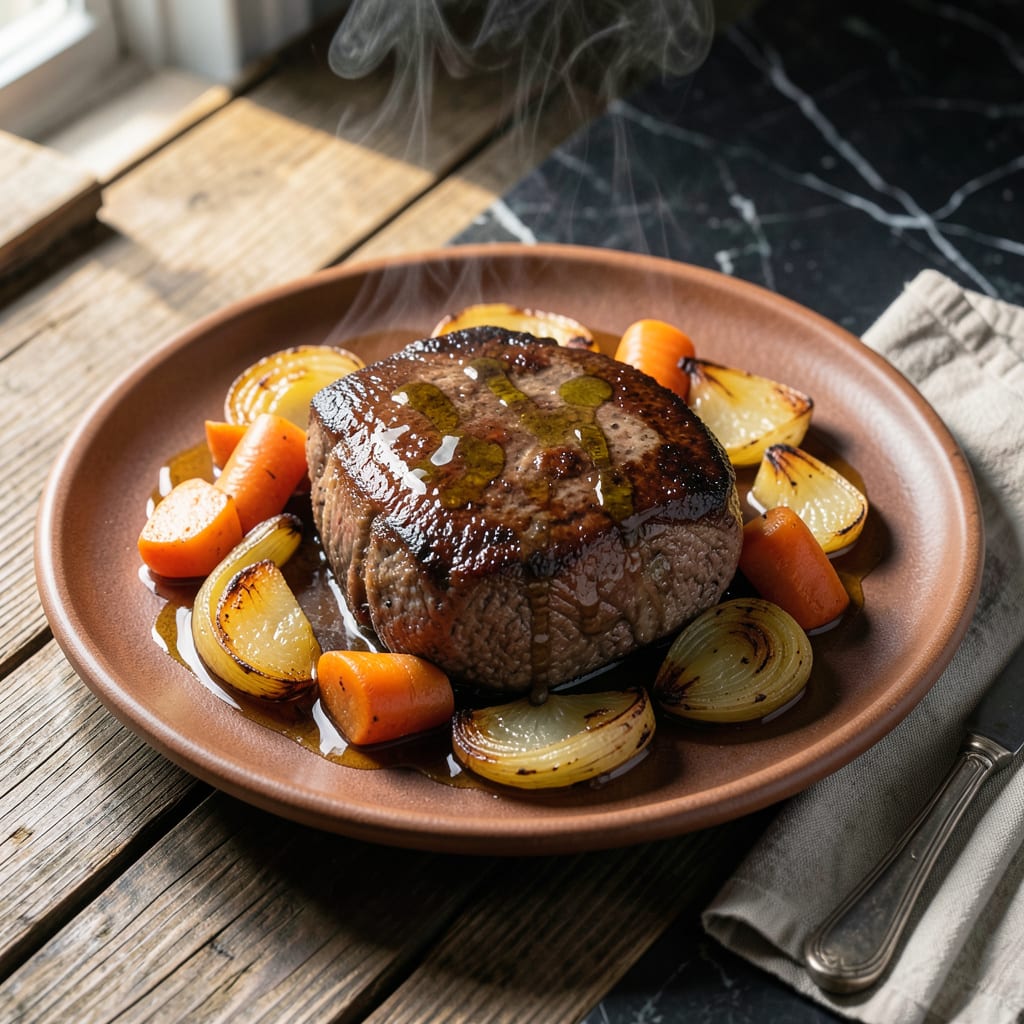
This slow-cooked pot roast delivers the rich, savory depth that made Houlihan’s version legendary. The secret lies in the long, gentle cooking process that transforms tough cuts into fall-apart tender meat.
With simple ingredients and patient time, you’ll achieve a dish with deep flavor, tender beef, and a gravy that’s restaurant-quality without the restaurant price.
Ingredients for Houlihan’s Pot Roast
Simple ingredients transform into restaurant-quality comfort with patient cooking and careful selection.
| Ingredient | Amount | Notes |
|---|---|---|
| Chuck Roast 🥩 | 3 lb | Well-marbled, boneless preferred |
| Olive Oil 🫒 | 2 tbsp | Divided for searing and deglaing |
| Kosher Salt 🧂 | 1 ½ tsp | Diamond Crystal preferred |
| Freshly Ground Black Pepper 🌶️ | 1 tsp | Coarse grind for texture |
| Yellow Onion 🧅 | 2 whole | Large, cut into chunks |
| Carrots 🥕 | 4 whole | Peeled, cut into 2-inch pieces |
| Celery Stalks 🌿 | 3 whole | Cut into 2-inch pieces |
| Garlic Cloves 🧄 | 6 cloves | Smashed for robust flavor |
| Beef Broth 💧 | 2 cups | Low-sodium preferred for control |
| Red Wine 🍷 | 1 cup | Dry variety like Cabernet Sauvignon |
| Tomato Paste 🍅 | 2 tbsp | Double-concentrated for depth |
| Dried Thyme 🍃 | 1 tsp | Crushed between fingers to release oils |
| Dried Rosemary 🌿 | 1 tsp | Crushed between fingers to release oils |
| Bay Leaves 🍃 | 2 whole | Fresh or dried, removed before serving |
| All-Purpose Flour 🌾 | 2 tbsp | For thickening gravy |
[recipeingredientscaler]
The beef is non-negotiable for authentic results. Chuck roast with visible marbling (look for USDA Choice or Prime) ensures the melt-in-your-mouth texture that defines this dish. Most Whole Foods or Costco locations carry well-marbled cuts—ask the butcher for a 3-pound piece if you’re serving a crowd. Avoid lean cuts like round; they’ll stay tough no matter how long you cook them.
No red wine? Substitute with 1 cup beef broth plus 1 tbsp balsamic vinegar. Fresh herbs can replace dried (use triple the amount), but dried work perfectly here. Short on time? Pre-cut mirepoix from Trader Joe’s saves chopping. For gluten-free gravy, swap the flour for cornstarch (use 1 tbsp cornstarch + 1 tbsp water as a slurry).
Leftovers taste even better the next day. Store in an airtight container in the fridge for up to 5 days or freeze for 3 months. Reheat gently on the stove with a splash of broth to revive the gravy. Always remove bay leaves before storing to avoid bitterness.
Why You’ll Love This Recipe
- Set It and Forget It: I just season the chuck roast with salt, pepper, and let it slow-cook with onion—minimal hands-on time.
- Feeds Everyone: Honestly, it’s my go-to for Sunday dinner, potlucks, or even a cozy night in with leftovers.
- Budget Winner: A cheap chuck roast turns into something extraordinary—saves me money and still impresses.
Step-by-Step Instructions for Slow-Cooked Savory Pot Roast
Master the technique for fall-apart tender meat and rich, velvety gravy with these precise steps.
Step 1: Sear and Season the Chuck Roast
Pat the 3 lb chuck roast dry with paper towels, then season generously with 1.5 tsp kosher salt and 1 tsp freshly ground black pepper on all sides. This drying step is crucial—it ensures a proper sear rather than steaming.
Heat 1 tbsp olive oil in a Dutch oven over medium-high heat until shimmering. Add the chuck roast and sear for 4-5 minutes per side until deeply browned. You want a dark, caramelized crust—this builds the foundation of flavor for the entire dish.
Step 2: Build the Aromatic Base
Remove the chuck roast and set aside. In the same Dutch oven, add the remaining 1 tbsp olive oil. Add the 2 whole yellow onion (cut into chunks), 4 whole carrots (peeled and cut into 2-inch pieces), and 3 whole celery stalks (cut into 2-inch pieces). Cook for 5-6 minutes until the onions begin to soften.
Add the 6 cloves garlic cloves (smashed) and cook for 1 minute until fragrant. Stir in the 2 tbsp tomato paste and cook for 2 minutes, allowing it to deepen in color. This step develops the base flavors that will infuse the meat during the long cook.
Step 3: Deglaze and Add Liquids
Pour in the 1 cup red wine and scrape the bottom of the pot to release all the browned bits. Let it simmer for 3-4 minutes until reduced by half. This deglazing step captures all the concentrated flavor from the searing process.
Add the 2 cups beef broth, 1 tsp dried thyme, 1 tsp dried rosemary, and 2 whole bay leaves. Return the chuck roast to the pot, along with any accumulated juices. The liquid should come about halfway up the meat.
Step 4: Slow Cook to Perfection
Bring the liquid to a simmer, then reduce the heat to low. Cover and cook for 3-3.5 hours, turning the chuck roast every 45-60 minutes to ensure even cooking. You want the meat to become fork-tender and easily pull apart.
The cooking time may vary slightly depending on your pot and heat source, but the meat is done when it shreds easily with a fork. Resist the urge to peek too often—every time you lift the lid, you extend the cooking time.
Step 5: Thicken the Gravy and Serve
Remove the chuck roast and set aside. Skim any excess fat from the surface of the liquid. In a small bowl, mix the 2 tbsp all-purpose flour with 2 tbsp of the cooking liquid to create a slurry. Stir the slurry into the pot and simmer for 5-7 minutes until the gravy thickens.
Return the chuck roast to the pot to coat it in the gravy. Remove the bay leaves before serving. This dish is best when the meat is served with the vegetables and gravy ladled over the top.
Pro Tips For Making Houlihan’S Pot Roast
- Sear the Chuck: I learned this the hard way—always sear the chuck roast on all sides in hot olive oil until deeply browned (about 4-5 minutes per side). It builds a flavor base that slow cooking just can’t replicate.
- Season Generously: Don’t be shy with the kosher salt and black pepper; coat that roast like you mean it, especially if it’s a thick cut. The seasoning needs to penetrate.
- Don’t Rush the Onions: After searing the meat, cook the yellow onions in the same pot until they’re soft and translucent—about 8 minutes. Skipping this step leaves them raw and harsh.
- Use a Heavy Pot: A Dutch oven or heavy-bottomed pot distributes heat evenly and prevents burning, especially during the long braise. Thin pots always give me uneven results.
Storing and Reheating Leftovers
Refrigerator Storage
Let your pot roast cool to room temperature within 2 hours, then transfer to airtight containers. I use glass containers with locking lids to prevent leaks. Store in the fridge at 40°F or below for up to 5 days. The flavors continue to develop overnight. ❄️
Freezer Storage
For longer storage, freeze portions in heavy-duty freezer bags with as much air removed as possible. Label with the date—it’ll keep for up to 3 months without losing quality. I recommend freezing in individual servings for easy reheating. Leave 1 inch headspace for expansion.
Stovetop Reheating
My preferred method: transfer the pot roast and gravy to a saucepan. Add ¼ cup beef broth to loosen the gravy. Heat over medium-low heat for 10-15 minutes, stirring occasionally, until warmed through. This revives the texture perfectly. 🔥
Microwave Reheating
For quick meals, place a single portion in a microwave-safe dish. Cover with a damp paper towel and heat on 70% power for 2-3 minutes. Stir, then continue heating in 1-minute intervals until reaching 165°F. Add a splash of broth if needed.
Nutrition Facts
Frequently Asked Questions
What’s the best cut for tender results?
Use a well-marbled 3 lb chuck roast for authentic texture. Lean cuts like round stay tough no matter how long they cook. Look for USDA Choice or Prime at your butcher.
Can I skip the red wine?
Yes! Substitute with 1 cup beef broth plus 1 tbsp balsamic vinegar. The acidity mimics wine’s depth. This works nearly as well for the rich gravy.
How do I know when it’s done?
Check after 3 hours—it’s ready when meat shreds easily with a fork. Don’t rely on time alone; the texture is the true test. Turn every 45-60 minutes for even cooking.
Why did my gravy turn out thin?
You may need more slurry. Mix 1 tbsp flour with 1 tbsp cooking liquid, then stir in. Simmer for 5-7 minutes until thickened to coat the back of a spoon.

- 4C Bread Crumbs Meatballs Recipe: Crispy Crust and Juicy Centers - September 25, 2026
- 6 Oz Chocolate Chip Cookie Recipe: Perfectly Balanced Crispy Edges and Chewy Hearts - September 25, 2026
- 6-Inch Coffee Cake Recipe: Vanilla Bean Swirls and Buttery Streusel Topping - September 25, 2026