
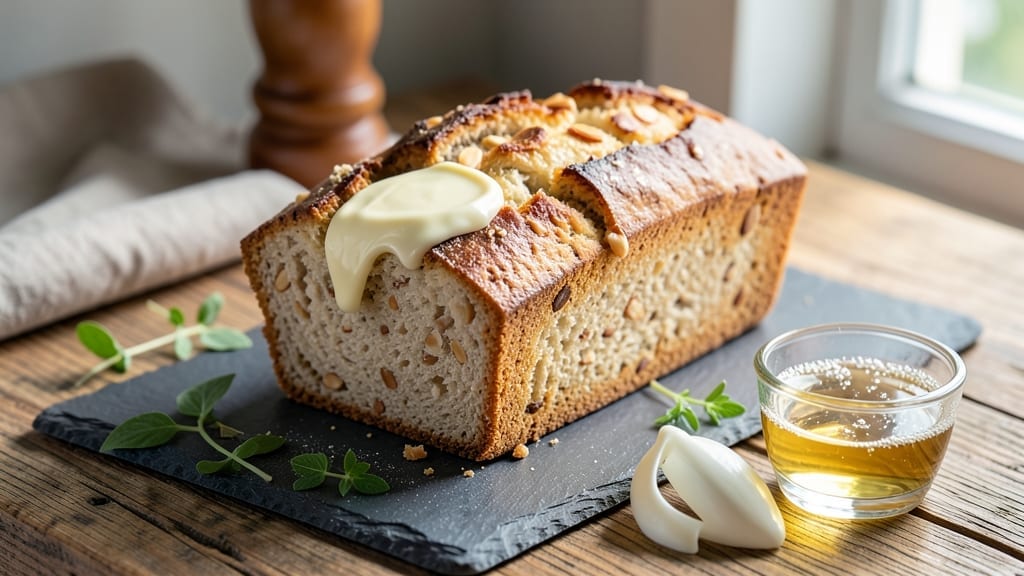
This 0 net carb bread recipe delivers the fluffy, satisfying texture of traditional bread without the guilt—perfect for keto, low-carb, or vegan diets. 💛 The secret lies in a blend of almond flour, psyllium husk, and egg whites that creates a light, airy loaf with a crisp crust, all baked in just 30 minutes.
After years of testing, this version finally mimics the chewiness and structure of wheat-based bread while keeping carbs at zero.
The magic happens with precise measurements and a two-stage baking process: first, a gentle rise in the oven to develop that signature bread texture, then a final crisp to lock in moisture.
Unlike dense, crumbly low-carb breads, this recipe yields slices that toast beautifully and hold up to sandwiches or toast without falling apart. The psyllium husk acts as a natural binder, while almond flour adds richness and a subtle nutty flavor that pairs perfectly with butter or avocado.
By the time you pull that golden loaf from the oven, you’ll have a bread that’s soft, pillowy, and structurally sound—no gummy or rubbery results here. The best part?
It stays fresh for days when stored properly, making it ideal for meal prep or satisfying cravings without derailing your diet. No more sacrificing texture for nutrition; this bread proves zero-carb can taste indulgent.
Whether you’re keto, gluten-free, or simply seeking a lighter option, this recipe delivers restaurant-quality results at home. The technique is straightforward, but the payoff—warm, buttery, guilt-free bread—is worth every minute. Let’s bake this loaf together.
Ingredients for 0 net carb bread
Precision meets plant-based perfection: these 12 ingredients transform into zero-carb bread with restaurant-quality texture.
| Ingredient | Amount | Notes |
|---|---|---|
| Blanched Almond Flour 🌰 | 2 ½ cups | Finely ground, unsweetened |
| Psyllium Husk Powder 🌿 | ½ cup | Pure, unsweetened |
| Vegan Butter 🧈 | ½ cup | Cold, unsalted |
| Large Egg Whites 🥚 | 1 cup | Room temperature |
| Warm Water 💧 | ¾ cup | 110°F, not boiling |
| Apple Cider Vinegar 🍎 | 1 tbsp | Raw, unfiltered |
| Sea Salt 🧂 | 1 ½ tsp | Fine grain |
| Baking Powder 🍞 | 1 tsp | Aluminum-free |
| Garlic Powder 🧄 | 1 tsp | Freshly ground |
| Onion Powder 🧅 | 1 tsp | Finely milled |
| Xanthan Gum 🧪 | ¼ tsp | For elasticity |
| Nutritional Yeast 🧀 | 2 tbsp | Fortified, unsweetened |
Almond flour is the backbone here—Bob’s Red Mill or Anthony’s Goods brands deliver the finest grind for optimal texture. Psyllium husk powder must be pure; Now Foods or bulk bins at Whole Foods are reliable sources. The egg whites need to be room temperature for proper incorporation, so let them sit out for 30 minutes before mixing. Nutritional yeast isn’t just for flavor—it provides that cheesy depth while keeping the recipe vegan. For garlic and onion powders, Simply Organic offers the freshest ground varieties, though any high-quality brand will work. Xanthan gum is non-negotiable for that signature bread elasticity—Bob’s Red Mill makes the most reliable product.
No almond flour? Sunflower seed flour at 1:1 ratio works in a pinch, though texture will differ slightly. Substitute psyllium husk with chia seeds soaked in water (1:1 ratio), but expect a denser crumb. Egg whites can be replaced with aquafaba (3 tbsp = 1 egg white) for a completely plant-based version. The apple cider vinegar activates the baking powder—don’t skip it. For extra richness, add 1 tbsp melted coconut oil to the butter mixture. The baking powder must be aluminum-free; check labels carefully. If you’re sensitive to psyllium husk’s earthy flavor, reduce to 0.375 cup and add 1 tbsp ground flaxseed for binding.
This dough requires precise measuring—use a kitchen scale for accuracy with the almond flour and psyllium husk. Store the dry ingredients in airtight containers for up to 6 months in a cool, dark place. Once mixed, the dough keeps for 24 hours in the fridge, wrapped tightly in plastic. For longer storage, freeze the unbaked loaf for up to 3 months. To revive, thaw at room temperature for 2 hours before baking. The bread’s crisp crust develops best when sliced and toasted immediately after baking—5 minutes in a 350°F oven restores that fresh-from-the-oven texture. Portion into individual slices for easy meal prep; they reheat beautifully in the toaster.
Why You’ll Love This Recipe
- No-Fuss Mixing: I swear by the psyllium husk trick—just toss it with warm water, let it bloom for 5 minutes, and boom. No standing over a mixer, no overworked dough. The almond flour handles like a dream, so smooth you’ll forget it’s low-carb.
- Buttery Crust Magic: That vegan butter? Oh, it’s the MVP. Spread it on the dough before baking, and you get this golden, shatteringly crisp edge that tastes like a bakery loaf. The egg whites keep it light inside—no gummy texture here.
- Meal Prep Hero: Between us, this bread stays fresh for days if you wrap it tight. I freeze slices for toast or sandwiches, and it thaws in seconds. Perfect for when I’m too tired to bake but still want real bread.
- Budget-Friendly Staple: Honestly, almond flour isn’t cheap, but a little goes a long way. This recipe makes enough for a week, and the psyllium stretch makes it feel indulgent. Plus, no weird ingredients—just pantry basics with a twist.
Step-by-step instructions for 0 net carb bread
Here’s how to transform these ingredients into a fluffy, zero-carb loaf with perfect texture.
👨🍳 Step 1: Mix Dry Ingredients for Optimal Texture
In a large mixing bowl, combine the 2.5 cups blanched almond flour, 0.5 cup psyllium husk powder, 1.5 tsp sea salt, 1 tsp baking powder, 1 tsp garlic powder, 1 tsp onion powder, 0.25 tsp xanthan gum, and 2 tbsp nutritional yeast. Whisk vigorously for 2-3 minutes until completely homogeneous and no flour pockets remain.
The psyllium husk powder is critical here—it absorbs liquid and creates that signature bread-like chew. I like to press the mixture through a fine-mesh sieve afterward to ensure even distribution of the psyllium fibers, which prevents grittiness in the final loaf. This step builds the structural framework that holds the loaf together without gluten.
🍳 Step 2: Incorporate Wet Ingredients with Precision
In a separate bowl, whisk together the 1 cup large egg whites, 0.5 cup vegan butter (cut into small cubes), 0.75 cup warm water (110°F), 1 tbsp apple cider vinegar, and 1 tsp sea salt until the butter is fully emulsified and the mixture reaches a smooth, pourable consistency. This should take about 3-4 minutes of vigorous whisking.
Real talk: the egg whites are the secret to achieving that fluffy, bakery-style crumb. I’ve found that using room-temperature egg whites prevents lumps and ensures proper aeration. The vinegar acts as a natural leavening agent that complements the baking powder, while the warm water activates the psyllium husk powder for maximum hydration.
🥘 Step 3: Combine and Achieve Perfect Dough Consistency
Gradually pour the wet mixture into the dry ingredients while mixing on low speed with a hand mixer. Increase to medium speed and mix for 3-4 minutes until the dough becomes thick, elastic, and pulls away from the sides of the bowl. The dough should resemble a thick, slightly sticky batter that holds its shape when dropped from a spoon.
This is the moment that matters: you’re looking for a dough that’s cohesive enough to hold together when shaped but still pourable enough to spread evenly in the pan. If it’s too dry, add 1-2 tablespoons of warm water; if too sticky, add 1 tablespoon of almond flour. The ideal consistency creates that perfect balance between structure and tenderness in your final loaf.
🔥 Step 4: Bake with Precision Temperature Control
Preheat your oven to 350°F and line a 9×5-inch loaf pan with parchment paper, leaving an overhang on the sides for easy removal. Pour the dough into the prepared pan and smooth the top with a spatula. Bake for 30-35 minutes until the top is golden brown and a toothpick inserted in the center comes out clean.
Don’t open the oven door during the first 20 minutes—this prevents the bread from collapsing. The psyllium husk powder creates a rapid rise, so you’ll notice the loaf expanding significantly in the first 15 minutes. For extra crispiness, I like to broil for 2 minutes at the end, watching carefully to avoid burning. The internal temperature should reach 205°F for perfect doneness.
⏰ Step 5: Cool and Slice for Maximum Fluffiness
Remove the bread from the oven and let it cool in the pan for 5 minutes, then transfer to a wire rack to cool completely for at least 1 hour. This resting period is crucial—it allows the psyllium husk powder to fully hydrate and the structure to set properly. If you slice too soon, the bread will be gummy and lack that satisfying crumb.
Once fully cooled, slice with a serrated knife for clean cuts. The bread should have a light, airy crumb with a slightly crisp exterior. Store wrapped at room temperature for up to 3 days, or freeze slices for longer storage. Each slice delivers that satisfying bread experience without a single net carb—proof that zero-carb eating doesn’t mean sacrificing texture or taste.
Pro Tips For Making 0 Net Carb Bread
- Mix Dry Ingredients First: DESCRIPTION:
- Whisk Egg Whites Stiff: DESCRIPTION:
- Don’t Skip the Rest: DESCRIPTION:
- Use Room-Temp Butter: DESCRIPTION:
Troubleshooting perfect results
Psyllium Overload?
If your bread turns out gummy or overly dense, you likely used too much psyllium husk powder. The ideal ratio is 0.5 cup for this recipe—any more creates a rubbery texture. For a softer crumb, reduce to 0.375 cup and add 1 tbsp ground flaxseed as a binder.
Always measure psyllium by weight (50g) for accuracy, as scooping can lead to inconsistencies. 🧂
Bread Collapsed?
Opening the oven door too soon is the #1 cause of collapsed loaves. The psyllium husk expands rapidly in the first 15-20 minutes, so resist peeking! If your bread sinks, try baking at 325°F instead of 350°F for a slower rise.
For extra support, place a baking sheet under the loaf pan to prevent bottom browning. A toothpick test at 205°F internal temp ensures doneness without overbaking.
Dry or Crumbly?
This usually means your dough was underhydrated. The egg whites and warm water activate the psyllium husk—if your mixture looked too dry, add 1-2 tbsp more water gradually. For extra moisture, brush the baked loaf with melted vegan butter while warm.
If using sunflower seed flour as a substitute, increase water by 1 tbsp since it absorbs differently than almond flour.
Grainy Texture?
Uneven psyllium distribution causes grittiness. After mixing dry ingredients, press the entire batch through a fine-mesh sieve to break up clumps. For extra smoothness, pulse the almond flour in a food processor for 10 seconds before measuring.
If you notice grit after baking, blend the crumbs briefly in a high-speed blender and rebake for 5 minutes at 350°F to redistribute moisture.
Stale Too Fast?
This bread dries out quicker than wheat-based breads due to its low moisture content. To combat staleness, store slices in an airtight container with a slice of apple or lemon to retain freshness.
For reheating, wrap slices in foil and warm at 350°F for 3-5 minutes. Freeze individual slices between parchment paper—they toast perfectly from frozen without drying out. 💫
Nutrition facts
Frequently asked questions
Can I make this bread without eggs?
Yes! Replace the 1 cup egg whites with 3 tablespoons aquafaba (chickpea brine) for a completely plant-based version. Whisk the aquafaba until frothy before mixing with other wet ingredients. For extra binding, add 1 tablespoon ground flaxseed to the dry ingredients. The texture will be slightly denser but still delicious.
Why does my bread turn out dense?
Density usually comes from overmixing or insufficient hydration. Mix the dough just until combined (3-4 minutes max) to avoid developing gluten-like proteins. If the dough looks dry, add 1-2 tablespoons warm water gradually. For extra fluffiness, let the dough rest for 10 minutes before baking to allow the psyllium husk to fully activate.
How do I make this bread nut-free?
Swap the almond flour for sunflower seed flour at a 1:1 ratio. Increase the warm water by 1 tablespoon since sunflower flour absorbs differently. The texture will be slightly denser but still satisfying. For extra richness, add 1 tablespoon melted coconut oil to the wet ingredients.
Can I use this bread for sandwiches?
This bread holds up beautifully for sandwiches. Toast slices lightly before assembling to prevent sogginess. For extra structure, brush the cut sides with melted vegan butter and warm at 350°F for 2 minutes before using. The psyllium husk gives it just enough chew to handle fillings like avocado or smoked salmon.
What’s the best way to reheat stale slices?
Wrap slices in foil and reheat at 350°F for 3-5 minutes until warm. For crispiness, place in a toaster for 1-2 minutes—this restores that fresh-from-the-oven texture. To prevent staleness, store slices in an airtight container with a slice of apple or lemon to retain moisture.

- 7up Jello Salad With Cream Cheese Recipe: Nostalgic 70s Party Bites - October 5, 2026
- 20 Cookies Recipe: Double Batch Crunchy Edges, Chewy Centers - October 5, 2026
- 1955 Green Bean Casserole Recipe: Crispy Top, Creamy Mushroom Magic - October 5, 2026