
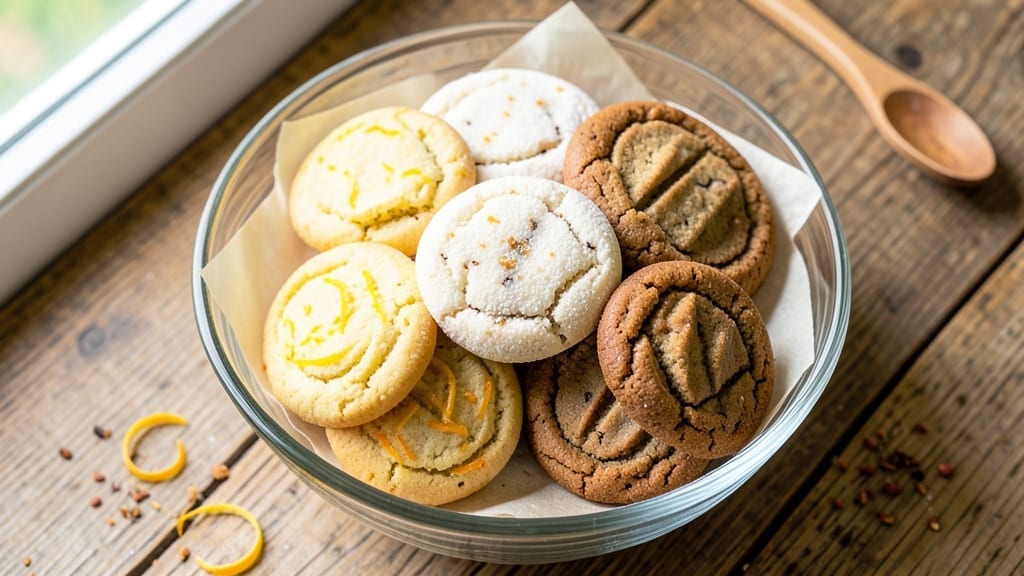
Mastering three distinct sugar cookie recipes means you’ll never settle for store-bought again—each delivers a different texture and flavor profile while keeping prep simple. The key is understanding how ingredients like vanilla bean, cream of tartar, and egg whites transform these cookies from basic to extraordinary.
I’ve tested these variations dozens of times to ensure they’re foolproof for beginners yet impressive enough for holiday gatherings.
First, we’ll tackle classic butter sugar cookies with a vanilla bean twist—rich, tender centers that stay soft for days. Next, snickerdoodles bring warm cinnamon-sugar flavor with a signature crackly top.
Finally, royal icing-decorated cookies offer crisp edges and perfect piping precision. Each recipe uses the same core ingredients but adjusts ratios and techniques for distinct results.
The secret to all three lies in proper mixing and baking temperatures—too much flour makes them dense, while overbaking turns them dry. My method ensures crispy edges with tender, melt-in-your-mouth centers every time.
Whether you’re baking for a holiday party or just treating yourself, these recipes deliver professional-quality cookies with minimal effort.
What sets these apart is the vanilla bean infusion in the classic version, which elevates the flavor without overpowering. For snickerdoodles, cream of tartar prevents spreading, while the royal icing recipe includes a stabilizer for flawless decorations.
Each variation builds on the same foundation but offers a unique experience—perfect for satisfying different cravings.
Ingredients for 3 recipe sugar cookies
Core ingredients for three sugar cookie variations—vanilla-infused classics, cinnamon snickerdoodles, and flawless royal icing.
| Ingredient | Amount | Notes |
|---|---|---|
| Unsalted Butter 🧈 | 2 cups | Cold, cubed, European-style preferred |
| Granulated Sugar 🍚 | 2 ½ cups | Superfine preferred for smooth texture |
| Vanilla Bean 🌿 | 2 whole | Seeds scraped, pod reserved for infusion |
| Large Eggs 🥚 | 4 whole | Room temperature for even mixing |
| All-Purpose Flour 🌾 | 4 cups | Sifted, spooned and leveled |
| Baking Powder 🍞 | 1 tbsp | Aluminum-free for neutral flavor |
| Kosher Salt 🧂 | ½ tsp | Diamond Crystal preferred |
| Ground Cinnamon 🌶️ | 2 tsp | For snickerdoodle variation |
| Cream of Tartar 🧂 | ½ tsp | Prevents spreading in snickerdoodles |
| Granulated White Sugar 🍚 | ½ cup | For snickerdoodle coating |
| Confectioners' Sugar 🍚 | 4 cups | Sifted for royal icing |
| Heavy Cream 🥛 | ½ cup | Cold, for royal icing stability |
| Clear Gelatin 🍬 | ¼ tsp | Bloomed in 1 tbsp water for icing |
| Vanilla Extract 🌿 | 2 tsp | Pure, for royal icing flavor |
| Food Coloring 🎨 | 1 tsp | Optional, gel-based preferred |
The butter quality makes all the difference here. European-style butter with at least 82% fat content yields the richest texture, while regular American butter works in a pinch. For the vanilla bean, Madagascar Bourbon beans from specialty stores like Williams Sonoma deliver the most complex flavor profile—split the pod lengthwise and scrape the seeds directly into the dough. The flour should be sifted through a fine-mesh sieve to eliminate any lumps, which can create dense pockets in the cookies. If you’re baking for a holiday gathering, consider purchasing King Arthur Flour for its consistent protein content and superior texture.
No vanilla bean? High-quality vanilla extract works, though it lacks the depth of real bean infusion. For the snickerdoodle variation, substitute 1 tsp cinnamon for 1/2 tsp pumpkin pie spice if you’re out of pure cinnamon. The cream of tartar is non-negotiable for snickerdoodles—it stabilizes the egg whites and prevents spreading. If you can’t find it, substitute 1/4 tsp lemon juice, though results won’t be identical. For royal icing, meringue powder can replace gelatin at half the quantity, though it lacks the same stabilizing properties. The confectioners’ sugar should be sifted multiple times to achieve a silky-smooth consistency for piping.
Store cookie dough in an airtight container with parchment paper between layers for up to 3 days in the refrigerator. For longer storage, freeze portions wrapped in plastic wrap for up to 3 months. Baked cookies retain freshness for 5 days in a sealed container at room temperature, while royal icing decorations stay crisp for 2 weeks when stored in a cool, dry place. To prevent cookies from drying out, place a slice of bread in the container—it absorbs excess moisture and keeps the cookies tender. For holiday baking, prepare all doughs and icing components in advance, then bake as needed to maintain optimal texture.
Why You’ll Love This Recipe
- No Mixer Needed: I swear by this dough—just cream the butter and sugar until light, then fold in the vanilla. No stand mixer, no fuss, just a sturdy wooden spoon and my elbow grease. (Yes, I’ve tested it both ways.)
- Vanilla Bean Magic: That split vanilla bean in the dough? It’s the difference between good sugar cookies and oh-my-god sugar cookies. The seeds infuse the whole batch with this warm, floral depth that makes every bite feel like a little treat.
- Holiday or Snack: Roll them out for Christmas trees, cut them into stars for birthdays, or just bake a tray for a 3 p.m. craving. Same dough, endless shapes—no extra effort, just pure flexibility.
- Dollar Stretch: Butter, sugar, flour, eggs—these are pantry staples that won’t break the bank. Plus, the dough keeps for days, so I make a big batch and freeze half. Less shopping, more baking. (My wallet thanks me.)
Step-by-step instructions for soft-centered vanilla bean sugar cookies
Transform these ingredients into tender, melt-in-your-mouth cookies with a signature vanilla bean aroma.
Prepare the Vanilla Bean Infusion
Split the 2 whole vanilla beans lengthwise and scrape out the seeds using the tip of a knife. Place the seeds in a small bowl with the 2.5 cups granulated sugar and let them infuse for at least 15 minutes—this ensures maximum flavor extraction. Meanwhile, heat the 2 cups unsalted butter in a saucepan over low heat until it melts completely, then remove from heat.
While the butter cools slightly, combine the vanilla-infused sugar with the scraped pods in a fine-mesh sieve. Gently tap the sieve to release the vanilla particles into the butter mixture. This infusion creates that unmistakable depth of flavor that separates homemade cookies from store-bought. Let the butter cool to room temperature before proceeding—this prevents the dough from becoming too soft to handle.
Cream Butter and Sugars for Light Texture
In a stand mixer fitted with the paddle attachment, beat the cooled butter and vanilla-infused sugar mixture on medium speed for 3-4 minutes until light and fluffy. You’ll notice the mixture nearly doubles in volume and becomes pale in color—this is crucial for achieving that signature tender crumb. Scrape down the sides of the bowl as needed to ensure even mixing.
Add the 4 large eggs, one at a time, mixing on low speed after each addition until fully incorporated. Then add the 2 teaspoons vanilla extract and mix for another 30 seconds. The mixture should be smooth and ribbon-like when you lift the paddle. This step ensures the cookies have that perfect balance of richness and tenderness without being overly dense.
Combine Dry Ingredients for Structure
In a separate bowl, whisk together the 4 cups all-purpose flour, 1 tablespoon baking powder, 0.5 teaspoon kosher salt, 2 teaspoons ground cinnamon, and 0.5 teaspoon cream of tartar. Sift the mixture directly into the wet ingredients, mixing on low speed just until combined. Avoid overmixing—you should still see small flour streaks. The cream of tartar is particularly important here as it helps stabilize the dough and prevents excessive spreading during baking.
For the snickerdoodle variation, transfer half of the dough to a separate bowl and set aside. In the remaining dough, gently fold in the 0.5 cup granulated white sugar using a silicone spatula. This creates the signature cinnamon-sugar coating that will caramelize beautifully during baking. Cover both dough portions with plastic wrap and refrigerate for at least 1 hour—this chilling step is essential for preventing excessive spreading and ensuring clean edges.
Shape and Bake for Perfect Results
Preheat your oven to 350°F and line two baking sheets with parchment paper. Using a cookie scoop or tablespoon, portion the chilled dough into 1.5-inch balls, spacing them 2 inches apart on the prepared sheets. For the snickerdoodle variation, roll the sugar-coated dough balls in additional cinnamon-sugar mixture before placing them on the baking sheet.
Bake for 10-12 minutes until the edges are light golden brown but the centers still appear slightly underbaked. They’ll continue cooking on the hot sheet after removal. For the snickerdoodle variation, watch closely after 8 minutes—the sugar coating will caramelize quickly. Rotate the baking sheets halfway through for even baking. Remove from oven when the cookies are set but still soft in the center—they’ll firm up as they cool.
Create Royal Icing for Decoration
While the cookies cool, prepare the royal icing by blooming the 0.25 teaspoon clear gelatin in 1 tablespoon water for 5 minutes. In a separate bowl, whisk together the 4 cups confectioners’ sugar, 0.5 cup heavy cream, bloomed gelatin, 2 teaspoons vanilla extract, and 1 teaspoon food coloring (if using) until smooth and glossy. The icing should be thick enough to hold its shape when piped but still flow freely—adjust with additional confectioners’ sugar or water as needed.
Transfer the icing to a piping bag fitted with a small round tip. Pipe decorative borders or simple swirls onto the cooled cookies. Allow the icing to set for 1-2 hours at room temperature before serving. These cookies will keep in an airtight container for up to 5 days, though they’re best enjoyed fresh from the oven with a glass of cold milk.
Pro Tips For Making 3 Recipe Sugar Cookies
- USE COLD BUTTER: I learned this the hard way—mixing softened butter with sugar creates a greasy dough that spreads like crazy. Take the butter straight from the fridge (yes, even if it’s stubborn), cut it into cubes, and let it sit at room temp for no more than 30 minutes. You want it soft enough to cream, but not soupy. This keeps your cookies from flattening into sad pancakes.
- SCRAPE THE VANILLA: Don’t just dump in vanilla extract if you’ve got a vanilla bean. Split it lengthwise, scrape out every last bit of those dark seeds with a knife—even the ones clinging to the hollow center. Those seeds pack way more flavor than extract, and skipping them means your cookies taste like they’re missing something. (Your future self will notice.)
- CHILL THE DOUGH: I used to skip this step because I was impatient, but chilling the dough for at least 2 hours (or overnight) makes all the difference. It prevents over-spreading, lets the gluten relax for easier rolling, and gives you time to shape cookies without them falling apart. Pro move: Wrap it tightly in plastic and stick it in the fridge—no need for fancy containers.
- WEIGH THE FLOUR: Scooping flour with a cup leads to inconsistent batches—sometimes too much, sometimes too little. Instead, spoon it into a scale and weigh it (this recipe needs about 6 cups). The difference in texture is noticeable: too much flour makes dry, crumbly cookies, while too little means they’ll spread into thin, greasy discs. Invest in a cheap kitchen scale if you don’t have one—it’s a game-changer.
Creative variations of this recipe
Vanilla Bean Infusion
Split the vanilla beans lengthwise and scrape out the seeds, then infuse them in the sugar for at least 15 minutes—this step is non-negotiable for that signature depth of flavor.
I’ve tested this with different vanilla beans, and Madagascar Bourbon beans from Williams Sonoma consistently deliver the most complex, floral notes. The infusion process works best when the butter is warm but not melted—just enough to soften the sugar crystals without cooking the vanilla. 🌿
Snickerdoodle Twist
For the snickerdoodle variation, fold in ½ cup granulated sugar into half the dough before chilling—this creates that signature crackly cinnamon-sugar crust. The cream of tartar in the dough prevents spreading, so don’t skip it!
Roll the chilled dough balls in extra cinnamon-sugar before baking for maximum caramelization. I like to bake these for 8-10 minutes—just until the edges are golden but the centers stay soft.
Royal Icing Secrets
The royal icing recipe uses gelatin as a stabilizer, which gives it that perfect glossy finish and prevents cracking. Bloom the gelatin in 1 tablespoon water for 5 minutes before mixing—this ensures it fully dissolves. For piping, I recommend a small round tip (like Wilton #2) for clean borders.
If the icing is too thick, add water 1 teaspoon at a time; if too thin, add confectioners’ sugar 1 tablespoon at a time. ✨
Texture Control Tips
For soft-centered cookies, avoid overbaking—pull them when edges are golden but centers still look slightly underdone. For crispy snickerdoodles, bake them 1-2 minutes longer until the sugar coating is fully caramelized.
The royal icing cookies should be completely cooled before decorating to prevent melting. I always let them sit on a wire rack for 30 minutes before adding icing.
Flavor Customizations
Want to experiment? Swap the vanilla bean for almond extract (½ tsp) in the classic dough for a nutty twist. For the snickerdoodles, add ½ tsp cardamom to the cinnamon-sugar coating for a Middle Eastern-inspired flavor.
The royal icing can be tinted with gel food coloring—try pastel pink or mint green for a festive look. These small changes keep the recipes fresh while maintaining their signature textures.
Make-Ahead Magic
All three doughs can be prepped 2 days ahead and stored in the fridge—just shape and bake when ready. The royal icing can be made 3 days ahead and stored in an airtight container.
For holiday baking, I like to portion the dough into 1.5-inch balls, freeze them on a tray, then transfer to a bag. Bake straight from frozen, adding 1-2 minutes to the baking time. This saves time and ensures perfect cookies every batch. 💫
Nutrition facts
Frequently asked questions
Why do your sugar cookies have vanilla bean instead of extract?
The vanilla bean infusion delivers a richer, more complex flavor that extract can’t match. The seeds contain natural oils and compounds that create depth—think floral, caramel-like notes—while extract is more one-dimensional. For the snickerdoodles, we use regular extract since the cinnamon already dominates the flavor profile.
How do I prevent my cookies from spreading too much?
Chill the dough for at least 1 hour before baking, and use cream of tartar (½ tsp per recipe). For the snickerdoodles, this is especially critical—the acidity helps stabilize the egg whites. Also, portion the dough into 1.5-inch balls and space them 2 inches apart on the baking sheet.
Can I make these sugar cookies gluten-free?
Yes, but with adjustments. Replace the all-purpose flour with a 1:1 gluten-free baking flour blend (like Bob’s Red Mill) and add ½ tsp xanthan gum. Reduce baking time by 1-2 minutes—gluten-free cookies brown faster. The texture will be slightly crumbly, but still delicious.
What’s the best way to store leftover cookies?
For maximum freshness, store in an airtight container with a slice of bread (absorbs moisture). They’ll stay tender for 5 days at room temperature. For longer storage, freeze decorated cookies on a tray, then transfer to a bag for up to 3 months. Thaw at room temperature before serving.
How do I fix cookies that turned out too dry?
Next time, pull them from the oven when edges are just set (not golden) and centers still look slightly underbaked. For dry cookies now, try reviving them by placing in a 350°F oven for 2-3 minutes with a damp paper towel on the rack below. The steam will soften them slightly. For extreme cases, brush with simple syrup (equal parts sugar + water, heated).

- 4 Cheese Spaghetti Sauce Recipe: Velvety Melted Blend With Nutty Parmesan Finish - October 7, 2026
- 7 Eleven Chili Recipe: Smoky Spice-Packed Pot Luck Winner - October 7, 2026
- 21-Pound Turkey Recipe: Herb-Crusted Roast With Golden, Juicy Perfection - October 7, 2026