
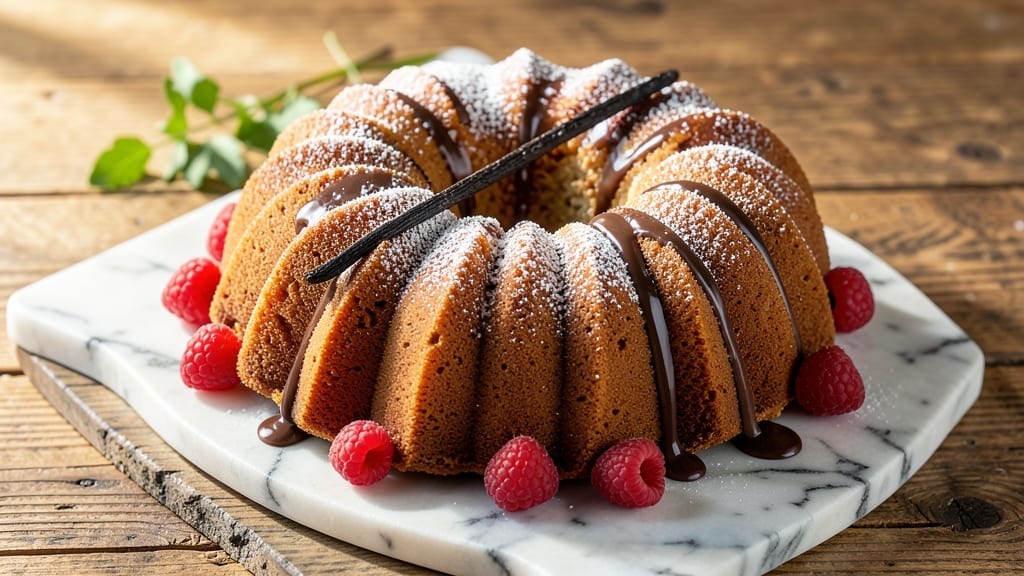
This 7-inch bundt cake recipe delivers the perfect balance of vanilla bean swirls and a buttery crust that makes every slice feel like a special occasion. 💛 The secret lies in the high-ratio butter and precise baking technique that creates a moist, tender crumb with just the right amount of golden-brown edges.
I’ve baked this version for years, and it never fails to impress—whether you’re serving it at a brunch or simply treating yourself to a midweek dessert.
The recipe combines simple ingredients with a foolproof method that ensures consistent results every time. A touch of vanilla bean paste adds depth, while the buttery crust gives it that bakery-style appeal.
Baking at the right temperature and using the correct pan size guarantees a cake that’s perfectly set with no doming or cracking—no matter how many times you make it.
What you’ll end up with is a showstopping dessert that’s light enough to eat for breakfast but rich enough to feel indulgent. The vanilla swirls create beautiful patterns when sliced, and the buttery crust adds a satisfying crunch.
It’s the kind of cake that makes guests ask for the recipe—and makes you want to bake it again immediately.
Serve it plain for a classic presentation or with a light dusting of powdered sugar and fresh berries for a pop of color. This recipe scales perfectly for a single serving or a crowd, making it versatile for any occasion. Let’s get baking!
Ingredients for 7 inch bundt cake
Simple staples with a touch of luxury—vanilla bean swirls and golden crust await.
| Ingredient | Amount | Notes |
|---|---|---|
| All-Purpose Flour 🌾 | 2 ½ cups | Sifted for light texture |
| Unsalted Butter 🧈 | 1 ½ cups | Cold, cubed for crust |
| Granulated Sugar 🍚 | 2 cups | Superfine for smooth batter |
| Vanilla Bean Paste 🌿 | 2 tbsp | High-quality for rich flavor |
| Large Eggs 🥚 | 3 whole | Room temperature preferred |
| Whole Milk 🥛 | 1 cup | Room temperature |
| Vanilla Extract 🌸 | 1 tbsp | Pure extract for depth |
| Baking Powder 🍞 | 2 tsp | Fresh for leavening |
| Salt 🧂 | ½ tsp | Fine sea salt |
| Powdered Sugar 🍚 | 1 cup | For dusting and crust |
| Vanilla Bean Seeds 🌿 | 1 whole | Scraped from 1 pod |
| Cornstarch 🌾 | 1 tbsp | For swirl consistency |
The butter and flour are your foundation. Cold, cubed butter creates that coveted crust, so don’t skip chilling it. For the flour, King Arthur or Gold Medal brands are my go-to—they bake evenly. Vanilla bean paste? Nielsen-Massey is my favorite, but any high-quality paste works. The vanilla bean seeds add those beautiful swirls, so scrape every last bit from the pod. If you’re short on time, superfine sugar dissolves faster than granulated, but regular sugar works in a pinch (just whisk it well).
No vanilla bean paste? Double the vanilla extract and add a pinch of almond extract for depth. Substitute milk with evaporated milk or heavy cream for extra richness. For a lighter texture, replace 2 tbsp of flour with cornstarch. The baking powder must be fresh—if it smells old or lacks lift, toss it. Powdered sugar for dusting? Confectioners’ sugar is ideal, but icing sugar works too. If your bundt pan is nonstick, you can skip greasing, but a light coat of butter and flour ensures easy release.
Store the cake in an airtight container at room temperature for up to 3 days, or refrigerate for 1 week. For longer storage, wrap tightly in plastic and freeze for up to 3 months. The crust stays crisp for about 24 hours—after that, a quick broil revives it. Slice only when fully cooled to keep the swirls intact. Leftovers? Reheat individual slices in the microwave for 10 seconds to restore that buttery warmth.
Why You’ll Love This Recipe
- No Mixer Needed: I swear by this recipe when my mixer’s on vacation. Creaming that butter and sugar by hand takes about as much effort as stirring coffee—just a few minutes of elbow grease, and you’re golden.
- Vanilla Kiss Magic: That vanilla bean paste? It’s not just flavor—it’s a moment. One swirl gives you that rich, real-vanilla depth without the fuss of scraping seeds, and the eggs keep the crumb tender enough to melt in your mouth.
- Portion-Perfect Servings: A single 7-inch cake feeds two with dessert (or one very hungry person for breakfast). It’s my go-to for date nights, solo movie marathons, or when I’m too lazy to bake a whole sheet pan.
- Budget-Friendly Luxury: You’re using pantry staples here—no pricey extracts or specialty flours. The butter and sugar do all the heavy lifting, and leftovers? They reheat beautifully, so you’re not stuck with dry cake the next day.
Step-by-step instructions for vanilla bean bundt cake
Mastering this recipe delivers a showstopping cake with signature swirls and buttery crust every time.
👨🍳 Step 1: Create the Buttery Crust and Prepare the Swirl
Preheat your oven to 350°F and generously butter a 7-inch bundt pan, coating every crevice and dusting with 2 tablespoons of the powdered sugar. This prevents sticking and adds that signature crunch. Set aside.
In a small bowl, mix the 1 tbsp cornstarch with ½ cup of the granulated sugar and the vanilla bean seeds scraped from the pod. This creates the signature swirl mixture. Set aside until ready to use.
🍳 Step 2: Cream Butter and Sugar for Light Texture
In a stand mixer fitted with the paddle attachment, beat the 1.5 cups unsalted butter (cold and cubed) with the remaining 1½ cups granulated sugar on medium speed for 3-4 minutes until light and fluffy. You’re looking for a pale, airy texture that nearly doubles in volume.
This creaming process is crucial—it incorporates air that will create that tender crumb. If your butter isn’t cold enough, you’ll end up with dense cake instead of light, airy layers. I like to press the butter cubes between parchment to ensure they’re uniformly cold before starting.
👨🍳 Step 3: Add Eggs and Vanilla for Rich Flavor
Add the 3 whole large eggs, 1 at a time, mixing on low speed for 30 seconds after each addition until fully incorporated. Then add the 2 tbsp vanilla bean paste and 1 tbsp vanilla extract, mixing on low speed for another 30 seconds.
Here’s the thing—vanilla bean paste adds depth that regular extract can’t match. The paste contains both seeds and extract, giving you that authentic vanilla flavor. Mix just until combined to avoid over-developing the gluten in the flour we’ll add next.
🥘 Step 4: Combine Dry Ingredients and Prepare Swirls
In a separate bowl, whisk together the 2.5 cups all-purpose flour, 2 tsp baking powder, and ½ tsp salt. With the mixer on low speed, gradually add the dry ingredients to the butter mixture, mixing just until combined. Be careful not to overmix—you should still see small flour streaks.
Remove the bowl from the mixer and gently fold in the 1 cup whole milk using a silicone spatula. Then carefully fold in the cornstarch-sugar swirl mixture you prepared earlier. The batter should be thick but pourable—if it’s too thick, add 1-2 tablespoons more milk.
🔥 Step 5: Bake to Golden Perfection
Divide the batter evenly between two 1-cup measuring cups. Pour one cup into the prepared bundt pan, then use a spoon to drizzle the remaining batter in swirls around the edges. Tap the pan gently on the counter to release any air bubbles.
Bake for 50-55 minutes until a toothpick inserted in the center comes out clean and the top is golden brown. The cake is done when it springs back slightly when touched. For best results, I like to tent the pan loosely with foil after 30 minutes to prevent over-browning.
⏰ Step 6: Cool and Dust for Presentation
Remove the cake from the oven and let it cool in the pan for 10 minutes. Then invert onto a wire rack and let cool completely. Once fully cooled, dust generously with the remaining powdered sugar using a fine-mesh sieve for that professional finish.
This cooling step is crucial—rushing it can cause the cake to crack or fall apart when inverting. The powdered sugar not only looks beautiful but also adds that signature sweetness to every bite. Serve with fresh berries or whipped cream for the ultimate dessert experience.
Pro Tips For Making 7 Inch Bundt Cake
- Grease Like You Mean It: The 7-inch bundt pan is a sneaky little devil—skip the greasing shortcut, and you’ll spend 10 minutes scraping cake off the sides. Use 2 tablespoons softened butter and flour (tossed together) to coat the pan thoroughly, then tap out excess. I learned this the hard way after my first batch stuck like glue.
- Whisk Eggs Until Ribbon Stage: Overbeaten eggs make a dense cake. Whisk the eggs and sugar until the mixture forms a thick ribbon when the whisk is lifted—about 2-3 minutes. This ensures lightness without overworking the proteins. (Yes, even if you’re impatient like me.)
- Measure Flour Right: Scoop-and-sweep packing flour adds moisture and throws off the ratio. Use the spoon-and-level method: spoon flour into the cup, then level it off with a knife. A 7-inch bundt cake is forgiving, but this small step keeps it from turning out gummy.
- Rotate the Pan Early: After 20 minutes in the oven, rotate the bundt pan 180 degrees for even baking. I was skeptical until I tried it—now my cakes bake uniformly, and the edges don’t burn while the center stays moist. (Your future self will thank you.)
Storing and reheating this 7 inch bundt cake
Room Temp Storage
The buttery crust stays crisp for about 24 hours at room temperature, so keep your cake in an airtight container like a Rubbermaid Brilliance box to maintain freshness. I like to place a slice of bread or a damp paper towel inside the container to prevent drying.
Store in a cool, dark spot—avoid direct sunlight or warm areas like near the oven. 💛
Fridge Preservation
For longer storage, refrigerate your bundt cake in the same airtight container for up to 1 week. The cold temperature preserves the moisture and buttery flavor, but the crust may soften slightly.
To revive it, wrap a slice in foil and warm in the oven at 300°F for 5 minutes. I always double-wrap the cake in plastic wrap before placing it in the container to prevent freezer burn.
Freezer Magic
Freezing is perfect for batch baking—wrap your bundt cake tightly in plastic wrap followed by a layer of foil to create an airtight seal. Store in a freezer-safe bag for up to 3 months.
Thaw overnight in the fridge before serving. For individual slices, freeze them separately on a tray first, then transfer to a bag. This prevents sogginess when reheating later. ✨
Reheating Secrets
Microwave reheating works best for single slices—cover with a damp paper towel and heat for 10-15 seconds on medium power. For oven reheating, place slices on a baking sheet at 300°F for 8-10 minutes until warm through.
The oven method preserves the crust better than the microwave. I find that reheating restores that buttery warmth and makes the cake taste almost as good as fresh!
Dusting Revival
If your cake’s powdered sugar dusting wears off, simply dust with a fine-mesh sieve before serving. For extra flair, add a sprinkle of toasted coconut flakes or crushed pistachios while the cake is still warm.
This not only refreshes the presentation but also adds a delightful crunch. A quick broil for 1-2 minutes can also revive a slightly stale crust if you’re in a hurry. 🔥
Nutrition facts
Frequently asked questions
Why does my bundt cake stick to the pan?
Even with a well-greased pan, sticking happens when the batter isn’t fully set or the pan isn’t properly prepared. Always use 1 tablespoon melted butter + 1 tablespoon flour to coat every crevice of a 7-inch bundt pan, including the center tube. Tap the pan gently on the counter after filling to release air bubbles, then bake until a toothpick comes out clean. For extra insurance, use a nonstick spray like Baker’s Joy after buttering.
Can I make this recipe without vanilla bean paste?
For the same rich flavor, double the vanilla extract to 2 tablespoons and add ½ teaspoon almond extract for depth. For visual swirls, fold in 1 teaspoon vanilla bean seeds (scraped from a pod) directly into the batter. The texture will be slightly less luxurious, but the flavor will still be delicious.
How do I fix cracks in my bundt cake?
Cracks usually mean the cake baked too long or cooled too quickly. For prevention, tent the pan with foil after 30 minutes of baking to slow browning. If cracks appear, brush them with a simple glaze (½ cup powdered sugar + 1 tablespoon milk) or cover with whipped cream. The cake is still safe to eat—just focus on presentation for your next attempt!
What’s the best way to serve this cake?
Dust with powdered sugar right before serving for that bakery-style finish. Pair with fresh berries (raspberries or strawberries work beautifully) or a scoop of vanilla bean ice cream. For a boozy twist, drizzle with warmed caramel sauce or a rum glaze (mix ½ cup powdered sugar + 2 tablespoons dark rum + 1 tablespoon milk).
Can I use this recipe for a bundt cake without swirls?
Yes! Skip the cornstarch-sugar swirl mixture and simply mix the vanilla bean seeds directly into the batter. For a marbled effect, divide the batter into two bowls—one with 1 extra tablespoon vanilla extract and the other with 1 teaspoon lemon zest. Swirl them together in the pan before baking. The buttery crust and moist texture will still shine through!
